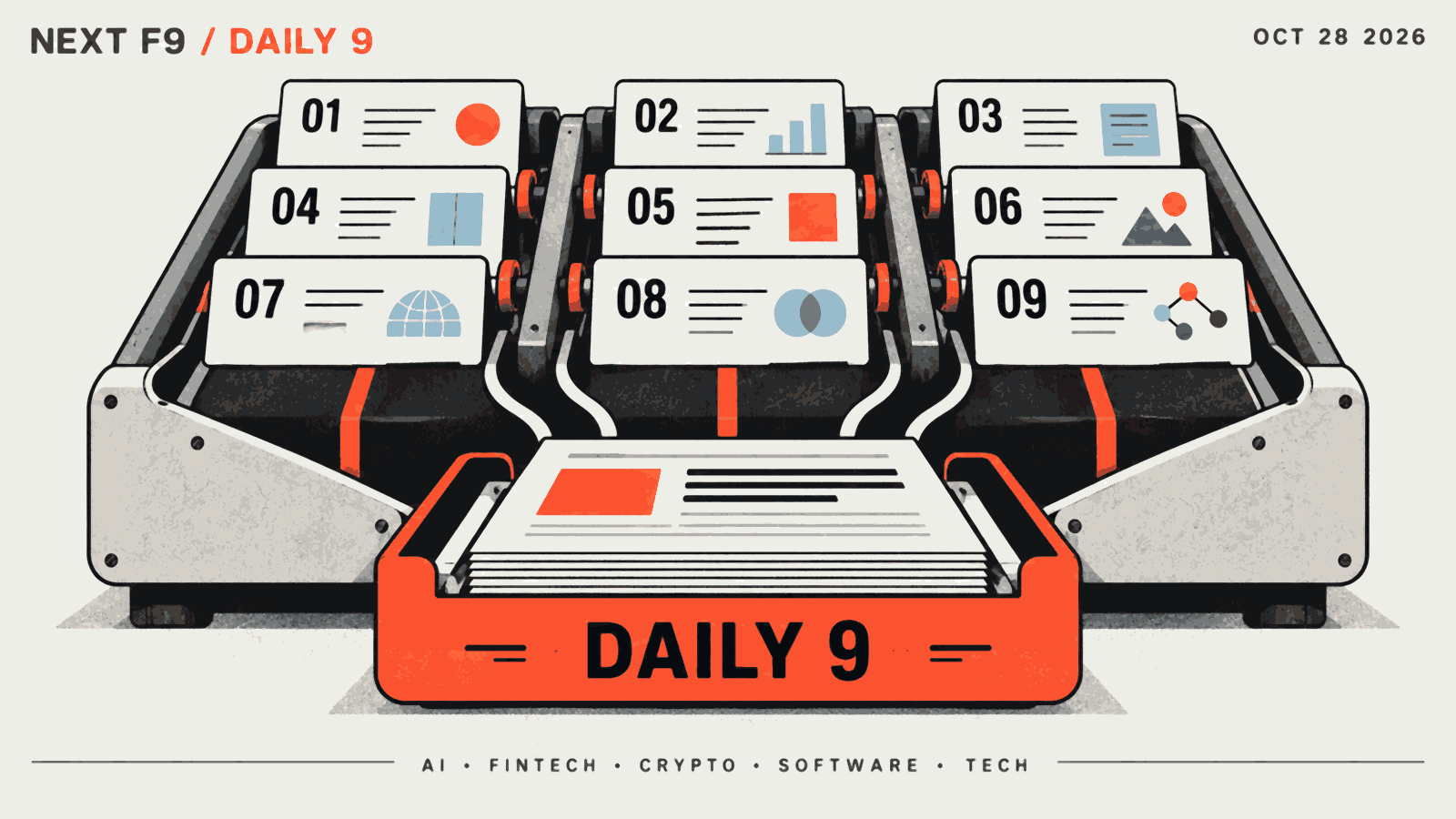
Daily 9 October 28, 2026 tracks nine verified developments across browser AI, workplace software, payments, crypto infrastructure and security. Most events landed on October 27; one regulator decision arrived on October 26, and one Google feature entered its scheduled-release phase on October 27 after an October 19 announcement. Browse the Daily 9 archive for earlier editions.
1. Opera starts shipping local AI models inside its browsers
Opera said on October 27 that it had begun shipping local AI models in Opera One as an opt-in early preview, with Opera GX and Opera Neon to follow. The preview runs on 64-bit Windows PCs with Intel or AMD processors and on Apple-silicon Macs. Its WebAI implementation lets sites and extensions use a browser-hosted model, but nothing downloads until the user turns it on, and site permissions decide which websites get access. Speed depends on the computer’s hardware. Source: Opera
2. Google Chat meeting recaps reach scheduled-release domains
Google announced meeting recap cards on October 19; the new development for this edition is the scheduled-release rollout that began October 27. When “Take notes for me” is used in Google Meet, the associated Chat space can receive a recap with the summary, decisions, action items and links to the notes, recording and transcript. Availability is limited to listed Business, Enterprise and Frontline Plus plans with Gemini enabled. The rollout may take up to 15 days. Source: Google Workspace
3. Broadcom ships 89 early Spring fixes and a patch-tracking hub
Broadcom said on October 27 that it had shipped fixes for 89 newly found open-source vulnerabilities in TrueSource Spring Enterprise to critical-infrastructure customers and others who qualify for early access, ahead of public disclosure. The company puts the total fixed across TrueSource offerings at 408. The release also adds TrueSource Hub, which connects to code repositories and shows which applications need a published fix, plus build plugins that open update pull requests in Maven or Gradle projects. Details and CVEs come later, when fixes reach the community. Source: Broadcom
4. Oracle introduces AI Security Mesh for automated testing
Oracle described AI Security Mesh on October 27 as a managed platform that uses frontier AI models for cybersecurity, including OpenAI Cyber models, to map systems and test them for weaknesses. Oracle says it proposes a test plan for the customer’s approval, uses a separate agent to repeat a test and confirm a finding, recommends what to fix first and checks that a gap is closed after changes. The post does not state a general-availability date, regions or pricing, and its effectiveness claims are Oracle’s own. Source: Oracle
5. Canto adds an assistant across digital asset workflows
Canto launched its Global Assistant on October 27 inside its digital asset management platform. The assistant tracks library health, enriches new uploads with metadata and alt text, flags possible duplicates and compliance issues, builds branded sharing portals and makes bulk changes across assets and products. Canto says the assistant asks follow-up questions on open-ended requests and that nothing changes until the user confirms. The release does not specify which subscription tiers or regions receive every capability. Source: Canto
6. Noda routes eligible card checkouts through open banking
Noda launched BIN-to-Bank on October 27 across 26 European countries; the company says it connects merchants to more than 2,000 banks. A shopper enters card details as usual, the card’s BIN identifies the issuing bank, and where a supported open-banking flow exists the shopper approves the payment in the banking app before the card is charged. If the bank payment is not completed, checkout returns to card processing. Merchants choose which eligible transactions take the bank route. Noda published no fee schedule. Source: Noda
7. Bitget Wallet launches USD and EUR virtual accounts
Bitget Wallet launched personal USD and EUR account numbers inside its self-custodial wallet on October 27, provided by its licensed partner Noah. Incoming ACH, Fedwire, SEPA and SWIFT transfers are converted automatically to USDT or USDC. Opening an account is free and needs no local residency, according to the company, though sending banks or blockchain networks may charge their own fees. Only incoming transfers work today; outbound transfers are planned for the coming months. Source: Bitget Wallet
8. Ripple receives final OCC approval for a national trust bank
Ripple said on October 26 that the US Office of the Comptroller of the Currency had granted final approval to charter Ripple National Trust Bank, following conditional approval in December 2025. The bank’s approved activities include managing the segregated reserves behind Ripple’s RLUSD stablecoin, acting as collateral trustee for RLUSD holders and providing fiduciary digital-asset custody. RLUSD will still be issued by Standard Custody & Trust Company, Ripple’s New York-regulated trust company. Ripple says it will keep working with the OCC and New York’s financial regulator as the bank begins operations. Source: Ripple
9. Cisco reviews its products for four high-severity Node.js flaws
Cisco published an advisory on October 27 covering four high-severity Node.js vulnerabilities that the Node.js project fixed on October 21 in its 22.x, 24.x and 26.x release lines. They involve an out-of-bounds write in the Brotli decoder, DNS resolution truncation with embedded NUL characters, and two ways to bypass TLS hostname validation with unusual IP-address formats. Cisco lists no workarounds and says it is still investigating a long list of products, from IOS XE and ISE to AppDynamics, and will update the advisory as results come in. Source: Cisco