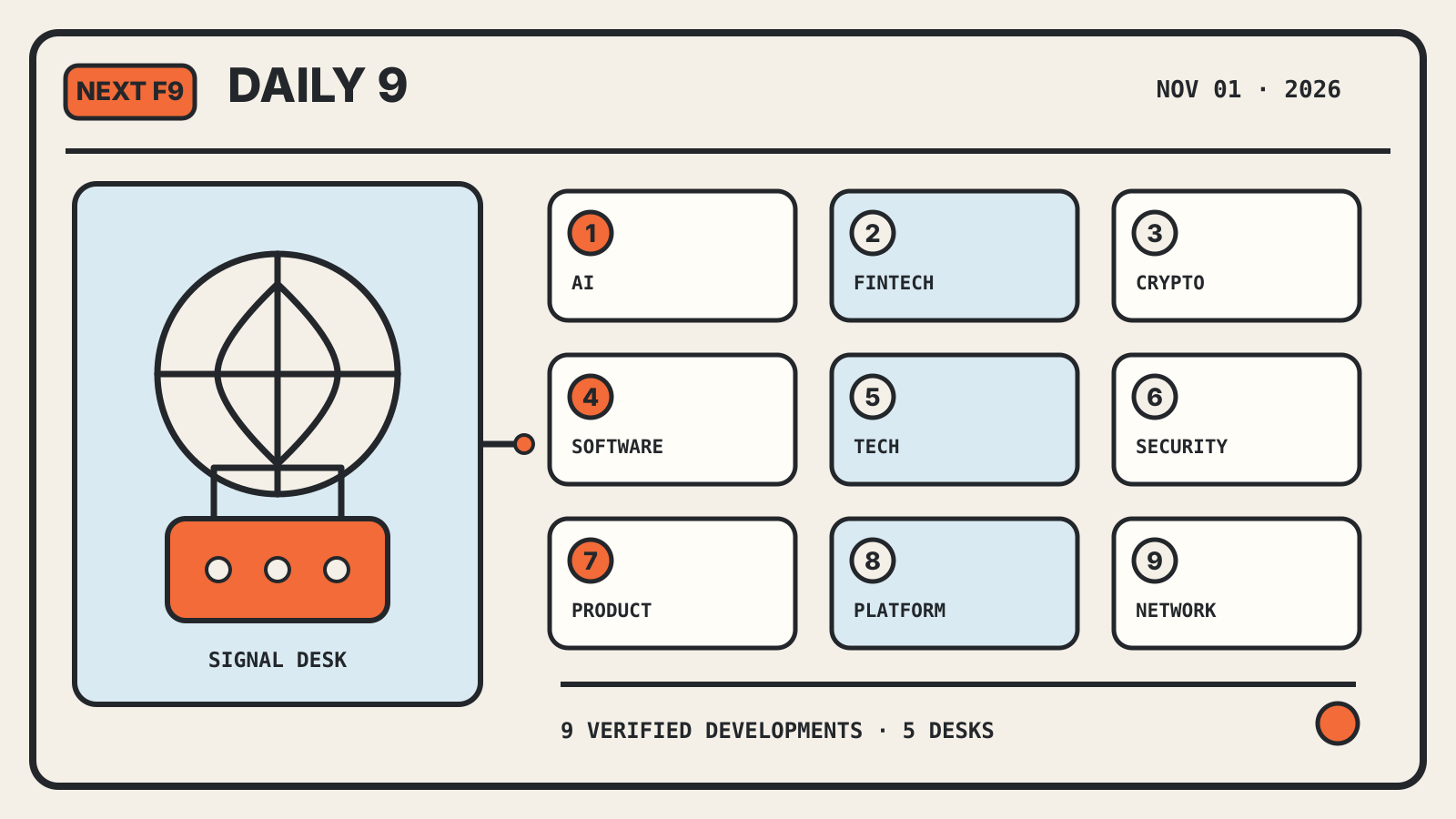
Daily 9 for November 1, 2026 brings together nine verified developments announced on October 30 across AI, fintech, crypto, software and enterprise tech. Each item links to the original company or research source.
1. OpenAI backs a shared robots.txt signal for AI training
OpenAI said it will honor a common robots.txt signal for foundational generative AI training. The company plans to implement the signal in the coming months, while keeping its existing crawler-specific controls in place. The idea comes from work in the IETF AI Preferences group and is meant to let site operators state one preference to several participating providers instead of maintaining separate rules for each crawler. OpenAI announcement, October 30. See our guide to opting out of AI training.
2. Gemini can edit an entire Google Slides deck
Google is rolling out Gemini edits that can change multiple slides or a whole presentation from one prompt. The Slides side panel can revise content, refresh styles, combine slides and match a reference deck while keeping the output as editable native slides. The English-only launch began rolling out on October 29 and may take more than 15 days. It covers selected Business, Enterprise, consumer AI and Education plans. Google Workspace update, October 30.
3. OnePay starts converting USDC deposits into dollars
OnePay launched stablecoin deposits for selected US customers. Users can send USDC from an external wallet across 12 supported chains, including Base, Ethereum, Solana and Tempo, then receive dollars in OnePay Checking. Stripe’s Bridge platform creates the deposit addresses, runs compliance checks and handles conversion. OnePay says it charges no conversion fee at launch, although network fees and longer processing times can still apply. OnePay announcement, October 30.
4. BBVA adds a travel eSIM inside its Italian banking app
BBVA customers in Italy can now buy and activate a travel eSIM without leaving the bank’s app. The Gigs-powered service includes plan selection, usage tracking, validity checks, top-ups, alerts and support. It is initially available to Italian residents over 18 who hold a BBVA online current account and use an eSIM-compatible device. BBVA says the service may later expand to other markets. BBVA announcement, October 30. Compare the basics in our eSIM versus roaming guide.
5. Binance details its response to a major hot-wallet breach
Binance’s second incident update says unauthorized withdrawals began on October 29 at about 20:05 UTC after hot wallets were compromised. The exchange estimates the loss at roughly $6.3 billion in token assets and says it will cover the impact through its SAFU fund and corporate treasury. It reported about $3 billion frozen on-chain, temporarily suspended withdrawals and said its investigation had found multiple breach points, with no evidence so far that wallet private keys leaked. Binance update, October 30.
6. Chainalysis discloses a separate security incident
Chainalysis said an external actor used what it called offensive agentic techniques to access company systems and internal tools. Its investigation found that some customer user IDs, names, email addresses and organisation role labels were accessed. The company said it found no indication of access to investigation content, transaction or query results, clear-text passwords, MFA secrets or session tokens. It also stated that this incident was unrelated to the Binance theft. Chainalysis disclosure, October 30.
7. Cloudflare opens private-origin services to general availability
Cloudflare made its services for private origins generally available. Customers can point a proxied DNS record at a private IP and route traffic over an existing Cloudflare One connection, while applying WAF, caching, bot management, rate limiting, rewrites and Workers. The origin keeps its private IP without an inbound firewall exception. Some limits remain: Argo Smart Routing and Dedicated CDN Egress IPs are unsupported, and health checks require Load Balancing. Cloudflare announcement, October 30.
8. App Store Connect accepts Xcode 27.2 builds
Apple updated App Store Connect so developers can upload apps built with Xcode 27.2 and the 27.2 SDKs for iOS, iPadOS, macOS, tvOS, visionOS and watchOS. Those builds can now go to the App Store or to internal and external testing through TestFlight. The change moves the submission pipeline beyond the release-candidate support Apple listed on October 20 and applies across all six named platforms. Apple release notes, October 30.
9. Microsoft maps two certificate-abuse intrusion paths
Microsoft Security Research detailed two human-operated intrusions that began with help-desk impersonation over Teams and remote access through Quick Assist. Attackers then assessed Active Directory Certificate Services and used either an ESC1-vulnerable template or ESC8 NTLM relay to obtain authentication certificates. Microsoft stressed that the activity did not exploit a Teams vulnerability. In one case, an excluded privileged account later enabled data exfiltration; in the other, workstation isolation stopped further observed progression. Microsoft research, October 30.