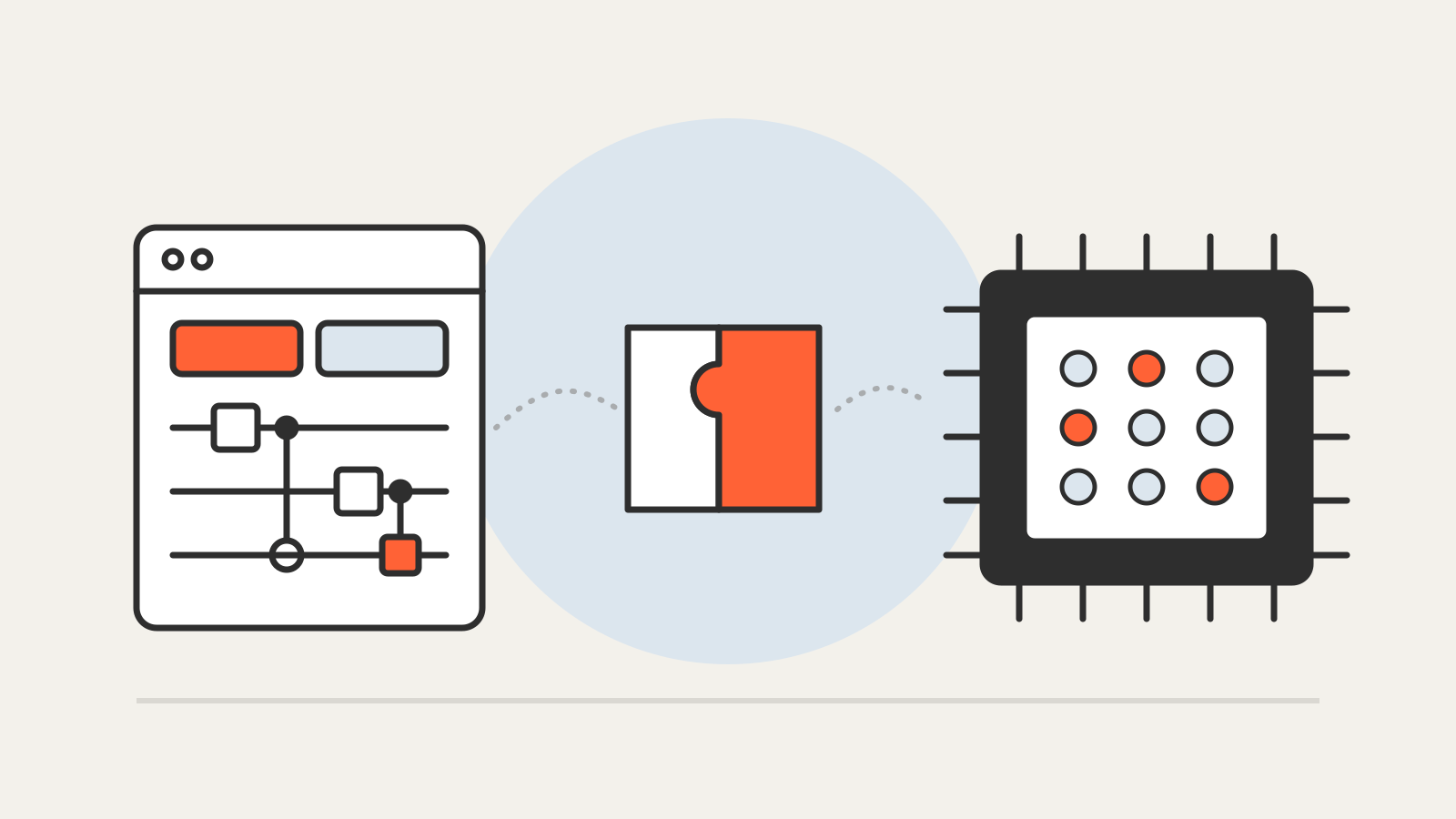
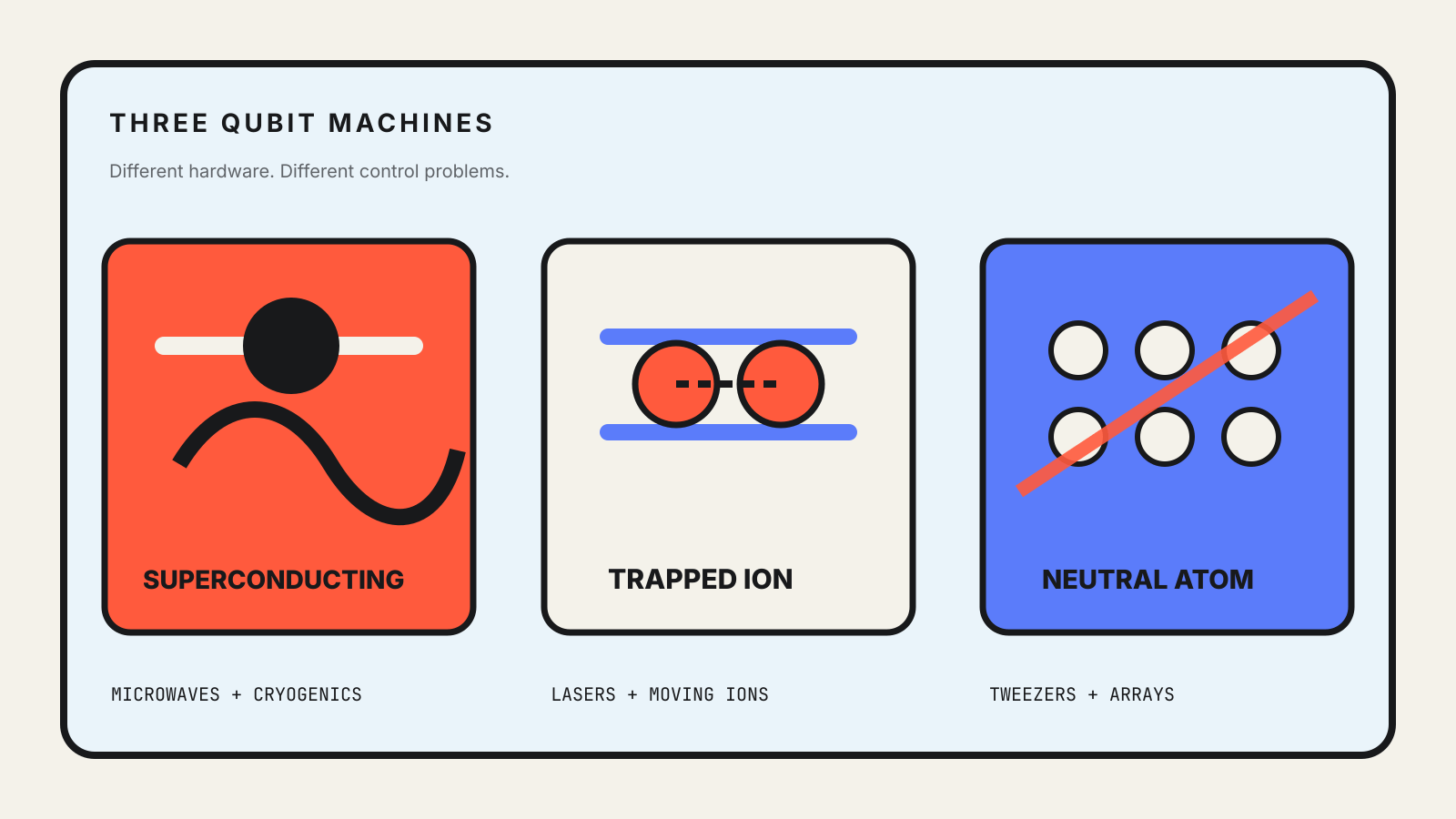
Quantum computers are often compared by qubit count, but superconducting, trapped-ion and neutral-atom qubits are built and controlled in very different ways. The useful question is not which label wins. It is which machine fits the circuit, connectivity, latency and operating constraints of a particular workload.
All three approaches encode quantum information in physical systems that can be prepared, controlled and measured. Their engineering trade-offs begin with how those systems are held in place and how gates are applied.
Superconducting qubits: fast electrical control in a deep freezer
A superconducting processor uses fabricated electrical circuits. IBM describes its transmon qubits as a Josephson junction paired with a capacitor, controlled by microwave pulses. The chip runs in a dilution refrigerator because thermal energy would otherwise disturb the qubits. IBM’s current hardware also uses a heavy-hex layout, so a two-qubit gate normally acts between neighboring qubits rather than any arbitrary pair.
That combination makes superconducting hardware look familiar to semiconductor engineers: the processor is patterned on a chip, control lines deliver shaped pulses, and calibration maps software instructions to the behavior of a particular device. Gates can be short, but connectivity is local. A compiler may need to insert SWAP operations when two logical qubits are not adjacent, increasing circuit depth and error exposure.
The practical questions for a superconducting job are therefore concrete:
- Does the circuit map cleanly to the chip’s coupling graph?
- How much depth will routing add?
- Are the required gates native to the device, or will they be decomposed?
- How stable is the calibration during the job window?
Those questions matter more than a headline qubit total. IBM’s hardware overview is a useful example of how topology, native gates and calibration shape execution.
Trapped ions: movable qubits and flexible interactions
Trapped-ion systems encode qubits in atomic energy levels. Electromagnetic fields hold ions above a trap, while lasers prepare, manipulate and read them. Because the qubits are atoms of the same element, the physical qubits are naturally uniform. The harder engineering work moves into trapping, cooling, optical control and transport.
Quantinuum’s hardware documentation describes a quantum charge-coupled device architecture in which ions can be moved through the trap and brought into gate zones. That transport lets the system create interactions without committing every qubit to a fixed neighbor graph. In practice, “all-to-all connectivity” is not a promise that every pair interacts simultaneously. It means the system can route ions to support gates between arbitrary pairs, subject to transport, scheduling and gate-zone constraints.
That changes the compiler’s problem. It may spend less effort inserting logical SWAP gates for connectivity, while paying attention to ion movement, zone availability and the duration of the complete circuit. The relevant questions become:
- How are transport and gate operations scheduled?
- How many gate zones can operate in parallel?
- Which native entangling gates and rotations are available?
- How do queueing and execution time affect a long circuit?
Quantinuum’s hardware user guide documents the moving-ion architecture and the distinction between storage and gate regions.
Neutral atoms: programmable arrays built with light
Neutral-atom machines use lasers to trap individual atoms in optical tweezers. The tweezers can arrange atoms into one- or two-dimensional patterns before a calculation. Qubit states are typically encoded in atomic ground states, while controlled excitation to a Rydberg state creates strong interactions for entangling operations.
Pasqal’s documentation describes arrays of rubidium atoms held in optical tweezers and identifies ground and Rydberg states as the basis of its hardware model. The ability to rearrange atoms is important: the geometry can be chosen for a problem or protocol rather than etched permanently into a chip. But geometry is still not the same as unrestricted, cost-free connectivity. Interaction range, blockade behavior, atom loading, movement and the available control sequence all constrain what the device can do.
Neutral-atom platforms are also used in analog quantum simulation, where the hardware directly implements a many-body Hamiltonian, as well as in gate-based workflows. A buyer or researcher should check which mode a service exposes rather than assuming every neutral-atom machine accepts the same circuit model.
The useful questions include:
- Is the workload gate-based, analog or a hybrid workflow?
- Which array geometries and interaction ranges are supported?
- Can atoms be rearranged between shots or during a program?
- How are missing atoms, readout errors and failed preparations handled?
Pasqal’s platform glossary gives the vendor’s current vocabulary for optical tweezers, neutral atoms and Rydberg states.
The comparison that actually changes a workflow
The biggest differences show up before a circuit runs.
A superconducting compiler usually treats a fixed coupling map as a central constraint. A trapped-ion compiler can use transport to create more flexible pairings, but it must account for movement and shared gate resources. A neutral-atom workflow may begin by choosing an array geometry and interaction pattern, and it may not even use the same gate-based abstraction as the other two.
Error rates and fidelities are tempting to place in one table, but vendor figures are rarely directly comparable. A quoted number may refer to a different gate, device generation, calibration window, circuit shape or measurement method. The same caution applies to “quantum volume,” algorithmic-qubit counts and application benchmarks. They can be informative inside a clearly defined test, but they do not erase the hardware differences.
For a fair evaluation, start with one representative circuit and record:
- the logical qubit count and required connectivity;
- the native gate set and compiled two-qubit gate count;
- the depth after routing and scheduling;
- the shot count, queue time and full execution time;
- the error-mitigation or post-processing steps;
- the final task metric, not only a device-level fidelity.
That process also makes procurement claims easier to audit. A platform can be strong for one circuit family and awkward for another without either result being contradictory.
Which qubit type should you choose?
Choose the system that lets you test the real bottleneck in your work.
A shallow circuit with a topology that maps well to a superconducting chip may benefit from fast pulse control and mature cloud tooling. A circuit with many long-range interactions may compile more directly on a trapped-ion system. A simulation built around a spatial interaction graph may fit a neutral-atom array particularly well.
There is no permanent winner because the hardware, control stack and compiler change together. Treat public specifications as dated snapshots, reproduce the compilation step, and keep the circuit plus software versions with the result.
If your concern is how quantum hardware could affect today’s public-key systems, Next F9’s explainer on what “Q-Day” means separates the cryptographic risk from the much earlier engineering milestones.