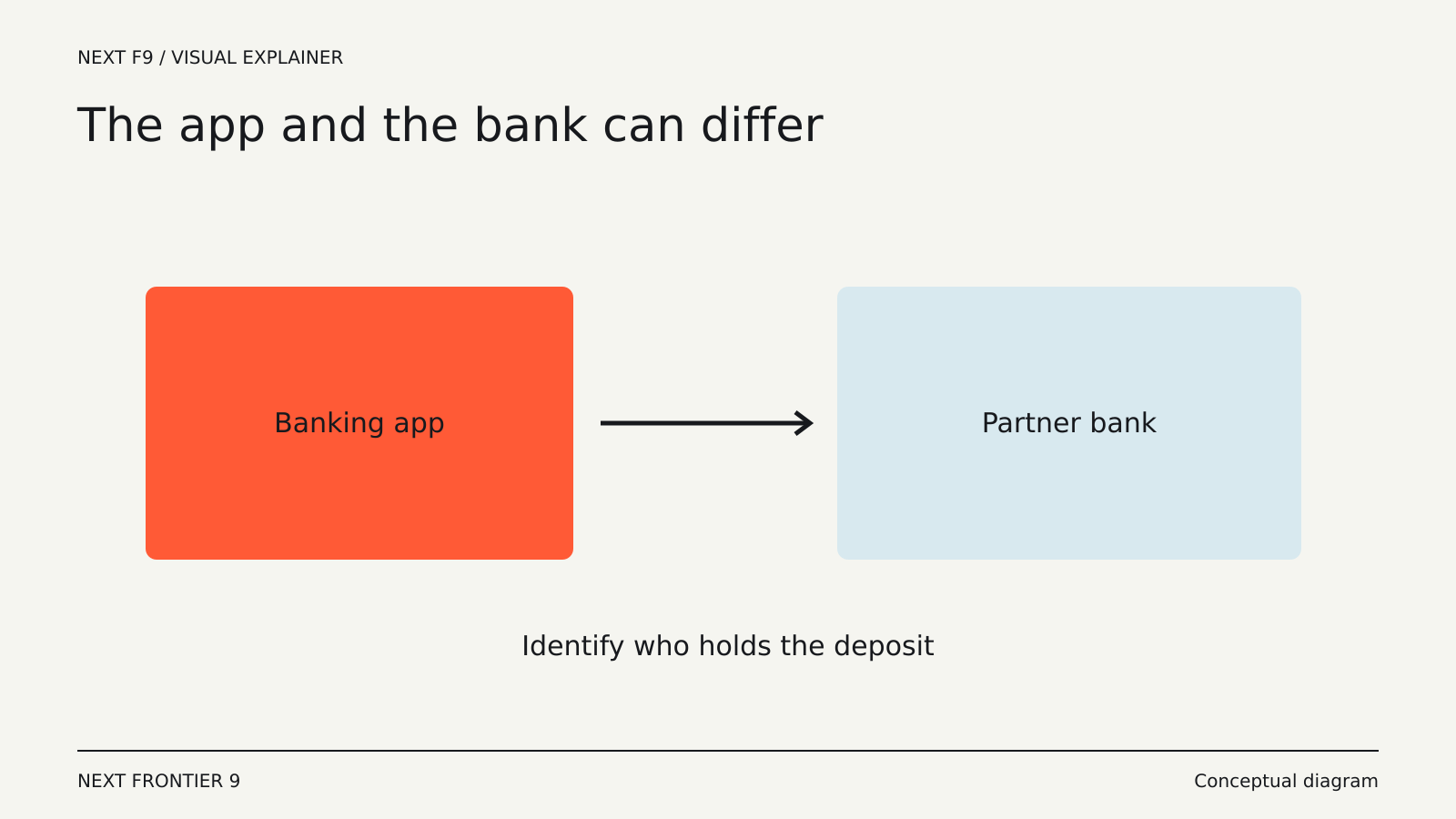
A polished app can show a balance, issue a card and let you send money without itself being a bank. It may be a financial technology company using a partner bank, a payment institution or another kind of service provider.
The distinction matters when you want to know who holds your money, which protections apply and who can help if access stops working. The color of the card and the word “banking” in a description do not answer those questions.
Separate the brand from the account provider
Start with the account agreement and the product’s disclosures. Look for the organization providing the account, the institution issuing the card and the place where customer funds are held.
Those can be different entities. A technology company may provide the interface and customer service, while a bank holds deposits or issues a card. In another arrangement, the product may hold safeguarded customer funds under a payment-services framework.
The rules depend on the country and product. A company can be regulated without being a bank, and different permissions cover different activities. The relevant question is what authorization applies to the service you are using.
A U.S. example: the partner-bank distinction
The U.S. Federal Deposit Insurance Corporation’s guidance on third-party apps explains that nonbank companies are not themselves FDIC-insured.
Where a nonbank places customer funds at an insured bank, pass-through deposit insurance may apply if the required conditions are met. The FDIC highlights matters such as records identifying the owners of the money and the amounts attributable to them.
That is different from saying the app itself is insured. It is also different from assuming every balance shown by the app has already become an eligible deposit at the partner bank.
This is a U.S. example. Deposit-protection and safeguarding arrangements elsewhere have their own definitions and requirements; the FDIC rules should not be copied into a description of another country’s product.
What protection is protecting against
Deposit insurance generally addresses a specified type of institutional failure under the relevant scheme. It does not turn every problem with a financial application into an insured event.
The FDIC states that its deposit insurance does not protect against the insolvency or bankruptcy of a nonbank company. If an app provider fails, customers may face delays and a recovery process even when some funds are held at a bank.
A technical outage is another kind of problem. The balance may still exist while the app, support team or integration needed to access it is unavailable. The account’s legal structure and its day-to-day accessibility are related but separate issues.
Read the balance description
An app may offer several products in the same interface: a deposit account, a payment balance, investments, cryptoassets or a lending product. Similar-looking numbers on the screen can represent different claims and risks.
Open the disclosure for the specific balance. A statement about a cash account does not automatically apply to an investment or digital asset displayed beside it.
Watch for language such as “provided by,” “held with,” “issued by” and “subject to eligibility.” These phrases often identify the boundary between the brand you recognize and the institution performing the financial service.
Confirm the institution independently
If a service names a bank, check the bank in the relevant regulator’s official register. The FDIC points U.S. customers to BankFind for checking insured institutions.
Use the exact legal name supplied in the account documents. Similar names can be misleading, and a genuine institution’s existence does not prove that an unrelated website or app is its authorized partner.
The app’s own support information should also explain how to contact the service about a transaction, complaint or access problem. Unclear ownership and inconsistent contact details deserve attention before money is committed.
Questions worth answering before relying on the app
You should be able to identify who owes you the balance, where it is held and how to withdraw it. Establish whether there are transfer limits, waiting periods or account restrictions relevant to the way you intend to use it.
Find out what happens if the interface is unavailable. Does the account documentation identify another route to support or access? Can you download statements and transaction records?
These are practical product questions, not a reason to assume that every nonbank app is unsuitable. Many useful services are built through partnerships. The goal is to understand the arrangement instead of inferring it from the interface.
A banking app is the visible layer. The account agreement and verified institutional relationships explain what sits underneath. Reading those details makes it much easier to distinguish a bank account from a product that merely feels like one.