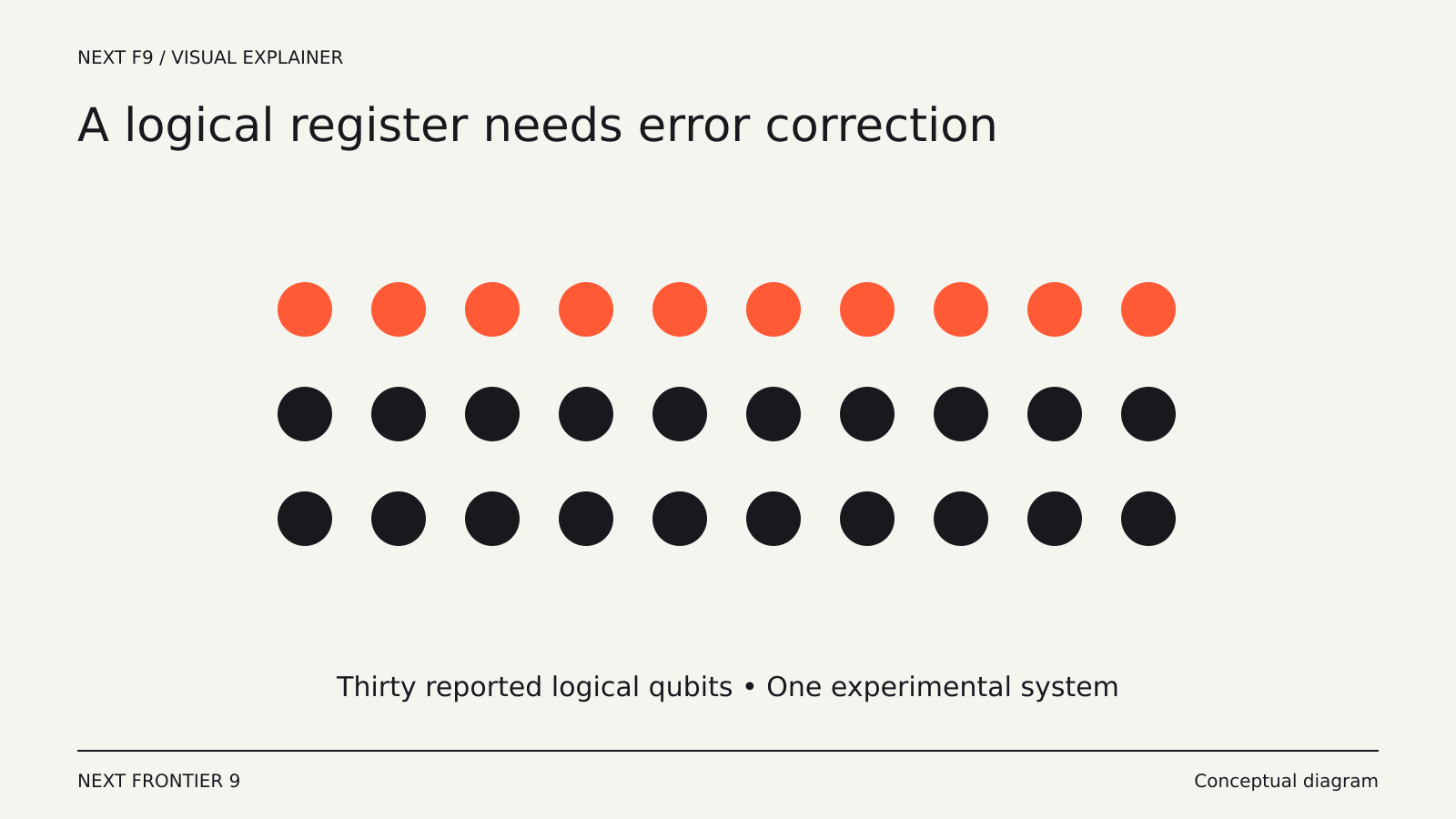
Infleqtion announced on September 24 that it had entangled 30 logical qubits using 80 physical qubits on its Sqale system. The company describes the experiment as a milestone in the development of its neutral-atom computing platform. Source: Infleqtion
The result concerns a particular coherent quantum state and circuit. It is not equivalent to demonstrating that a general-purpose quantum computer can outperform classical systems on arbitrary commercial tasks.
Why logical qubits are the focus
Physical qubits are affected by noise and errors. Logical qubits use an encoded arrangement and supporting procedures intended to make computation more reliable.
Counting physical qubits alone therefore leaves out a large part of the engineering problem. The reliability of operations and the ability to connect logical qubits into a useful computation are important measures too.
Infleqtion says its experiment executed roughly 1,000 physical operations and connected all 30 logical qubits into one state. Those are company-reported details of the demonstrated circuit.
A software-assisted change to the circuit
The announcement attributes part of the progress to a newly identified logical operation that reduces the physical gates required for a key step. Infleqtion says AI-assisted work contributed to finding that operation.
Fewer gates can be useful because each operation introduces another opportunity for error. The relevant question is how the improvement performs within the complete encoded circuit and under the conditions of the experiment.
The company points to a separate technical write-up containing more details. Next F9 has not reproduced the result.
Roadmap numbers remain future targets
Infleqtion describes goals of 100 logical qubits in 2028 and 1,000 in 2030. Those numbers are targets, not capacities established by the September announcement.
The company also discusses customer research and application development. That does not by itself demonstrate broad economic advantage over classical computing.
For readers comparing quantum announcements, it helps to separate three things: the hardware used, the operation actually demonstrated and the future system being proposed.
This release supplies evidence about a particular entanglement experiment on Sqale. The next questions concern sustained reliability, the range of supported operations and the depth of computations the system can carry out, rather than treating the logical-qubit count as a complete performance score.