A qubit, short for quantum bit, is the basic unit of information in a quantum computer. Like an ordinary bit, it can be read out as a 0 or a 1. Before it is read, though, a qubit can be in a superposition, which NIST describes as “state 0, state 1, or a mix of the two.” The term itself is attributed to the physicist Benjamin Schumacher.
That one difference, together with a few related quantum effects, is what makes quantum computers behave so differently from the laptop or phone you are reading this on.
Bits and qubits
A classical bit is a physical thing with two clear states: a voltage that is high or low, a tiny magnet pointing up or down. NIST notes that a bit put into a 0 or 1 state “will usually stay there for a long time,” which is why ordinary computers are so reliable.
A qubit is a two-state quantum system. Microsoft’s quantum team gives two examples: an electron’s spin, with spin-up and spin-down standing for 1 and 0, or a photon’s polarization, with vertical and horizontal standing for 1 and 0. Because these systems follow quantum rules, they can hold combinations of both states, not only one or the other.
Superposition and measurement
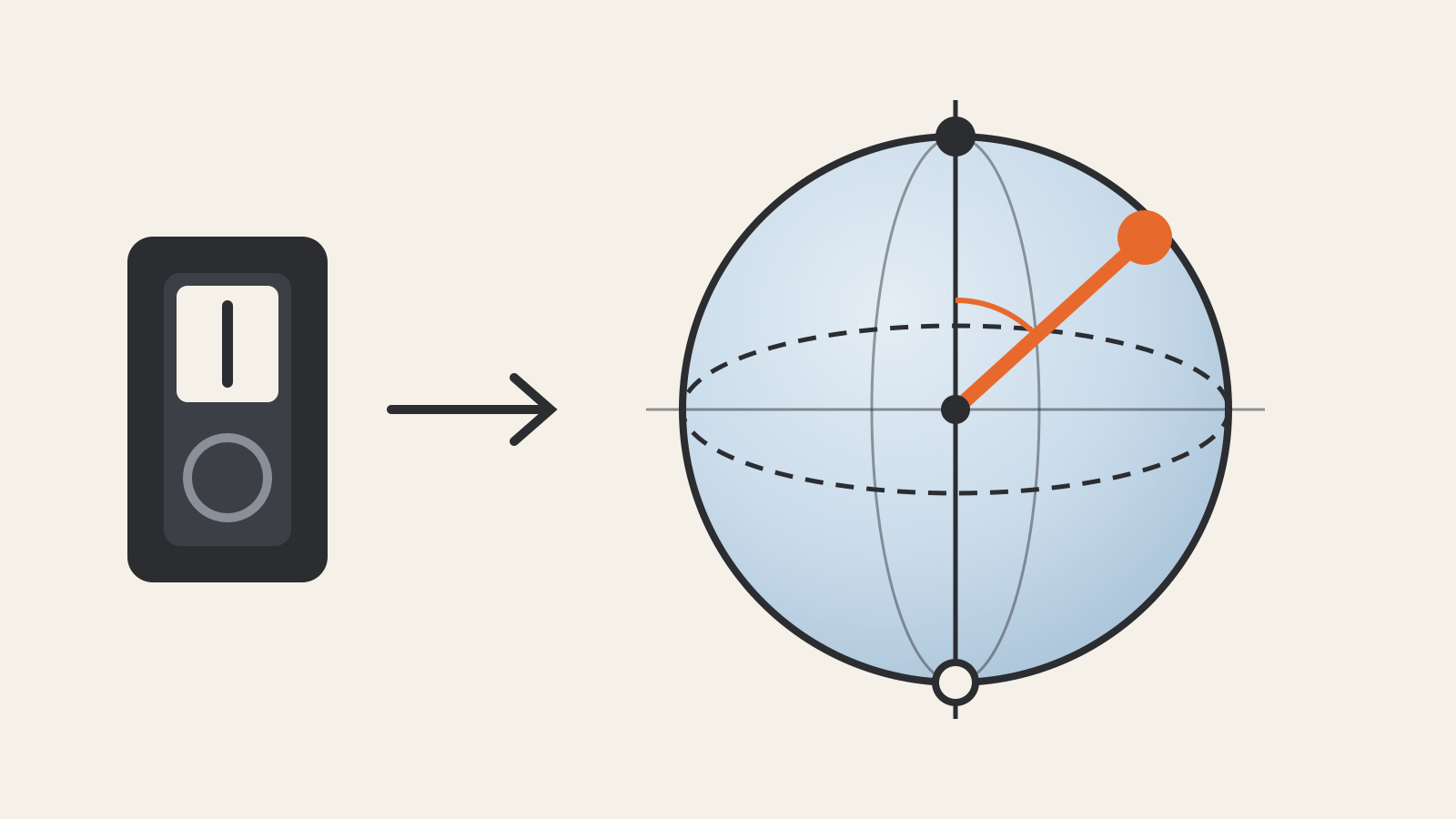
Google’s introduction to quantum computing uses a globe to picture a single qubit. The north pole is 0 and the south pole is 1. A qubit on the equator is in an even superposition: measure it and you have a 50% chance of getting 0 and a 50% chance of getting 1. Other points on the globe give other odds.
Measurement is the catch. When a qubit is measured, its superposition “collapses” to a single answer, 0 or 1, chosen at random according to those odds (NIST). You never read out the in-between state directly. So a qubit is not a way to store an unlimited amount of data in one particle; what you can extract at the end is still ordinary bits.
Entanglement and why qubit counts grow fast
Qubits become powerful in groups. They can be entangled, meaning they share a single quantum state, so measuring one tells you something about the others. Microsoft puts it this way: the state of one entangled qubit “depends on the state of the other.”
The numbers grow quickly. In NIST’s explanation, two classical bits hold one of four combinations at a time, while two qubits “can contain a superposition of four combinations of 0s and 1s simultaneously.” Three qubits cover eight combinations, four cover 16, and each added qubit doubles the count.
That does not mean a quantum computer simply tries every answer at once. NIST quotes Stephen Jordan, a Google researcher and former NIST staff member, on the point: computing in superposition “doesn’t allow quantum computers to do an efficient ‘brute force’ search over all the potential solutions,” because the final measurement “can only extract a small amount of information.” Useful quantum algorithms rely on interference, which Google describes as amplifying correct answers while canceling out incorrect ones, so that the measurement lands on something useful.
What qubits are made of
There is no single way to build a qubit. In theory, NIST says, any particle or system that obeys quantum rules can serve as one. Its overview of the main contenders:
| Qubit type | How it works, per NIST |
|---|---|
| Trapped ion | Charged atoms held by electric or magnetic fields in a vacuum, controlled with lasers and electromagnetic fields |
| Neutral atom | Uncharged atoms held in place by laser light in a vacuum |
| Superconducting | Tiny circuits on a chip cooled to near absolute zero |
| Semiconducting | Single electrons trapped in a small region of a material such as silicon, also cooled to near absolute zero |
| Photonic | Particles of light carrying information in properties such as polarization or arrival time |
| Topological | A proposed design that would encode information in “braided” quasiparticles; NIST says researchers are still seeking definitive evidence one has been built |
Each has trade-offs. NIST says ion qubits hold superpositions for a long time but are “relatively sluggish,” while superconducting qubits are fast and can be made with existing chip-manufacturing techniques but are more fragile and shorter-lived. Google’s Willow chip, for instance, is a superconducting system, while Infleqtion’s Sqale uses neutral atoms.
Why qubits are hard to keep
Qubits lose their quantum state easily. According to NIST, a stray electric or magnetic field, a temperature change “or even a cosmic ray” can ruin a superposition and leave the qubit acting like an ordinary bit. This loss is called decoherence. IBM notes that most quantum computers need extreme refrigeration to isolate their qubits.
The error rates show the gap with ordinary hardware. NIST says the best quantum computers today have hundreds of interconnected qubits and make an error “roughly once in every thousand operations,” while a classical computer makes around one error per quintillion calculations. Google’s own overview puts the best current cases at about one error in 10,000 operations, and says useful large-scale machines would need about one error in a trillion.
Physical qubits and logical qubits
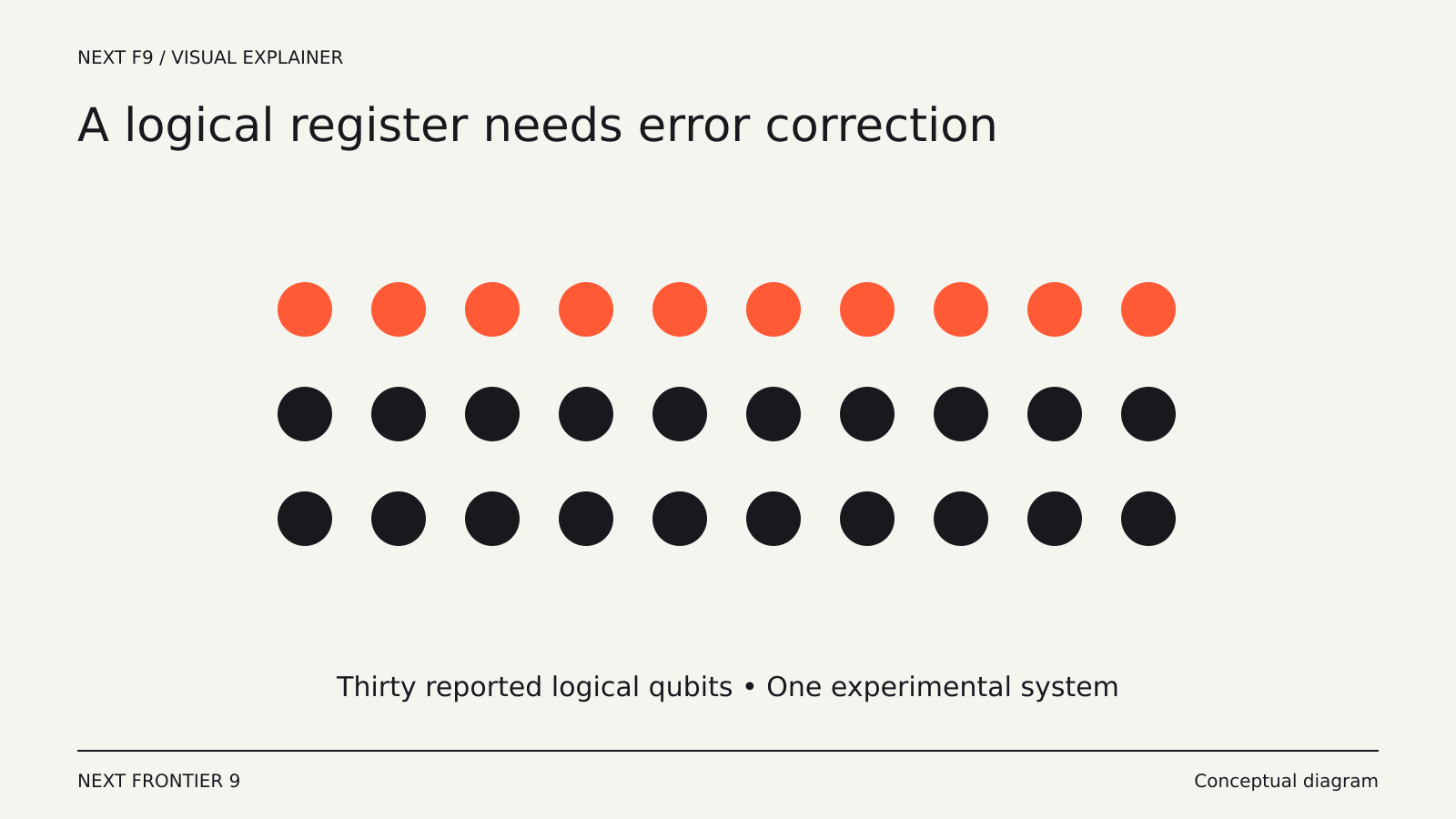
The main answer to errors is quantum error correction: spreading the information of one qubit across many physical qubits to form a more reliable logical qubit. Google calls this “the only way” it believes a large-scale machine with low enough error rates can be built.
For that to work, adding qubits has to reduce errors rather than add to them. On December 9, 2024, Google announced that its 105-qubit Willow chip did this: as it grew its encoded grids from 3x3 to 5x5 to 7x7 physical qubits, the error rate was cut in half at each step, a result known as operating “below threshold.” Companies now report results in logical qubits as well. Infleqtion, for example, said in September 2026 that it had entangled 30 logical qubits using 80 physical ones, and IonQ has reported work on decoding errors on a single standard CPU.
This is why a headline qubit number says little on its own. Google’s checklist for judging a quantum claim asks about qubit quality (how long qubits stay coherent, how fast and accurate operations are), how many operations run before the first error, whether the design can scale beyond a million physical qubits, and whether the result has been independently validated or peer-reviewed.
Qubits and your data
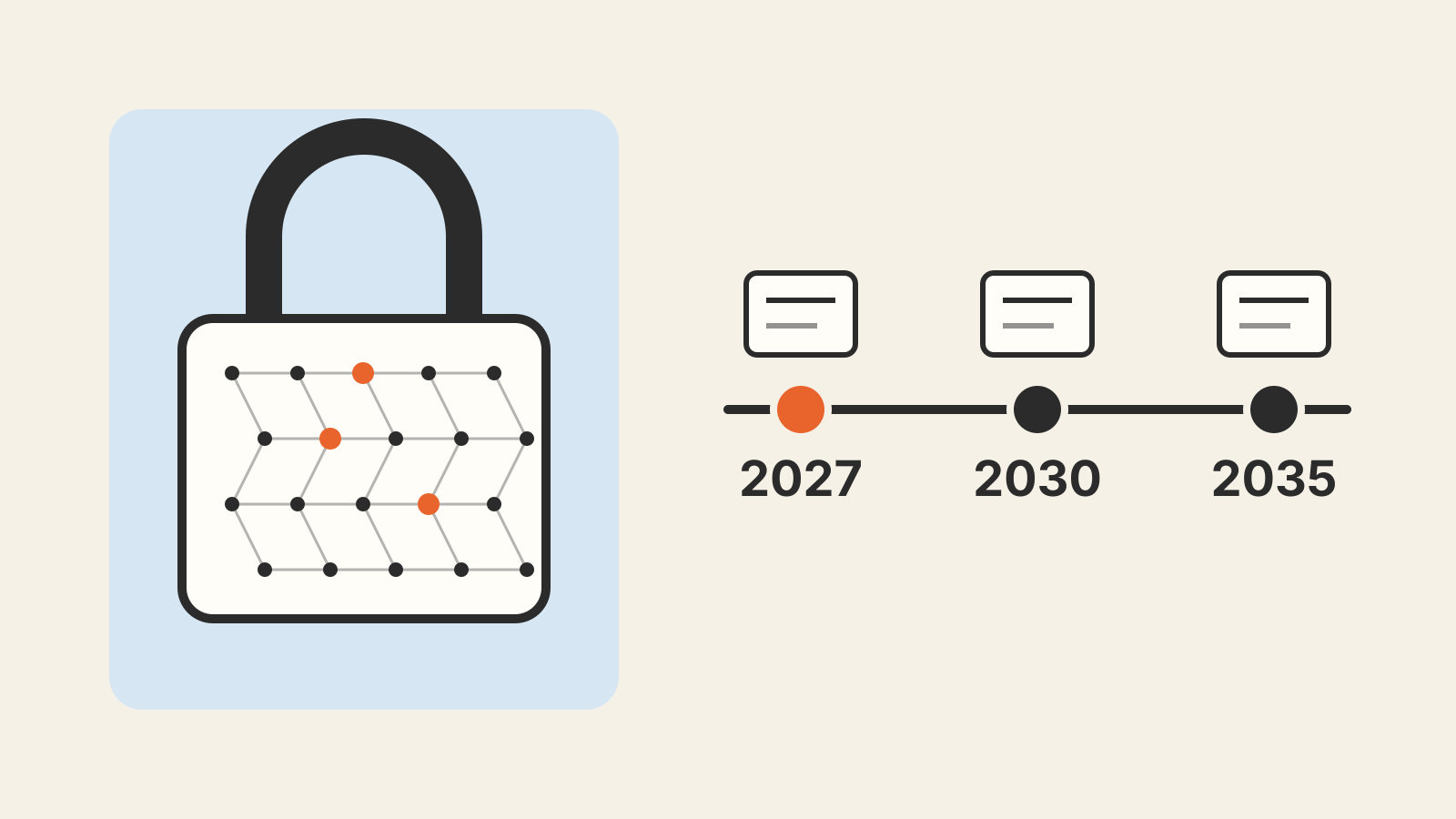
Qubits matter outside the lab mainly because of encryption. In 1994 Peter Shor described a quantum algorithm that could factor the large numbers behind much of today’s public-key encryption. NIST says a machine able to run it might need millions of qubits running without errors, and that such a computer is “probably still much further away.” The response is already under way: new post-quantum cryptography standards that run on ordinary devices and are designed to withstand that future machine.