You choose a familiar token on an exchange and the withdrawal screen asks for a network. That extra choice is not a technical formality. It determines where the transaction will be recorded and which version of the asset the recipient must support.
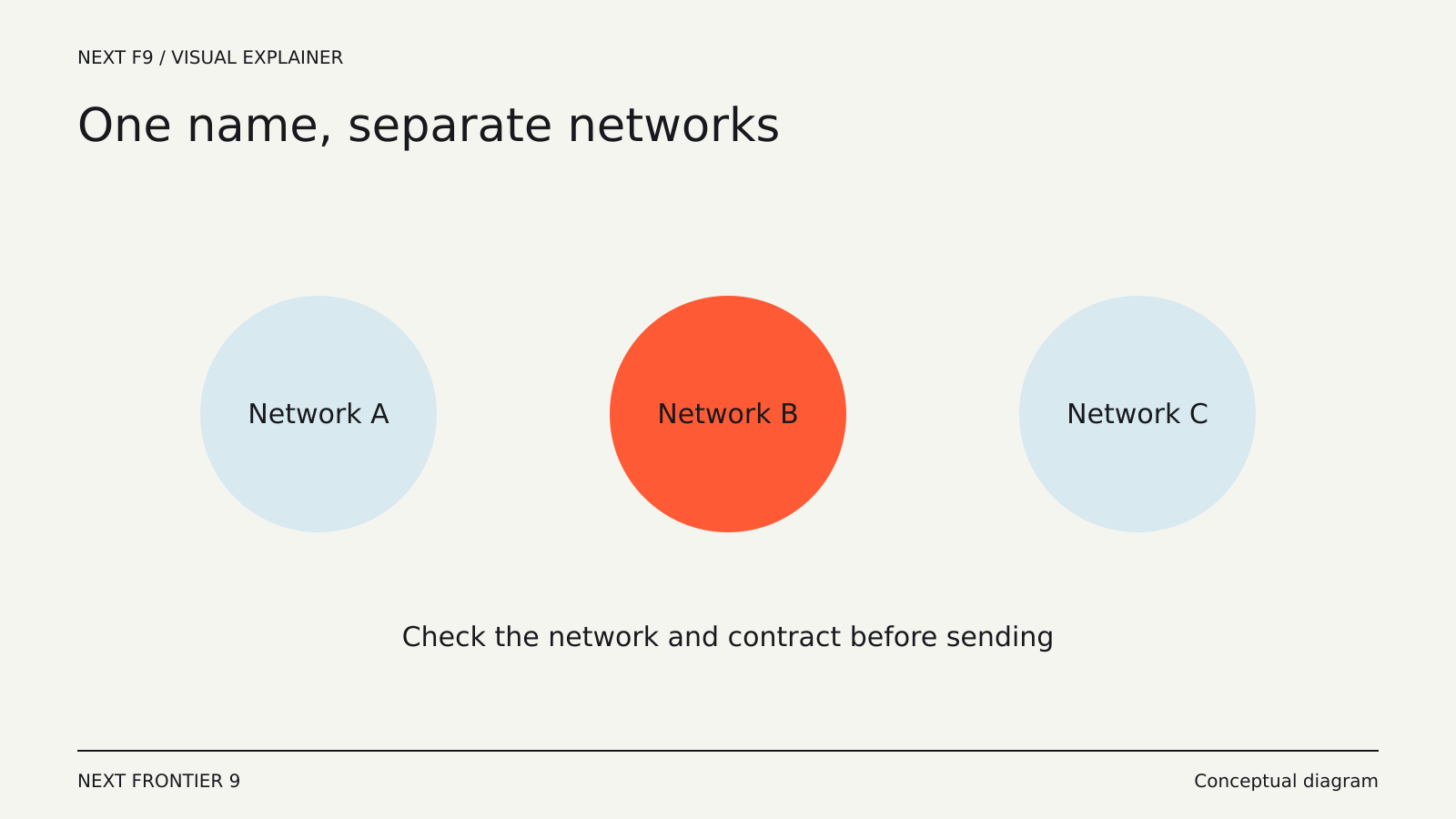
A token name or ticker can appear on several blockchains. Those networks maintain separate state, use different transaction rules and may represent the asset through different contracts.
A token exists within a network
On a smart-contract platform, a token commonly has a contract address that defines its implementation and keeps track of balances. Other blockchains can use their own built-in token primitives.
The name displayed by a wallet is a label. It is not a unique identifier across every network and every token. Anyone may be able to create another asset with similar branding, so recognition of the ticker is not enough.
The practical identity of a token includes the network and its official contract or asset identifier. These details should come from the issuer’s or project’s documentation.
An issuer can create native versions
An issuer can support the same economic asset on multiple networks by issuing and redeeming tokens within each supported environment.
Circle’s multichain USDC page provides a concrete example: it identifies networks on which USDC is natively supported and lists their corresponding token addresses or identifiers.
“Native” in this context describes a deployment supported directly by the issuer. It does not mean that the balances on all networks have merged into one shared ledger. A USDC balance on one network remains distinct from a USDC balance on another.
The issuer’s terms, supported integrations and transfer mechanisms determine how users can move between those environments.
A bridge creates another kind of relationship
A bridge can connect assets across networks. One common design locks tokens on a source network and creates a representation on a destination network. Other designs use different mechanisms, including burning and minting.
A bridged token may therefore depend on a separate set of contracts, validators, operators or message-verification rules. Its connection to the original asset is only as dependable as that design and its implementation.
A token can have familiar branding while carrying a different dependency from the issuer’s native version. Wallets sometimes distinguish these versions with a suffix, but naming conventions are not consistent enough to replace checking the documentation.
The same address format can be misleading
Some networks use compatible account and address formats. An address beginning with the same characters can look valid on multiple chains.
That does not prove a service accepts deposits on all of them. An exchange may monitor one network for a particular asset while not supporting another, even when the destination address looks identical.
If a deposit is sent through an unsupported network, recovery may be impossible or depend on the service’s capabilities and policies. A technically valid transaction can still be the wrong transfer for the intended recipient.
Fees belong to the chosen network
The network also determines how transaction fees are paid. A wallet may need the network’s native asset for gas even when the asset being transferred is a stablecoin.
Some services abstract that detail or sponsor fees, but the underlying cost still exists. A low withdrawal fee displayed by one exchange does not establish the cost of every later action on that network.
When comparing routes, consider the whole journey: withdrawing, receiving, using the asset and eventually moving it again. A cheap first step may leave the recipient with an unsupported token or a missing fee balance.
Check both ends before sending
The sender and recipient need to agree on the asset and network. For a custodial deposit, use the receiving service’s current deposit instructions. For a self-custody wallet, establish the network and official token identifier.
Do not assume that a previous successful transfer covers a new network selection. Services can add or remove support, and a wallet can display several versions at once.
A small test transfer can help confirm that the chosen route works, but it is not a substitute for verifying the destination. Fees and minimum deposit amounts may also make very small tests unsuitable.
Moving between networks is its own transaction
Changing a network selector in a wallet changes the view. It does not transport the balance.
To move value, you need a supported mechanism: an issuer’s transfer service, a bridge or an exchange that accepts one network and withdraws on another. Each route has terms, costs and dependencies to understand.
The useful habit is to read a token as a complete identity: asset, network and implementation. Once those are clear, the withdrawal screen’s extra question becomes easier to answer—and much harder to dismiss as a cosmetic choice.