A dollar stablecoin aims to trade near one U.S. dollar. The word “stable” describes that target. It does not explain how the target is maintained, who can redeem the token or what happens when confidence breaks down.
Two tokens with the same price objective can have very different structures. To understand one, start with the assets or mechanisms supporting it and the route between a token on a blockchain and money outside that blockchain.
A price target needs a mechanism
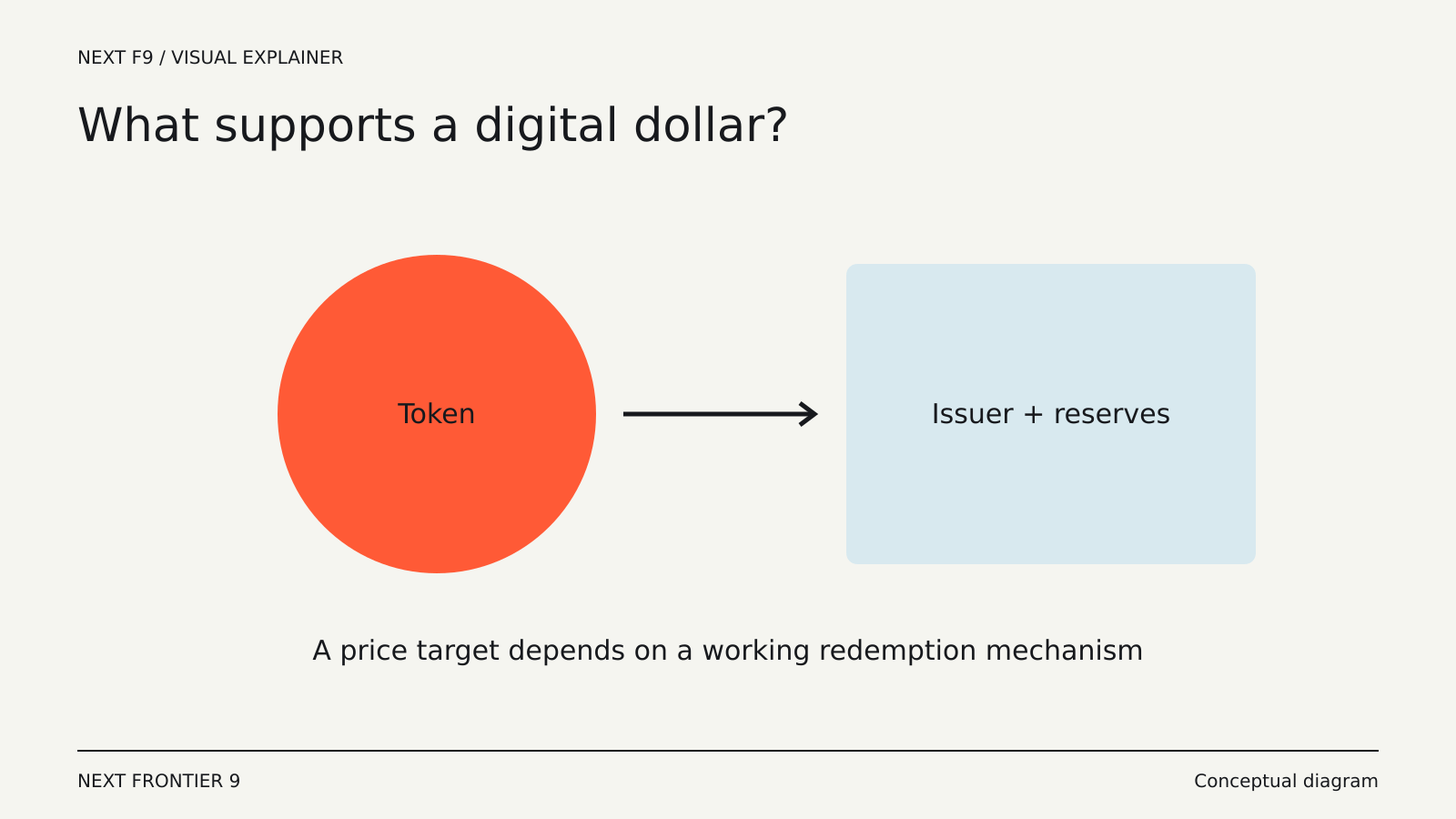
One common design uses reserves held by an issuer. The issuer creates tokens when it receives eligible funds and removes tokens when they are redeemed. The details depend on the issuer’s terms, reserve arrangements and supported customers.
Other designs use crypto collateral held in smart contracts. If the collateral can fluctuate sharply, the system may require more collateral than the value of tokens issued and use liquidation mechanisms to manage shortfalls.
The Ethereum community’s stablecoin overview distinguishes several designs, including fiat-backed, crypto-backed and algorithmic approaches. These categories are a starting point, not a quality rating.
Redemption and exchange trading are different
Buying a token on an exchange does not necessarily give you the same relationship with its issuer as a customer who can directly redeem it.
Direct redemption can involve eligibility requirements, minimum amounts, supported jurisdictions and operational procedures. Many holders instead sell through an exchange or another market participant. Their immediate exit price depends on market liquidity and demand.
The distinction becomes important during stress. If some participants can redeem at the target value while others can only sell into a thin market, their experiences may differ.
Before treating a token as a cash substitute, identify the actual route you would use to convert it back to the currency you need.
Why the market price can move
On an exchange, buyers and sellers set a traded price. A credible redemption route can create an incentive for eligible participants to buy below the target and redeem, or issue tokens and sell when the price is above it.
That process is not automatic or costless. Fees, transaction times, liquidity and doubts about the backing can weaken it. A token can trade away from its target even while its name and ticker remain unchanged.
A temporary deviation and a failure of the underlying structure are different situations, but the price alone may not reveal which one is happening. The reason for the deviation matters more than the reassurance of the word “stable.”
Reserves answer only part of the question
For a reserve-backed token, examine what the reserves consist of, who holds them and what information is published about them. A reserve report has a date and scope; it is not a continuous view of every operational risk.
The token also depends on issuance and redemption systems, custody arrangements, banking access and the relevant contracts. Holding assets worth the token supply does not by itself establish how quickly every holder can obtain money in every circumstance.
For crypto-backed designs, the questions shift toward collateral volatility, liquidation rules, price inputs and the behavior of the contracts. Different mechanisms create different points of failure.
The blockchain is another layer
A stablecoin can exist on several networks. Circle’s multichain USDC documentation lists native deployments on different blockchains, each with its own token implementation or address.
A token’s price target does not eliminate network fees, congestion or the need to use a supported network when sending it. An exchange may support one version and not another.
Bridged representations can add another dependency. A token representing an asset locked elsewhere depends on the bridge’s design as well as the underlying asset. Similar branding does not establish identical redemption rights or risk.
Yield is a separate product
Holding a stablecoin and lending it through a protocol are different activities. A lending return comes from an additional arrangement, with its own borrowers, contracts, liquidity conditions and possible losses.
A stable price objective does not make a lending rate guaranteed. If a service advertises yield, identify who pays it and what has to remain functional for you to withdraw.
This distinction also applies to exchange accounts that combine a token balance with an “earn” feature. The interface may make switching between them look minor, while the underlying exposure changes substantially.
What to establish before using one
For a particular stablecoin, identify its issuer or protocol, backing mechanism, redemption terms, supported network and official token address. Then look at how you would actually obtain and exit the position.
A stablecoin can be useful for moving value within digital payment systems, but the dollar symbol is only the beginning of the explanation. Its behavior comes from the institutions, contracts and markets that connect the token to its intended value.