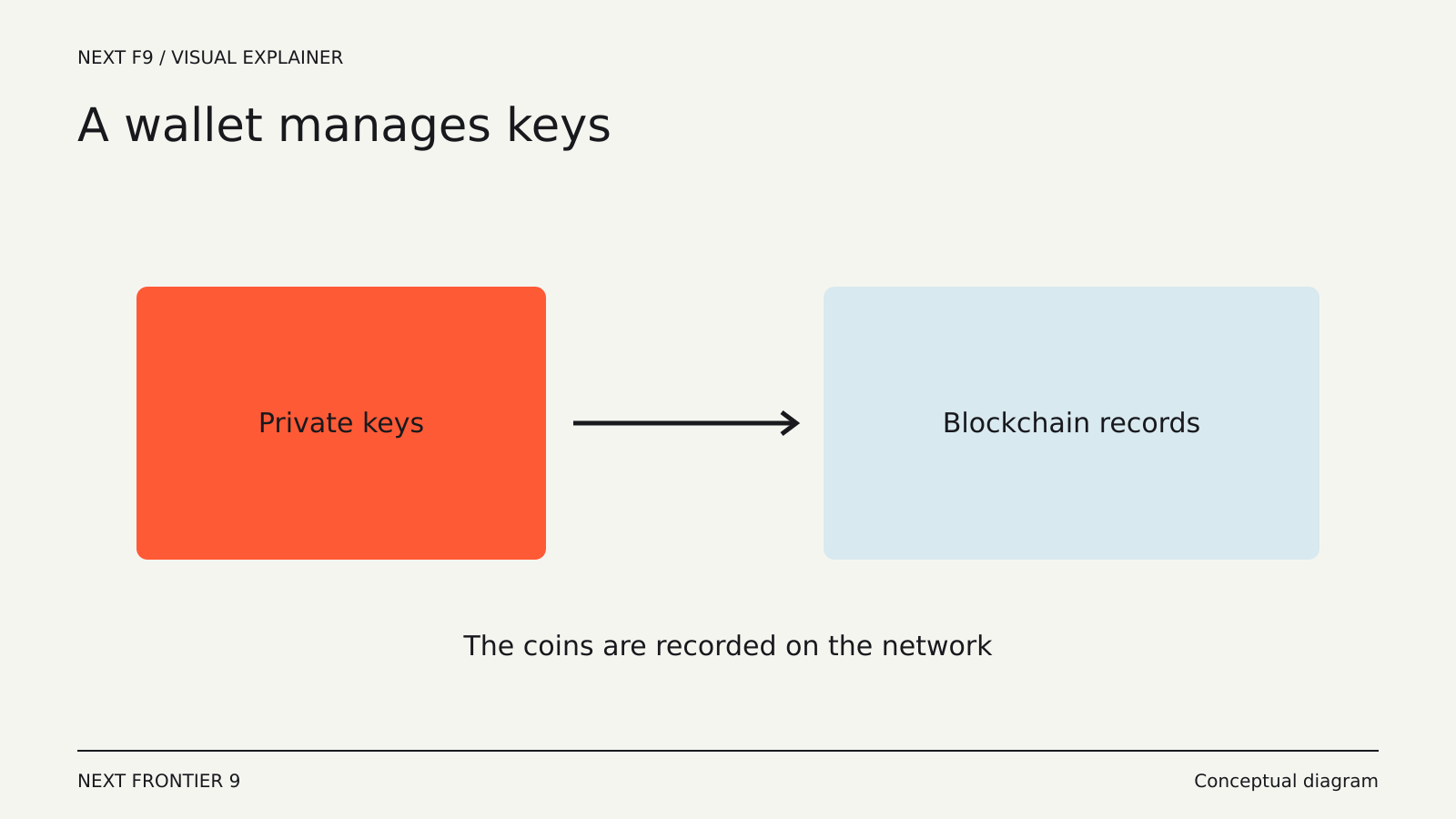
Deleting a self-custody wallet app does not delete coins from a blockchain. It may, however, delete the local information you need to control them. That difference explains both the flexibility and the responsibility of using a wallet.
The app is an interface to an account and its signing capability. The network maintains the record of assets and transactions. Losing the interface is inconvenient; losing the only usable signing and recovery information can be permanent.
Four terms that are easy to mix up
An address identifies a destination or account on a network. A private key is secret information used to authorize actions for a key-controlled account. A wallet is software or hardware that helps manage those keys and interact with the network.
An account is the entity represented in the network’s state. Different blockchains and account designs handle ownership and authorization differently, so not every wallet follows the same recovery model.
Ethereum’s wallet guide explains the distinction between wallets, accounts, keys and addresses. It also notes that one wallet can manage multiple accounts and that you can change wallet software without necessarily changing the underlying account.
The balance is a view of network data
When a wallet displays a token balance, it generally obtains information from the network, often through an infrastructure provider. The app organizes that information into a familiar list of assets and transactions.
The displayed list can be incomplete. A token may not have been detected, the wrong network may be selected or the connection to the network may have failed. An empty screen does not automatically prove that the underlying balance is zero.
A transaction explorer can provide another view, but it also needs to be the explorer for the correct network. The same-looking address on two networks does not imply the same assets or history.
Signing is the important capability
A wallet can create a proposed transaction and ask you to sign it. The signature allows the network or a service to verify that the action was authorized by the relevant key or account rules.
The private key should remain secret. A signature is not the key itself, but signing a harmful request can still authorize a harmful action. Protecting the key and understanding the request are both necessary.
Some signatures move funds. Others approve a contract to spend tokens, authorize an order or sign a message. The wallet’s confirmation screen is where that distinction needs to become clear.
What a recovery phrase does
Many self-custody wallets use a recovery phrase to derive keys. That phrase can be enough to recreate control of the associated accounts in compatible software.
It is not simply a password that customer support can reset. Someone with the phrase may be able to control the accounts without your original device. Conversely, losing all usable recovery information can leave you unable to restore access.
Other wallet designs use different arrangements, including multiple signers or account recovery mechanisms. Understand the design of your actual wallet rather than assuming every product uses the same phrase-based system.
Never enter a recovery phrase into a site merely because it claims to be helping with a transfer or support request. A normal payment destination only needs the relevant public receiving information.
Hardware changes where signing happens
A hardware wallet is designed to keep secret signing material inside a dedicated device. The computer or phone prepares a request; the hardware device signs under its rules.
This can reduce exposure of the key to the general-purpose device. It does not guarantee that every transaction presented for approval is desirable or correctly understood.
Checking the recipient, amount, network and requested permissions still matters. A secure signature on the wrong instruction is still a valid signature on the wrong instruction.
An exchange account is a different arrangement
A custodial service may show you a balance while controlling the underlying blockchain keys itself. You log in to the service and ask it to make transfers.
That can provide familiar recovery and support options, but it also means access depends on the custodian’s systems and rules. Your login password is not necessarily the private key controlling an on-chain address.
Self-custody transfers responsibility for key management to you. Custody transfers part of that responsibility to a service and introduces dependence on it. Neither arrangement should be confused with a guarantee that nothing can go wrong.
Before changing apps or devices
Confirm which networks and account types you use, how recovery works and whether you have a valid backup under the wallet’s documented process. Do not erase the only working installation until recovery is understood.
After a move, verify the address and network before assuming that the restored interface represents the intended account. Imported accounts and separately managed keys can require additional steps.
The wallet’s most important contents are therefore not digital coins sitting inside an app. They are the means of authorizing actions, the account information needed to find your assets and the recovery arrangement that keeps that access usable.