When a large cloud service has an outage, several apparently unrelated applications can fail together. They may share a provider, a region or a dependency that is less visible than the application’s own servers.
Cloud infrastructure offers ways to isolate failures, but an application only benefits from the protections it actually uses. A provider’s global map is not evidence that a particular service can move between locations without interruption.
A region contains smaller failure boundaries
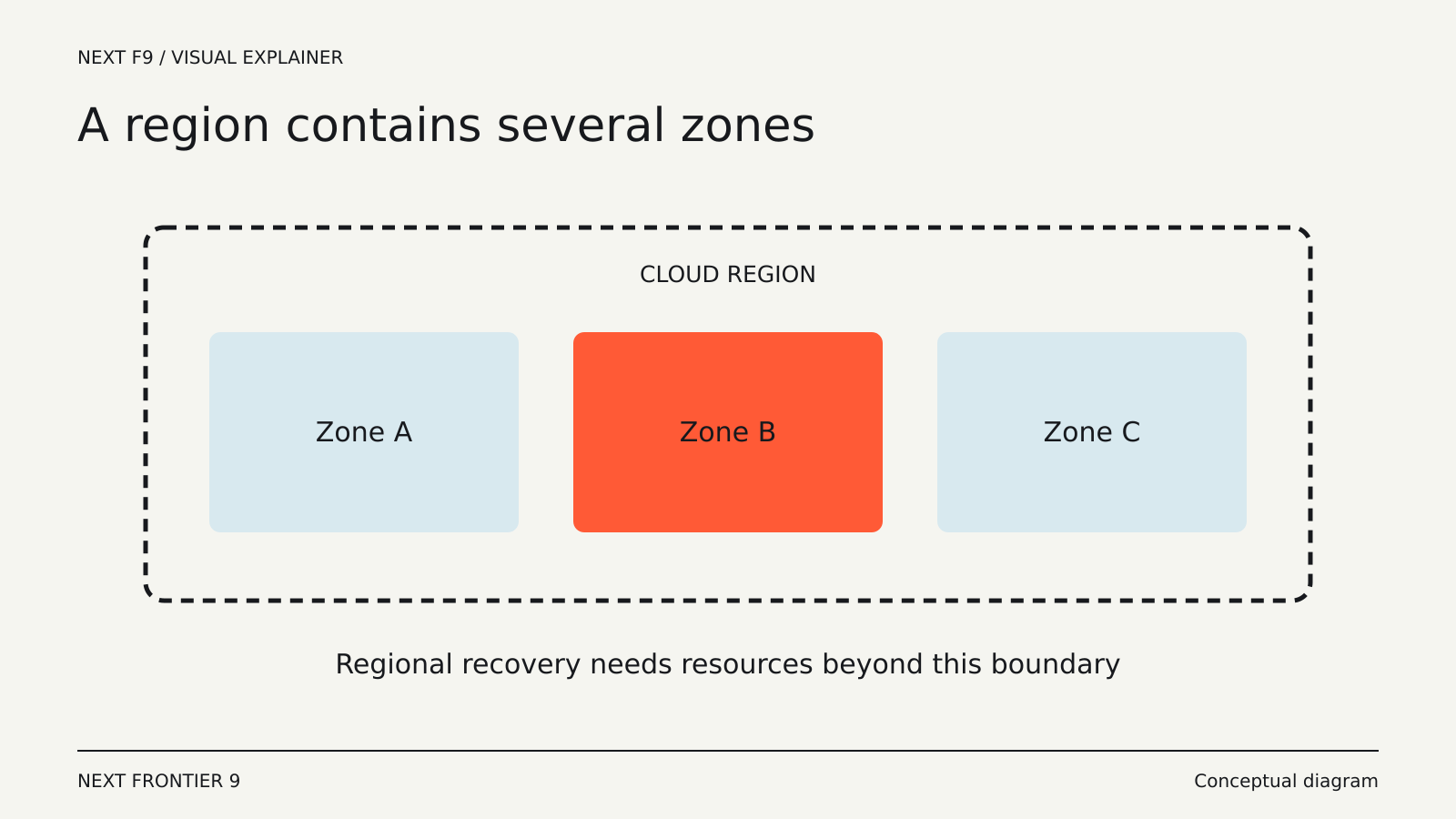
Cloud providers organize infrastructure into regions and, commonly, availability zones within those regions. The terminology and design vary by provider.
AWS describes an availability zone as one or more discrete data centers with separate and redundant power, networking and connectivity inside a region. Zones are designed to reduce shared failure risks while remaining close enough for low-latency communication.
A region is therefore not necessarily one building. Losing a single zone and losing access to a broader regional service are different scenarios.
Multiple zones help with some failures
An application distributed across zones can be designed to keep serving requests when one location fails. That requires more than placing a second server elsewhere.
Traffic needs a way to reach healthy instances. Data needs a suitable replication strategy. The surviving capacity must be able to handle the load, and dependencies must also remain available.
If all application servers depend on one database in the affected zone, distributing the servers does not remove the database dependency. The failure boundary follows the complete request path.
A regional dependency can affect many services
A regional problem can involve network connectivity, a shared control service or another component used by many applications. The visible symptom may be a slow login, a failed payment request or a page that loads without its data.
The company operating the application may also depend on a third-party service hosted in the same affected area. Different brand names do not guarantee different infrastructure.
This is why an application can be partially available. Its public pages may work while authentication, search or a background job does not.
Recovery elsewhere requires usable data
Running an application in another region is only helpful if it can access sufficiently current and consistent data there.
Synchronous replication can keep copies closely aligned but introduces latency and availability tradeoffs. Asynchronous replication can reduce some of that coupling, while leaving a window in which recent changes have not yet reached the other location.
An organization needs to decide how much downtime and potential data loss its service can tolerate. Those requirements shape the replication and recovery design.
A backup is useful, but restoring a backup is different from failing over to a live replica. Restoration can involve provisioning infrastructure, validating data and reconnecting application dependencies.
Switching traffic is not the whole operation
A recovery plan must account for configuration, secrets, network rules, storage, background workers and external integrations. A database endpoint is only one piece.
DNS changes and load-balancer decisions can redirect new requests, but clients may retain cached information or existing connections. In-flight operations may have uncertain outcomes.
For a payment or order, a timeout does not necessarily mean the action failed. The application needs a way to identify the original operation and check its state before retrying. Otherwise a recovery attempt can create duplicates.
Tests reveal assumptions that diagrams hide
A diagram showing two regions can look convincing while the secondary region lacks capacity or an important dependency. Recovery exercises expose those gaps.
A useful test checks whether the application can serve real representative tasks after a controlled failure, whether the data is correct and whether returning to the normal arrangement is safe.
The test should also include the people and access needed to execute the plan. A recovery procedure that relies on an unavailable account or undocumented knowledge is another dependency.
What users can reasonably look for
During an outage, a service’s status page can explain affected functions and recovery progress. It may be hosted separately, although that should not be assumed.
For important work, retain the transaction reference or a copy of the submitted data. Avoid repeatedly submitting an action with financial or operational consequences when the result is uncertain.
For organizations selecting a cloud-backed product, ask about the service’s actual resilience and recovery objectives rather than the provider’s total number of data centers.
Cloud regions make geography and infrastructure part of application design. They can provide strong building blocks for resilience, but the complete service still needs replicated data, independent dependencies and a recovery path that has been exercised under realistic conditions.