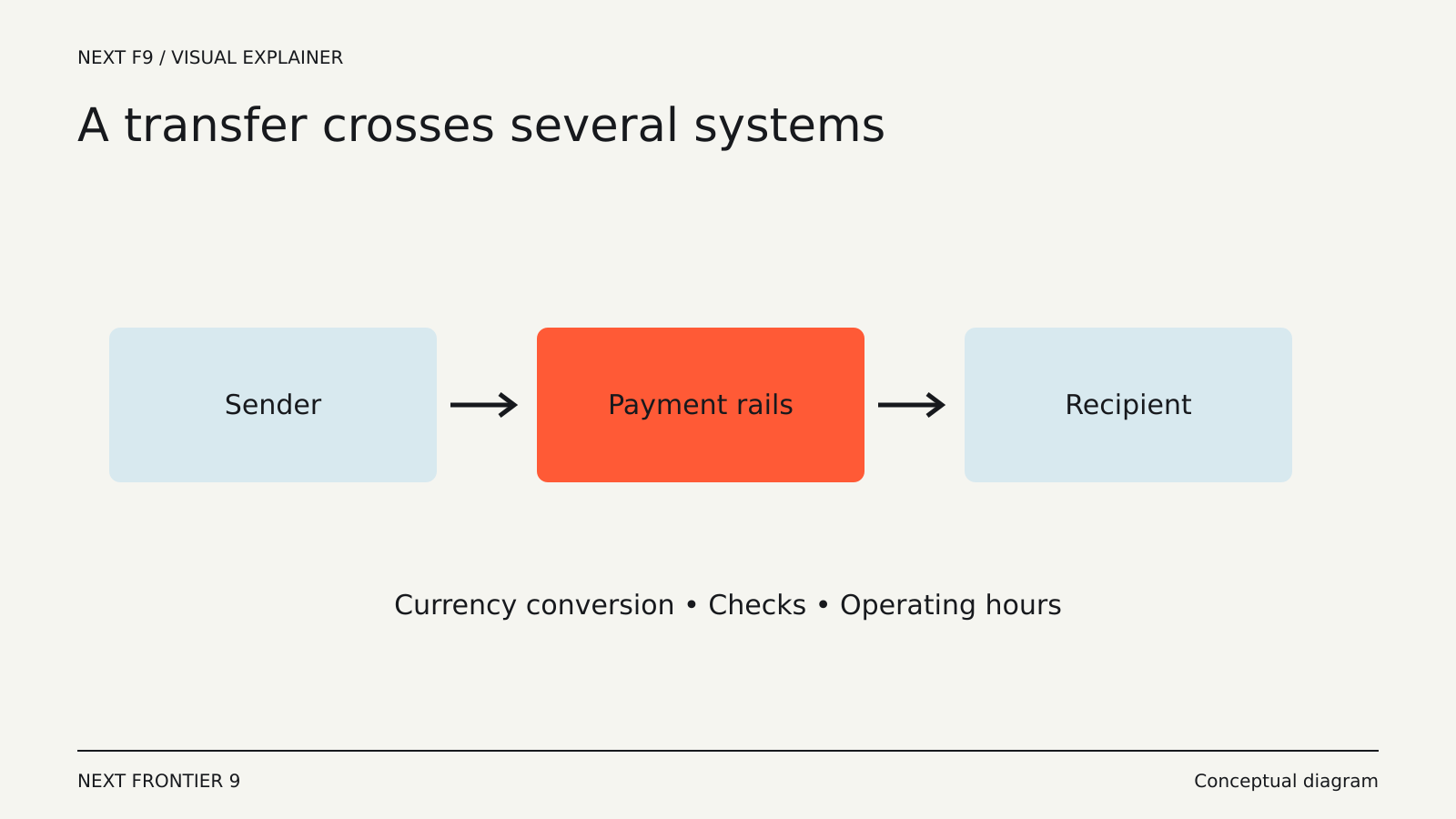
Two international transfers for the same amount can arrive at very different times. One may use funds already held in the destination country and a fast local payment system. Another may need to pass through several institutions, a currency conversion and a receiving bank’s processing schedule.
Distance alone explains very little. The important question is which route the payment takes and what has to happen before the recipient can spend it.
The transfer begins before money crosses a border
A provider first needs usable funds. Paying by a bank transfer, a card or an existing account balance can create different starting points. If your funding payment has not arrived or cleared, the international portion may not have begun.
An app can show that it has received your instruction while still waiting for the money. The distinction is easy to miss when every stage is summarized by a progress bar.
A useful receipt should identify the funding method, currencies, destination and expected arrival. If a quoted arrival time assumes the provider receives your funds before a cutoff, that condition matters.
A message and a movement of money are different
Financial institutions need a way to exchange payment instructions and information. Swift describes its role as infrastructure for financial messaging and transaction services.
A message can travel quickly while other parts of the payment take longer. The institutions still need to process the instruction, manage settlement and credit the beneficiary under the rules of the relevant systems.
This helps explain why “sent” is an ambiguous status. It can mean your provider has dispatched an instruction, passed money to the next institution or completed its own part of the process. Those milestones do not always equal “available in the recipient’s account.”
Local payout can shorten the route
A provider with access to local payment infrastructure can receive funds in one country and pay out from an account or liquidity pool in another. From the customer’s perspective it is an international transfer; some underlying movements may be domestic.
That arrangement can be fast when both sides support rapid payment and the provider has the required funds and access. It is not a universal promise. Currencies, receiving institutions and customer eligibility all affect the route.
Wise’s Thailand launch announcement illustrates the importance of local integration: its account and card offering sits alongside country-specific transfer and payment capabilities. A familiar global brand does not mean every country gets an identical product.
Clocks and calendars still matter
A transfer can encounter business hours, processing windows, weekends or holidays in more than one place. A payment initiated late on Friday may reach one stage promptly and then wait for another institution to resume processing.
Some payment systems run continuously. Others have scheduled settlement or operational windows. Even where the infrastructure is available around the clock, a provider may not process every kind of transfer continuously.
The sender’s country is only part of the calendar. A holiday in the destination market, or in a market involved in currency settlement, may be relevant too.
Checks can interrupt an otherwise fast route
Providers may need to verify identity, establish the purpose of a transfer or clarify information about a recipient. Incorrect account details can also send a payment into manual handling.
Those checks are not represented well by a single average speed figure. An automated transfer can be quick; a case requiring a document or correction can take much longer.
For a delayed transfer, ask which stage is waiting and whether any action is required from you. Sending the same payment again before understanding the first one can create a second problem rather than solve the delay.
Compare what the recipient gets
The exchange rate and visible transfer fee do not always describe the entire cost. The funding method, destination and possible intermediary or receiving-bank charges can matter.
Compare the amount the recipient is expected to receive, not just the fee printed beside the send button. A useful quote also tells you how long its exchange rate is valid and whether the arrival estimate is conditional.
For a time-sensitive payment, a provider’s actual quote for that corridor and funding method is more useful than a headline claim about global speed.
Track the stage, not just the elapsed time
Keep the transaction reference and receipt. Check whether the provider is waiting for funds, performing a review, converting currency or waiting for the receiving institution.
The recipient can check the expected account and currency, but a screenshot marked “sent” should not be treated as proof of final receipt. Confirmation from the receiving account is stronger evidence.
An international transfer is complete for the customer when the intended recipient can use the intended amount. The route between those two facts explains most of the difference between a transfer that takes minutes and one that takes days.