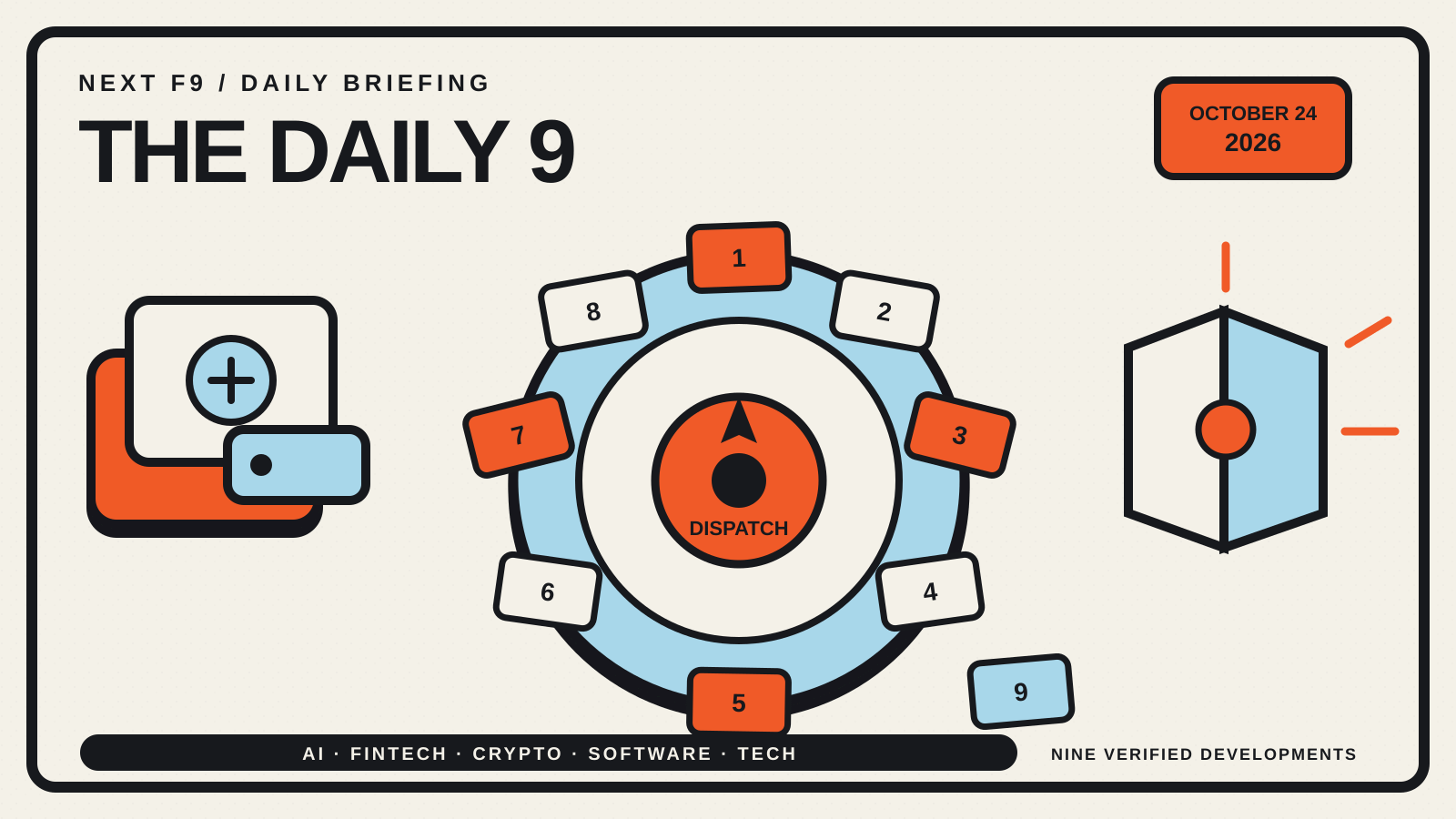
Daily 9 October 24 2026 tracks nine verified developments announced on October 22–23 across AI, fintech, crypto policy, software and consumer technology. Today’s briefing separates published research from shipping products, preview builds and future rollouts.
1. U.S. Treasury proposes a broader outbound-investment regime
On October 22, the U.S. Treasury published a proposed rule under the COINS Act that would replace and expand the current outbound investment security program. The notice covers specified activity involving semiconductors and microelectronics, artificial intelligence, quantum technologies, high-performance computing and hypersonic systems, while adding biotechnology under Treasury’s existing authority. It would retain notification and prohibition mechanisms for covered transactions. This is a proposal for public comment, not a final rule or an immediate ban.
2. Microsoft reports new medical-diagnosis research results
Microsoft AI introduced SDBench and new MAI-DxO results on October 22. SDBench combines 304 complex New England Journal of Medicine cases with typical emergency-department presentations drawn from MIMIC-IV-ED. Microsoft says its orchestrator reached 83% accuracy on the complex cases, versus 22% for physicians without references and 36% with them; it also reports 80% versus 47% on common cases. Those figures are company-reported research results, not evidence of clinical availability or regulatory clearance.
3. Sierra tests whether voice agents can preserve exact details
Sierra released τ-Entity on October 22, a benchmark for voice agents that must capture names, addresses, identifiers and other precise information during calls. It includes 200 tasks across ten entity types and evaluates each prompt under three audio conditions, using a Pass³ measure that requires success in all three. Sierra reports that the leading evaluated system scored 60.3% in regular conditions but only 34% across every condition. The results are Sierra’s own benchmark findings, not an independent industry ranking.
4. GitHub brings Copilot issue work into Microsoft Teams
GitHub updated its Microsoft Teams integration on October 23. From an issue notification, a developer can now ask Copilot to investigate the problem, propose a fix, run tests and open a pull request without leaving Teams. GitHub says the capability is part of its consolidated GitHub app for Teams. The previous app has been renamed “GitHub (deprecated)” and is scheduled to retire on November 16, so organizations need to install or update the consolidated app before then.
5. Windows 11 Insider builds add experimental settings filters
Microsoft issued new Windows 11 Insider builds on October 23: Beta build 26220.9757 and Experimental build 26340.9767, alongside platform builds for 26H1 and later development. The Experimental channel adds filters inside Settings search, while phone controls in Quick Settings are beginning a limited rollout. These are preview-channel changes, not stable Windows features available to every user. Microsoft may change, delay or remove experimental functions before a broad release.
6. Dapr 1.19 expands workflow and actor controls
Diagrid detailed the Dapr 1.19 release on October 22. The available release adds stateful workflow history, workflow-management APIs in SDKs and an opt-in scheduler-based actor-placement path. Diagrid also highlights alpha building blocks for binary storage, search, vector operations and an MCP server. In a company benchmark, the optional workflow fast path reduced median step latency from 553 milliseconds to 153 milliseconds. That measurement is Diagrid’s test result and may not represent every deployment.
7. Apple puts the foldable iPhone Duo on sale
Apple said the iPhone Duo reached stores and its online shop worldwide on October 23. The company describes it as its first foldable iPhone and is offering Personal Setup plus in-store learning sessions for new owners. This announcement marks actual retail availability, rather than a preview or future launch plan. Buyers still need to check local inventory, carrier support and regional pricing through Apple’s country-specific store pages because availability can vary by market.
8. Mastercard extends First-Party Trust beyond its initial markets
Mastercard expanded First-Party Trust on October 22. The program combines Mastercard risk signals with merchant evidence to help issuers distinguish unauthorized-card fraud from disputes where the cardholder or someone in the household made the purchase. Mastercard says the service is available across Eastern Europe, the Middle East and Africa from October 2026. A wider European rollout is planned for July 2027, so that second phase is not yet available.
9. Australian report estimates the value of wider SME AI adoption
The Tech Council of Australia released new small-business AI research on October 22, with analysis by Delwood Advisory and support from Google, Employment Hero and Deputy. The report estimates that broader adoption could add up to A$93 billion in annual economic value over five years, while the average small or medium-sized business could unlock about A$136,000 a year. These are modeled potential gains, not measured revenue already earned. Google also summarized the report and its assumptions.