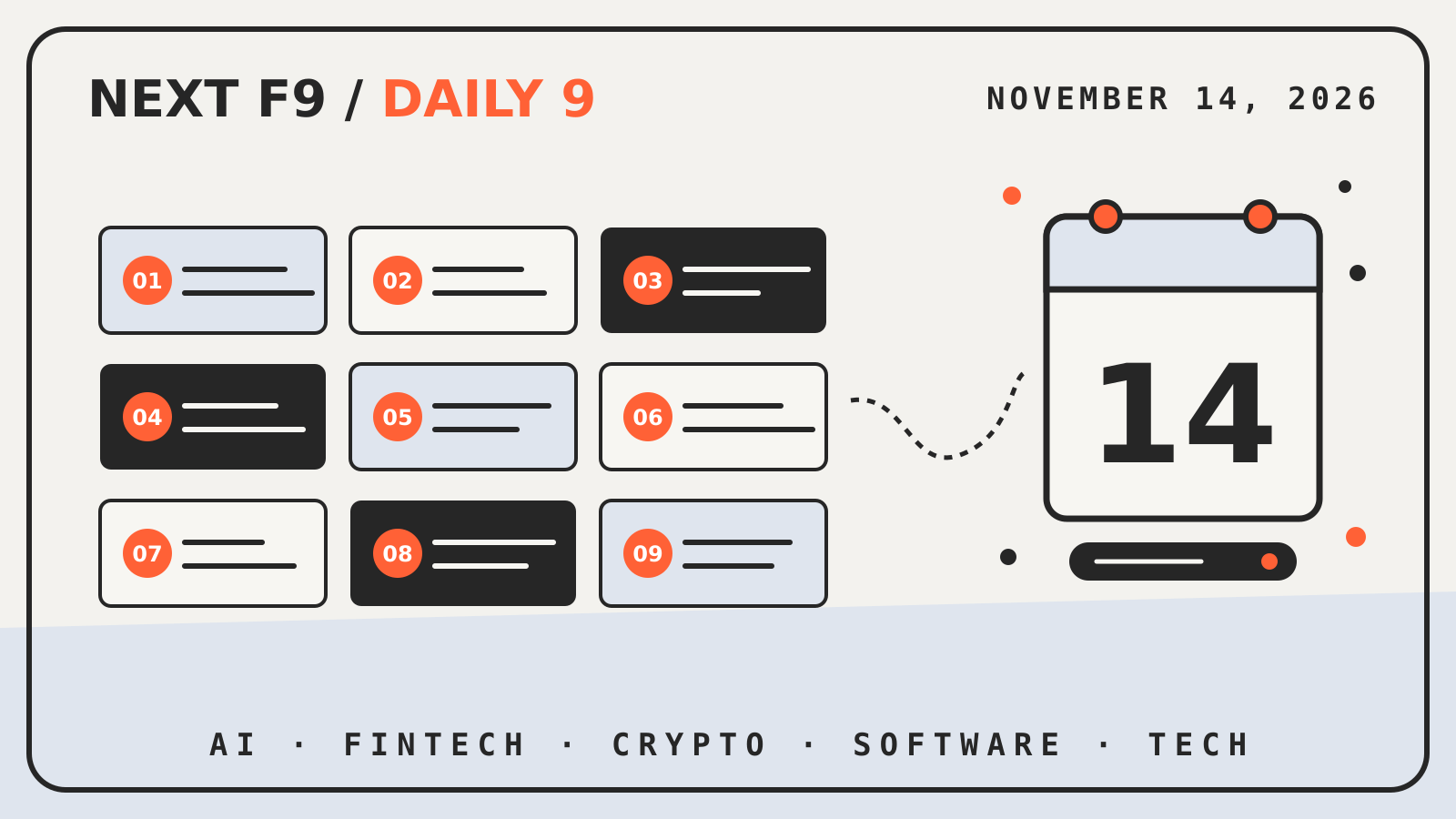
Daily 9 for November 14, 2026 covers nine developments across AI, fintech, crypto, software and tech, announced between November 12 and November 13. Jensen Huang resigned as Nvidia’s chief executive, OpenAI introduced ChatGPT Wallet for agent purchases, the CFTC sued Arkansas over prediction markets, and Rust 1.100 finally made the never type stable.
Each item links to the company, project or organization that published it.
1. OpenAI introduces ChatGPT Wallet for agent purchases
OpenAI introduced ChatGPT Wallet, built with American Express, Mastercard and Visa, so agents can pay without seeing a user’s real card details. Users add a card once, review the items, total and card before each purchase, and approve with a check such as Face ID or a fingerprint. The network then issues a payment token in place of the card number. It starts through dots for ChatGPT Pro subscribers in the US. OpenAI, November 13. Background: what a virtual card number is.
2. Anthropic launches Claude for Manufacturing
Anthropic released Claude for Manufacturing, a plugin with 17 skills and connectors to Autodesk Fusion, Infor, Microsoft 365 and Oracle NetSuite. The skills cover jobs such as drafting a quote from a customer request, documenting a failed inspection and ranking likely causes, and reading sensor exports to diagnose a breakdown. Anthropic says the person responsible reviews and approves the work before it reaches a customer or supplier. Infor is releasing its own plugin that can also change records. Anthropic, November 12.
3. CFTC sues Arkansas over Kalshi enforcement
The Commodity Futures Trading Commission said it has sued Arkansas to stop the state from halting event-contract trading and seeking civil penalties it puts at up to hundreds of millions of dollars. Arkansas has brought a civil enforcement case in state court against Kalshi, a CFTC-designated contract market. The CFTC says the state’s effort is preempted by the Commodity Exchange Act. Arkansas is the 11th state the agency has sued over the issue. CFTC, November 13.
4. Hong Kong regulators push tokenized deposits toward use
The Hong Kong Monetary Authority and the Securities and Futures Commission hosted about 200 practitioners on November 11 to discuss Project Ensemble and tokenized investment products. The seminar followed two recent steps: Ensemble TX now supports 24/7 interbank settlement of tokenized deposits, and the SFC approved round-the-clock secondary trading of tokenized money market funds. The HKMA says it will widen the use of tokenized deposits to settle more kinds of tokenized products. HKMA, November 12; SFC, November 12.
5. SEC approves Nasdaq ISE options on crypto trust shares
The SEC approved, on an accelerated basis, a Nasdaq ISE rule change that lets the exchange list options on Commodity-Based Trust Shares holding one or more digital commodities. ISE can now list those options soon after Nasdaq lists the underlying shares, without a separate SEC approval each time. The final amendment also says derivatives held by a trust count at gross notional value toward the rule’s 15% limit. The SEC received no comments on the original filing. Federal Register, November 13.
6. DTCC plans tokenized securities on Solana
The Depository Trust & Clearing Corporation plans to connect its DTCC Tokenization Service to Solana, so eligible assets held at The Depository Trust Company can be tokenized on that network. The service launched on October 28, and the Solana connection is planned for the second half of 2027. DTCC says tokens on Solana will keep the same investor protections, ownership rights and regulatory safeguards as traditionally held securities. DTCC, November 12. Background: what a blockchain is.
7. Rust 1.100 makes the never type stable
The Rust project released Rust 1.100.0. The never type is now stable after 10 years and five failed attempts. The release also stabilizes the core of the Allocator API, so library authors can write custom allocators that work with Vec and Box, and adds DropGuard, which runs a closure on every exit path from a function. Cargo can now report unused dependencies and gains a min-publish-age setting. Existing users update with rustup update stable. Rust Blog, November 12.
8. Cloudflare open-sources its Kitesurf agent browser
Cloudflare released Kitesurf, its stateless browser for AI agents, as open source under the Apache 2.0 license. Kitesurf runs on Cloudflare Workers and parses HTML, applies CSS, runs page JavaScript and renders screenshots without a browser container. It supports the Chrome DevTools Protocol, so clients such as Puppeteer can connect. Running it on Cloudflare needs Dynamic Workers, part of the Workers Paid plan. Cloudflare calls the project experimental and under heavy development. Cloudflare, November 13.
9. Jensen Huang resigns as Nvidia chief executive
Nvidia’s board said Jensen Huang resigned as president, chief executive and board member, effective immediately. Chief financial officer Colette Kress is interim CEO and keeps her finance role while the board searches for a permanent successor among internal and external candidates. Harvey C. Jones, a director since 1993, becomes Nvidia’s first chair of the board. Nvidia says its third-quarter results remain scheduled for November 17. Nvidia, November 12; Nvidia Form 8-K.