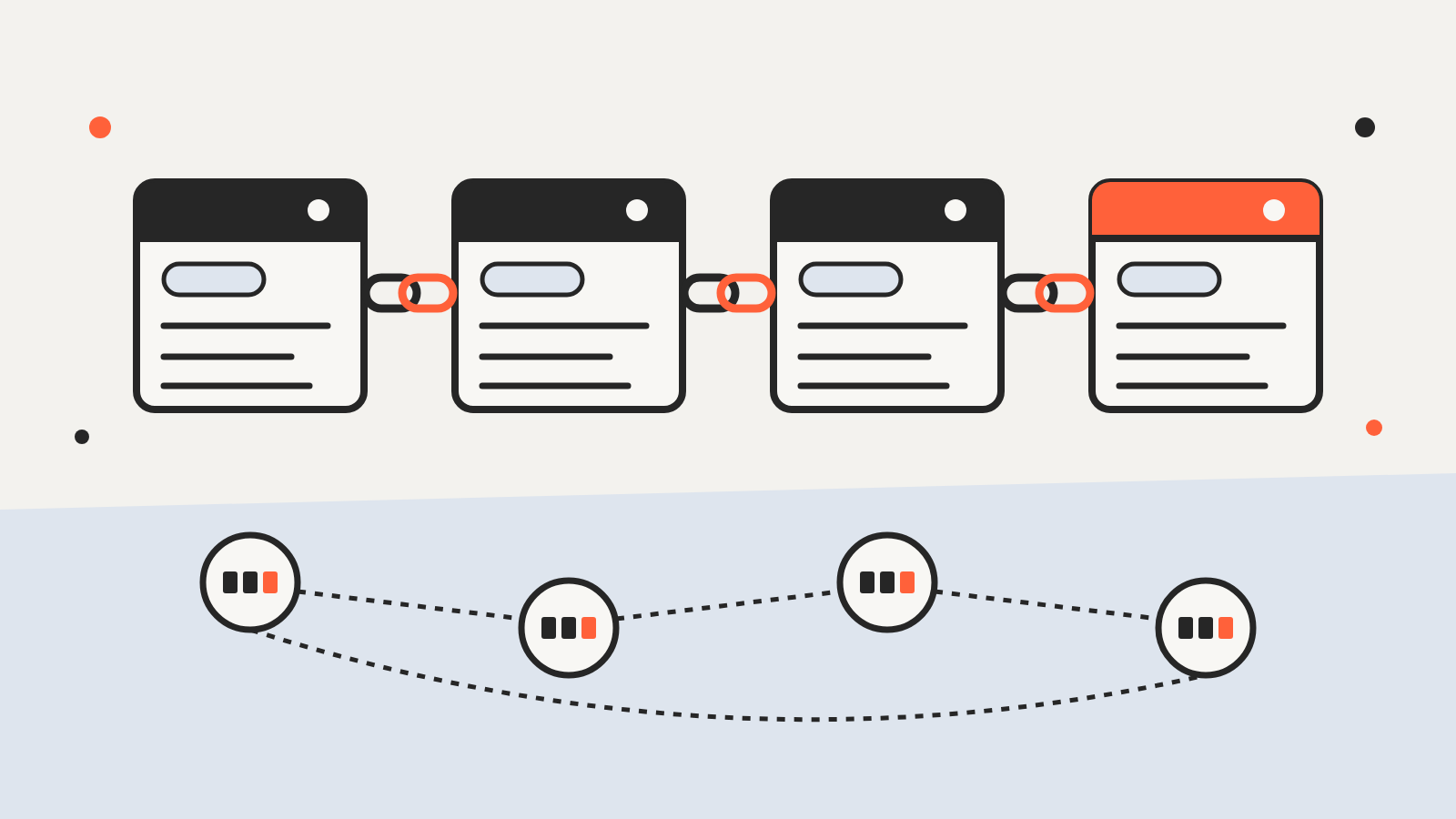
A blockchain is a shared digital ledger that many computers keep copies of, where records are grouped into blocks and each block is cryptographically linked to the one before it. NIST describes blockchains as tamper-evident and tamper-resistant ledgers that run in a distributed way, usually without a central authority such as a bank, company or government.
Quick answer A blockchain is a list of records that nobody can quietly rewrite. New transactions are bundled into blocks, each block carries a fingerprint of the previous one, and many independent computers keep copies and agree on which block comes next. Changing an old record would break every link after it, which the rest of the network would notice and reject. Bitcoin and Ethereum are the best-known blockchains.
The problem a blockchain solves
Digital money has an obvious weakness: a file can be copied. If you could send the same digital coin to two people, the coin would be worthless. Banks and payment companies solve this by keeping the one official record and checking every payment against it.
The Bitcoin white paper, published in 2008 under the name Satoshi Nakamoto, calls this the double-spending problem and sets out to solve it without a trusted middleman. Its answer was a public, time-ordered record of every transaction, kept by a peer-to-peer network rather than one institution. That record became known as a blockchain.
How a blockchain works
NIST’s overview breaks a blockchain into a few parts that fit together.
Transactions. Each transaction records what happened, such as a transfer of coins from one address to another. The sender signs it with a private key, so anyone can check that it really came from the owner of that address. That private key is what a crypto wallet stores.
Blocks. Transactions are grouped into blocks. Each block has a header with information about the block and a body holding the transactions.
The chain. Every block header except the very first contains a cryptographic hash of the previous block’s header. A hash is a short fingerprint of data: change even one character of the input and the fingerprint changes completely. Ethereum’s developer documentation spells out the consequence. Because each block holds the hash of the one before it, changing data in any block would change its hash and invalidate every block that came after it.
Copies everywhere. The ledger isn’t stored in one place. Independent computers called nodes each keep a full copy, check new blocks against the rules and pass them on. If one copy is altered, it no longer matches the others.
Consensus. Something has to decide who adds the next block and which version of the chain everyone accepts. That’s the job of the consensus mechanism.
Proof of work and proof of stake
The two best-known consensus mechanisms take different routes to the same goal: making it costly to cheat.
| Proof of work | Proof of stake | |
|---|---|---|
| Who adds blocks | Miners who solve a computing puzzle | Validators chosen to propose blocks |
| What they put at risk | Electricity and hardware | Coins they have locked up as stake |
| Example | Bitcoin | Ethereum |
| How a fork is settled | The chain with the most work wins | The chain backed by the most stake wins |
In proof of work, described in the Bitcoin white paper, miners race to find a value that gives the block a hash meeting a difficulty target. Finding it takes a lot of computing; checking it takes almost none. The network treats the longest chain, the one with the most work behind it, as the true record. The white paper says the system stays secure as long as honest nodes control more computing power than any group of attackers.
In proof of stake, which Ethereum uses, validators lock up coins as a deposit. Ethereum’s documentation says a new block is produced every 12 seconds, a validator needs 32 ETH to take part, and one validator is chosen at random to propose each block. If the chain splits, Ethereum’s fork-choice rule picks the version backed by the most staked ETH. Validators that break the rules can lose part of their deposit, which is covered in our guide to staking in crypto.
Why a blockchain is hard to change
Put the pieces together and you get the tamper resistance NIST describes. To rewrite an old transaction, an attacker would have to recompute that block and every block after it, and then convince the rest of the network to accept the altered chain over the honest one. Under proof of work, that means outspending the honest miners’ computing power. Under proof of stake, it means controlling a large share of the staked coins. As more blocks pile up on top of a transaction, reversing it gets harder.
This is also why the ledger is called tamper-evident. Even a small change shows up, because the hashes stop matching.
Public and private blockchains
NIST divides blockchains into two broad groups. In a permissionless blockchain, such as Bitcoin or Ethereum, anyone can read the ledger, send transactions and run a node. In a permissioned blockchain, an organization or group decides who may take part, which allows more control but means participants have to trust whoever runs the network.
What blockchains are used for
Cryptocurrencies are the main use today. Ethereum added programmable smart contracts, which are programs stored on the blockchain that run when certain conditions are met. Tokens such as stablecoins also live on blockchains, and the same token can exist on several networks at once.
Limits and misconceptions
NIST’s overview is blunt that blockchain is not magic and will not solve every problem. A few limits are worth knowing:
- Immutable does not mean correct. A blockchain faithfully records whatever is submitted, including mistakes and payments made to scammers. Most transactions can’t be reversed.
- Public is not private. On permissionless chains, every transaction is visible. Addresses aren’t names, but they’re not anonymous either.
- Security depends on users. If someone steals your private key or your seed phrase, the blockchain will treat their transactions as yours.
- Changes are slow. Data can’t simply be edited the way it can in a database. Apps work around this by adding new records that update older ones.