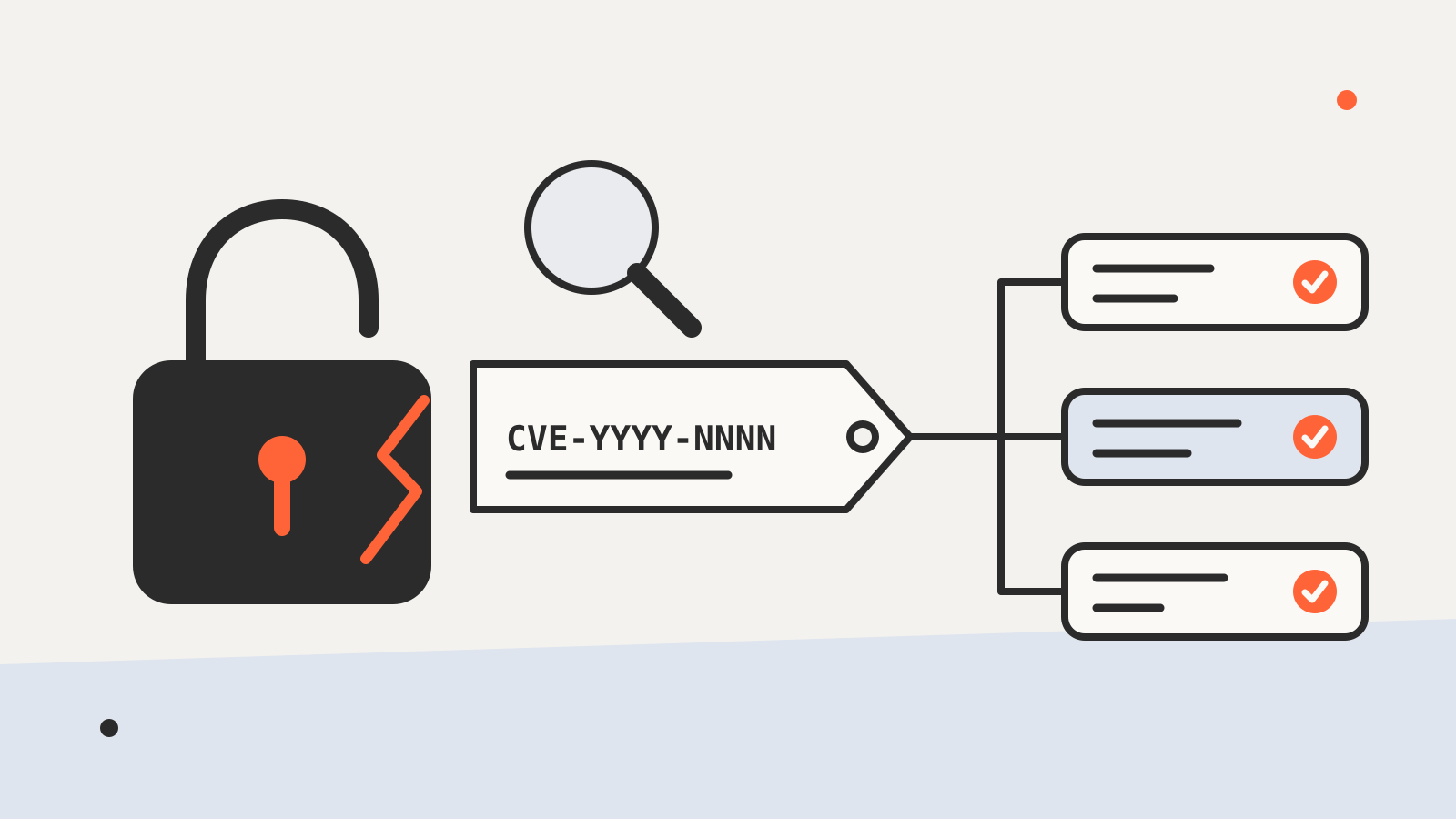
What is a CVE? It is a shared identifier for a publicly disclosed security vulnerability. When a software vendor says an update fixes CVE-2026-123706, any administrator, scanner or patch tool can look up the same flaw by that number instead of guessing from a product name or a nickname. That example comes from an advisory Qt published on November 27, 2026, covering an out-of-bounds write in its VectorImage component.
The number is only a label, though, and people often read more into it than it carries. A CVE does not say how dangerous a flaw is, whether anyone is attacking it, or whether a fix exists. This guide explains who issues the numbers, how a record is built, and which other systems supply the missing context.
Quick answer CVE stands for Common Vulnerabilities and Exposures. A CVE ID names one publicly disclosed vulnerability, and a CVE Record holds its basic facts: affected products, versions, type and at least one public reference. Severity scores, exploitation status and fixes come from other sources.
What a CVE ID and a CVE Record are
The CVE Program describes its mission as identifying, defining and cataloging publicly disclosed cybersecurity vulnerabilities, with one CVE Record for each vulnerability. Partner organizations around the world assign the IDs and publish the records, so descriptions stay consistent wherever they are read.
The program’s FAQ is blunt about what this is not: CVE is not a vulnerability database. Its job is correlation, so that two people or two tools can refer to a flaw and know they mean the same one. A scanner report, a vendor bulletin and a patch-management dashboard can all point at the same ID.
An ID begins with the letters CVE, followed by a year and a sequence number, as in the Qt example. Its exact format is defined in the CVE Record Format. The record behind it is structured data written by the organization that assigned the ID. According to the program’s process page, a record is published once it has the minimum required elements: the affected products, the affected or fixed versions, the vulnerability type, root cause or impact, and at least one public reference.
How a flaw gets its number
The CVE Program lays out a short lifecycle: someone discovers a flaw and reports it to a program partner, the partner assigns a CVE ID, and the ID is reserved. A reserved ID means stakeholders are using it for early coordination while the partner is not yet ready to disclose the flaw publicly. When the required details are in place, the responsible partner publishes the record.
The partners that do this are CVE Numbering Authorities, or CNAs. The program’s glossary defines a CNA as an authorized entity with a specific scope, such as a vendor’s own products, that regularly assigns IDs and publishes records. A CNA of Last Resort covers vulnerabilities outside every other CNA’s scope. The FAQ adds that an ID may be requested for any vulnerability.
A record can be in one of three states: Reserved, Published or Rejected. A rejected record stays on the CVE List so that anyone who sees the old ID knows it is invalid.
Not every advisory carries a CVE. The release notes for Incus 7.7, published on November 27, 2026, list some of the 46 security fixes by CVE number and others only by GitHub advisory ID.
What a CVE does not tell you
Most of what readers want to know comes from systems built around the CVE List.
| Question | Where it comes from | What it adds |
|---|---|---|
| What is the flaw, and which versions are affected? | The CVE Record | Description, affected products and versions, public references |
| How severe is it? | CVSS, maintained by FIRST | A score from 0.0 to 10.0 and a vector string |
| How is it classified? | NIST’s National Vulnerability Database | CVSS data, weakness types and affected-product lists added to published CVEs |
| Is it being exploited? | CISA’s Known Exploited Vulnerabilities catalog | A list of flaws exploited in the wild |
Severity. The program’s own overview lists “the CVE Program is responsible for assigning vulnerability severity scores” among the myths it corrects. Scores come from the Common Vulnerability Scoring System, which FIRST maintains. Version 4.0 produces a base score from 0.0 to 10.0 based on a flaw’s intrinsic qualities, and consumers can refine it with threat and environmental metrics for their own setting. The specification asks anyone publishing a score to include the vector string too, so others can see how it was derived. Qt’s advisory shows both: a CVSS 4.0 score of 1.7, rated low, with its vector. The same document says factors such as regulatory requirements or the number of customers affected are outside CVSS, so a score is an input to prioritizing, not the decision.
Enrichment. The National Vulnerability Database adds impact metrics, weakness types and applicability statements to CVEs once they are published. It says it does not test vulnerabilities itself and relies on vendors and researchers for the underlying information, and that its assessments can change as more becomes known.
Exploitation. CISA’s Known Exploited Vulnerabilities catalog is described as the authoritative source of vulnerabilities exploited in the wild, and CISA says organizations should use it as an input to their prioritization. Each entry shows the CVE ID, the date it was added and a due date. A flaw with a high score that is absent from the catalog and one with a modest score that is listed pose different problems, which is why no single number settles it.
Reading an advisory with a CVE in it
A few checks make an advisory easier to act on:
- Find the ID and confirm the product. The same ID should appear in the vendor’s notice and in your scanner’s report.
- Compare versions. Look at the affected range and the fixed version, then at what you run.
- Read the vector, not just the score. It tells you whether an attacker needs local access, a user action or special conditions. In the Qt case, the impact is limited to certain embedded devices.
- Check exploitation. See whether CISA’s catalog lists the ID.
- Look for mitigations. Advisories often name a workaround when an update cannot be installed right away.
For what happens when a flaw is attacked before a fix exists, see our guide to zero-day vulnerabilities, and for a worked case, the Chrome zero-day fixed in Chrome 157.