Edge computing means running computing and storage close to where data is produced or used, instead of sending every request to a distant data center. The “edge” can be a sensor with its own processor, a small server in a factory, or a server rack inside a mobile operator’s network. What these places share is distance: they are nearer to the device than a central cloud region.
The term is used loosely, so it helps to start with the definitions that standards bodies actually wrote down.
What standards bodies mean by “the edge”
NIST’s definition of cloud computing (SP 800-145, 2011) describes the cloud as on-demand network access to a shared pool of configurable computing resources, such as networks, servers, storage, applications and services. That pool usually sits in large data centers. Every request has to travel there and back.
In 2018, NIST published the Fog Computing Conceptual Model (SP 500-325) because, in its words, no consensus existed on the difference between fog computing, mist computing, cloudlets and edge computing. Its annex gives a narrow definition: edge computing is the network layer made up of the end devices and their users, providing for example local computing on a sensor, a meter or another network-accessible device. NIST notes that this layer is often called the IoT network.
Telecom standards put the edge somewhere else. ETSI, the European standards body, runs a group on Multi-access Edge Computing (MEC) that offers application developers cloud-computing capabilities “at the edge of the network,” inside or next to the operator’s radio access network. ETSI’s own MEC FAQ says the goal is to bring edge computing as close as possible to users “without it being in the user devices.” So for NIST the edge includes the device itself, and for ETSI MEC the edge stops just short of it.
Both views are in common use. When a product page says “edge,” check which one it means.
Edge, fog and mist
NIST’s model adds two more layers between the device and the cloud:
- Fog is a layer of fog nodes, physical or virtual, between smart end devices and centralized cloud services. A fog node can be a gateway, switch, router or server, or a virtual machine. Fog nodes give nearby devices local computing resources and, when needed, a connection onward to the cloud.
- Mist is a lightweight form of fog that sits at the very edge of the network fabric. It uses microcomputers and microcontrollers that feed data into fog nodes.
NIST says fog computing is often confused with edge computing and lists the differences. Fog is hierarchical and can be reconfigured for different applications. Edge computing, in NIST’s description, runs specific applications in a fixed logical location and tends to be limited to a small number of peripheral devices.
Outside standards documents, most companies use “edge computing” as the umbrella term for all of these layers. That is how the term is used in the rest of this guide.
Why move work closer to the device
The main reason is the round trip. NIST lists “contextual location awareness, and low latency” first among the essential characteristics of fog computing. Because fog nodes are often placed with the devices they serve, NIST says analysis and response to device data is much quicker than from a centralized cloud service or data center. NIST also says fog applications involve real-time interactions rather than batch processing.
The second reason is independence. Among the attributes NIST lists for fog nodes is autonomy: they can operate independently and make local decisions. A factory controller that has to stop a machine should not wait for a reply from another region, and it should keep working if the internet link drops.
Vendor documentation describes the same goals. Amazon says its AWS IoT Greengrass software lets devices act locally on the data they generate, run machine-learning predictions, filter and aggregate data, and react autonomously to local events, while still exporting data to the cloud.
A third reason is where data is allowed to live. Amazon lists meeting state and local data residency requirements as one reason to use AWS Local Zones, which place compute and storage close to large population and industry centers.
Edge computing in mobile networks
Mobile operators have their own edge. ETSI set up its MEC group in September 2014, according to an ETSI white paper. The FAQ says MEC first stood for Mobile Edge Computing and was renamed Multi-access Edge Computing from 2017 to cover Wi-Fi and fixed access networks as well. ETSI says the MEC environment offers ultra-low latency, high bandwidth and real-time access to radio network information that applications can use.
3GPP, the group that writes the 5G standards, builds edge support into the network itself. Its edge computing overview says early support appeared in Release 15, and normative work to enhance the 5G core for edge computing started in Release 17. That work produced specifications such as TS 23.548, “5G System Enhancements for Edge Computing,” which covers how the network routes an app’s traffic to a local server and how a phone app discovers the nearest edge application server.
Cloud providers sell this kind of placement too. AWS Wavelength puts standard AWS compute and storage at the edge of telecom operators’ networks, for applications that need low latency to mobile devices.
Edge computing vs. cloud computing
Edge computing does not replace the cloud. In NIST’s model, fog nodes connect devices to centralized services “when needed,” and the AWS products above all connect back to a parent cloud region. A typical split looks like this:
- The edge handles what is urgent or local: reading sensors, filtering noise, making a fast decision, keeping a site running offline.
- The cloud handles what benefits from scale: long-term storage, training models on data from many sites, dashboards and fleet management.
The trade-off is operational. Every edge site is another computer to secure, update and monitor, often in a place with no IT staff. Data processed at many sites also has to be reconciled later. NIST’s list of fog node attributes includes manageability, meaning nodes are managed and orchestrated by systems that automate routine operations, which is a hint at how much management a large edge deployment needs.
If you want the consumer version of this question, our guide to on-device vs. cloud processing covers phones and laptops. For what goes wrong when everything depends on one central location, see what happens when a cloud region goes offline.
Common examples
ETSI lists MEC use cases including the Internet of Things, connected vehicles, drones, gaming, video analytics, location services and augmented reality. NIST’s own example is delivering streaming services to moving vehicles through access points placed along highways and tracks. Amazon’s Local Zones page names real-time gaming, live streaming, AR/VR and virtual workstations.
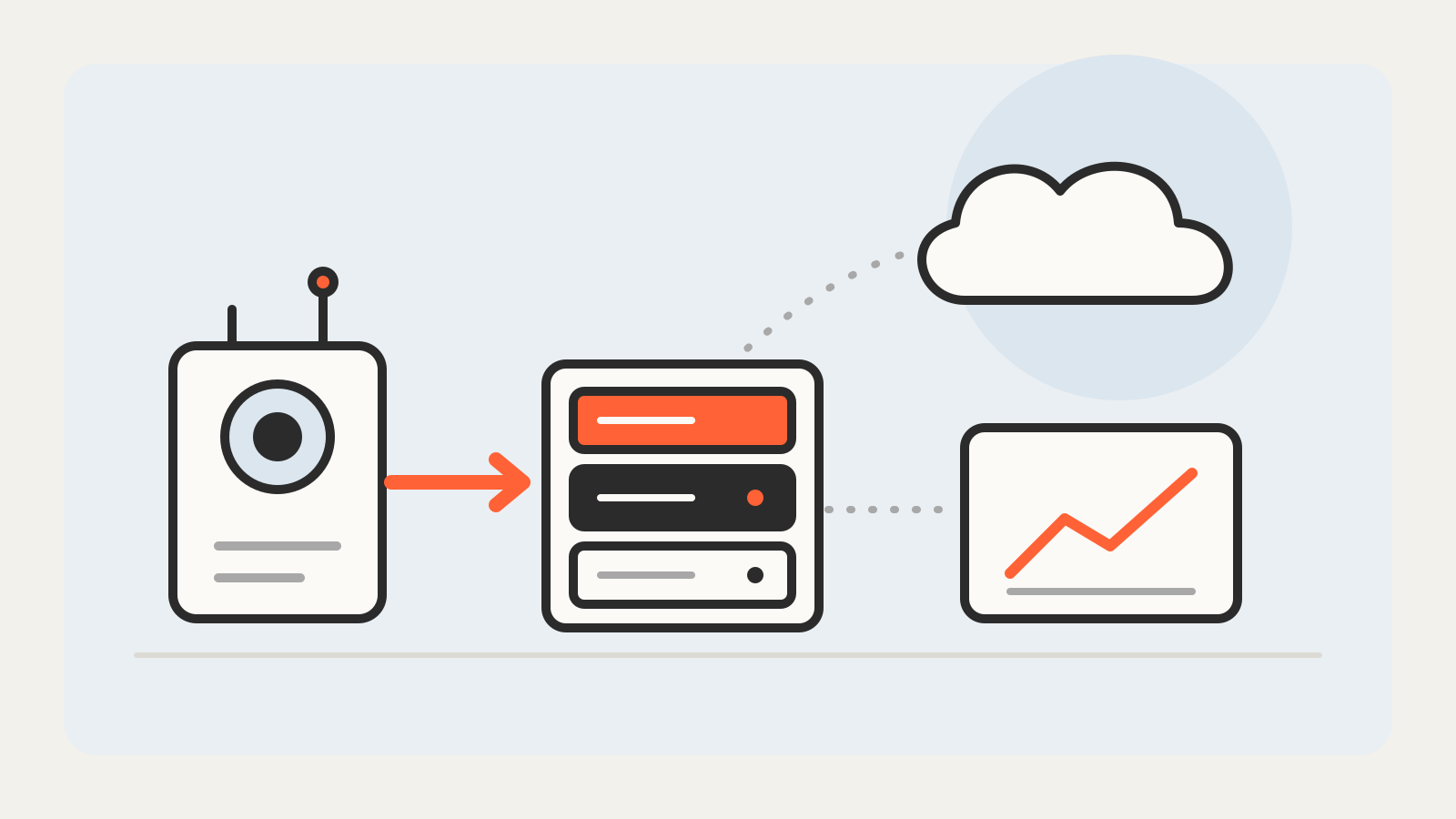
Video analytics shows the logic well. A camera that streams everything to a data center uses a lot of bandwidth. A nearby edge server can analyze the video locally and send only events or summaries to the cloud.