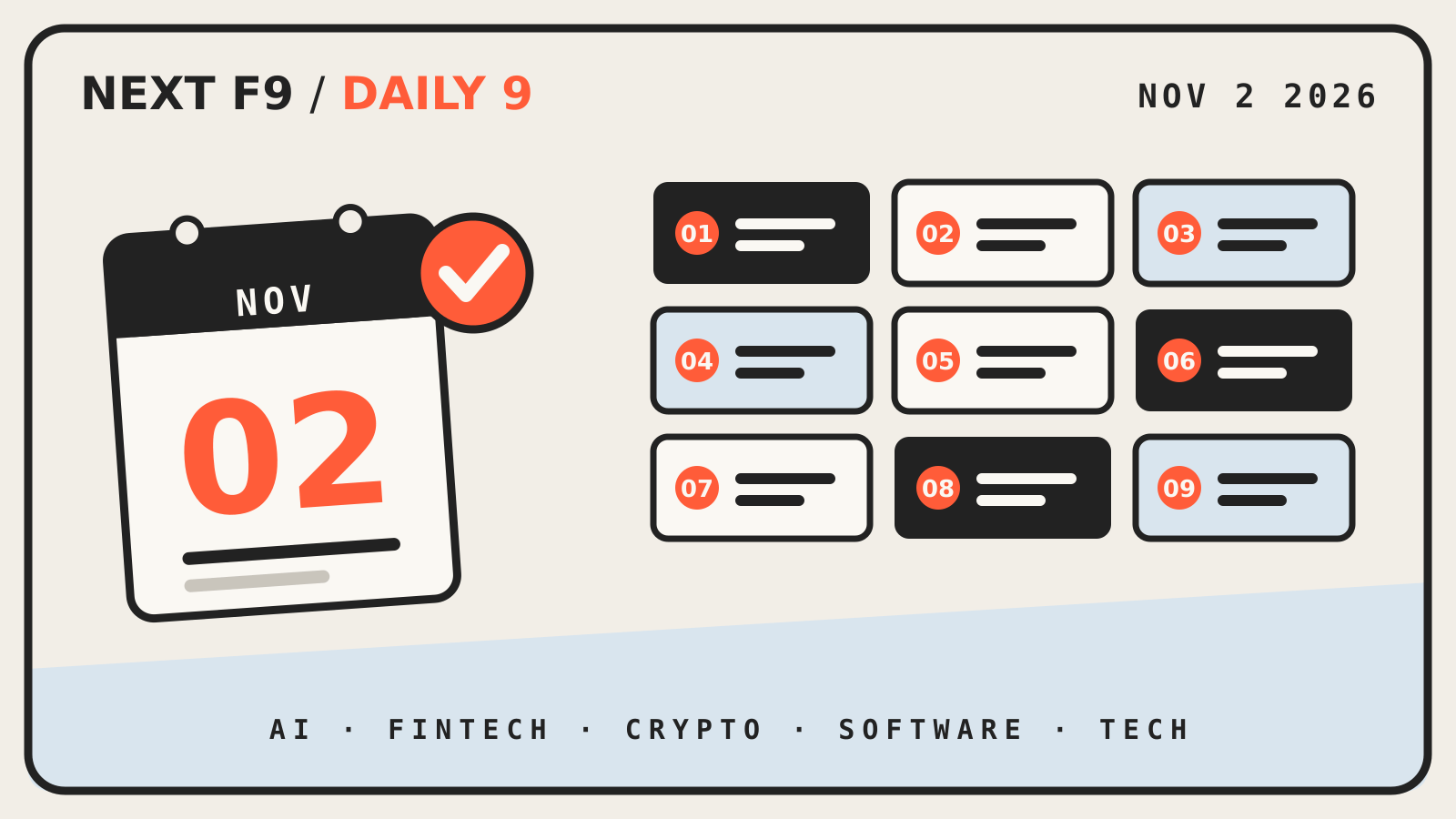
Daily 9 for November 2, 2026 brings together nine verified developments announced between October 28 and November 1 across AI, fintech, crypto, software and tech. The weekend was quiet, so a few items are older than 48 hours and carry their exact dates. Each item links to the original company, agency or project source.
1. The FBI attributes the Binance theft to North Korea
The FBI said North Korea was responsible for the theft of more than $6 billion in virtual assets from Binance on or about October 29. It calls the activity “TraderTraitor” and, with the Secret Service and IRS Criminal Investigation, says the actors are converting stolen assets mainly into Ethereum. The agencies expect further laundering through DeFi and instant swap services and ask node operators, exchanges, DeFi services and analytics firms to block transactions linked to a published address list. FBI alert, October 31. For the exchange’s own account, see our November 1 edition.
2. Trezor warns buyers of a reseller’s devices about a suspected implant
Trezor said it received a responsible-disclosure report on October 28 about a Safe 5 bought in August from CryptoBilis, a former official reseller in Southeast Asia. The report describes an extra board with a cellular module that could read the screen, including the wallet backup. Trezor has not yet examined the device but treats the report as credible, and says no losses have been reported. It advises anyone who bought a Trezor from CryptoBilis since March 2026 to move funds to a new wallet with a new seed. Trezor notice, October 30. Background: what a hardware wallet does.
3. Gitea 28.3.0 ships a batch of token-scope security fixes
Gitea released 28.3.0, the third maintenance release of the 28 series, and urges all users to upgrade. Most of the security fixes concern token scopes, including cases where a public-only token could reach private data or admin routes. One fix closes an account-linking flaw: with automatic linking and open registration, a user signing in through an OAuth2 provider could be linked to an existing account by typing its user name or email. The release binaries are also built with a newer Go version that stops trusting a set of intermediate certificates. Gitea release notes, November 1.
4. OpenAI plans one shared usage allowance for ChatGPT and Codex
OpenAI’s Help Center says that starting in December, Plus, Pro and Business plans will share one usage allowance across ChatGPT and Codex, as Work’s agentic capabilities move into the main ChatGPT experience. Usage will be measured in tokens, so advanced models and complex tasks use more, while Instant chat will not draw from it. Combined usage and reset times will appear under Settings, then Usage. At the limit, users can wait, upgrade or buy credits. OpenAI Help Center, updated November 1. For data controls on the same product, see our ChatGPT privacy page.
5. DeepSeek publishes a prototype coding agent that waits for requests
DeepSeek’s Harness team put dsh-superagent on GitHub on October 31 under the MIT license. The repository calls it a research prototype for reference only and not an official DeepSeek product. It is a coding agent for one GitHub repository, optionally also listening to Feishu. When an allowed person asks, it opens a work item in its own session and answers in the original thread, for example with a pull request. Proactive work starts in an observe-only mode that records what the agent would have done. dsh-superagent-prototype on GitHub, October 31.
6. Apple sets dates for Apple Intelligence in China, with Qwen for some requests
Apple said the first Apple Intelligence features for China open for testing on November 4 in the latest iOS developer beta, with the public release coming in December with iOS 27.3. Through a partnership with Alibaba, Siri, Writing Tools and Visual Intelligence can use Qwen for some requests, after users sign in to a Qwen account or with Sign in with Apple. The update excludes Siri AI and the other next-generation features shown at WWDC 2026, and starts on iPhone only. Apple newsroom (China), October 31.
7. Microsoft maps how North Korean groups use AI in their operations
Microsoft Threat Intelligence rates overall AI adoption by North Korean threat actors as high. It places Jade Sleet, Coral Sleet and Jasper Sleet at the stage where AI is part of routine workflows. Examples include Jade Sleet launching campaigns through three front companies in one week and Onyx Sleet producing more than 100 tailored PDF lures in August and September. Onyx Sleet and Pearl Sleet have used the open-source ARTEX penetration-testing framework since late October. Microsoft says the operations remain human-directed. Microsoft Security Blog, October 29.
8. Adyen starts routing UK payments through Visa Payment Passkey
Adyen announced it is rolling out Visa Payment Passkey through Authenticate, a module of its Uplift suite. Once a cardholder’s bank has verified them and they have created a passkey, they can approve eligible future online purchases by unlocking their device with a fingerprint or face scan. Adyen says Visa never collects or receives the biometric data. The UK comes first, with global expansion planned for 2027. Adyen announcement, October 29. New to the idea? Start with what a passkey is.
9. GitHub makes Copilot cloud sessions generally available on paid plans
GitHub said the connected Copilot cloud experience and cloud sandboxes are generally available on paid plans. A session can start on github.com, GitHub Mobile, the CLI, the Copilot app, VS Code, Slack or Microsoft Teams and continue elsewhere. Each session runs in a sandbox that saves a snapshot when it shuts down, and sandbox compute now draws on the included Actions entitlement, which becomes one dollar-based pool. A separate public preview adds connect-once connectors for 26 services. GitHub changelog, October 28.