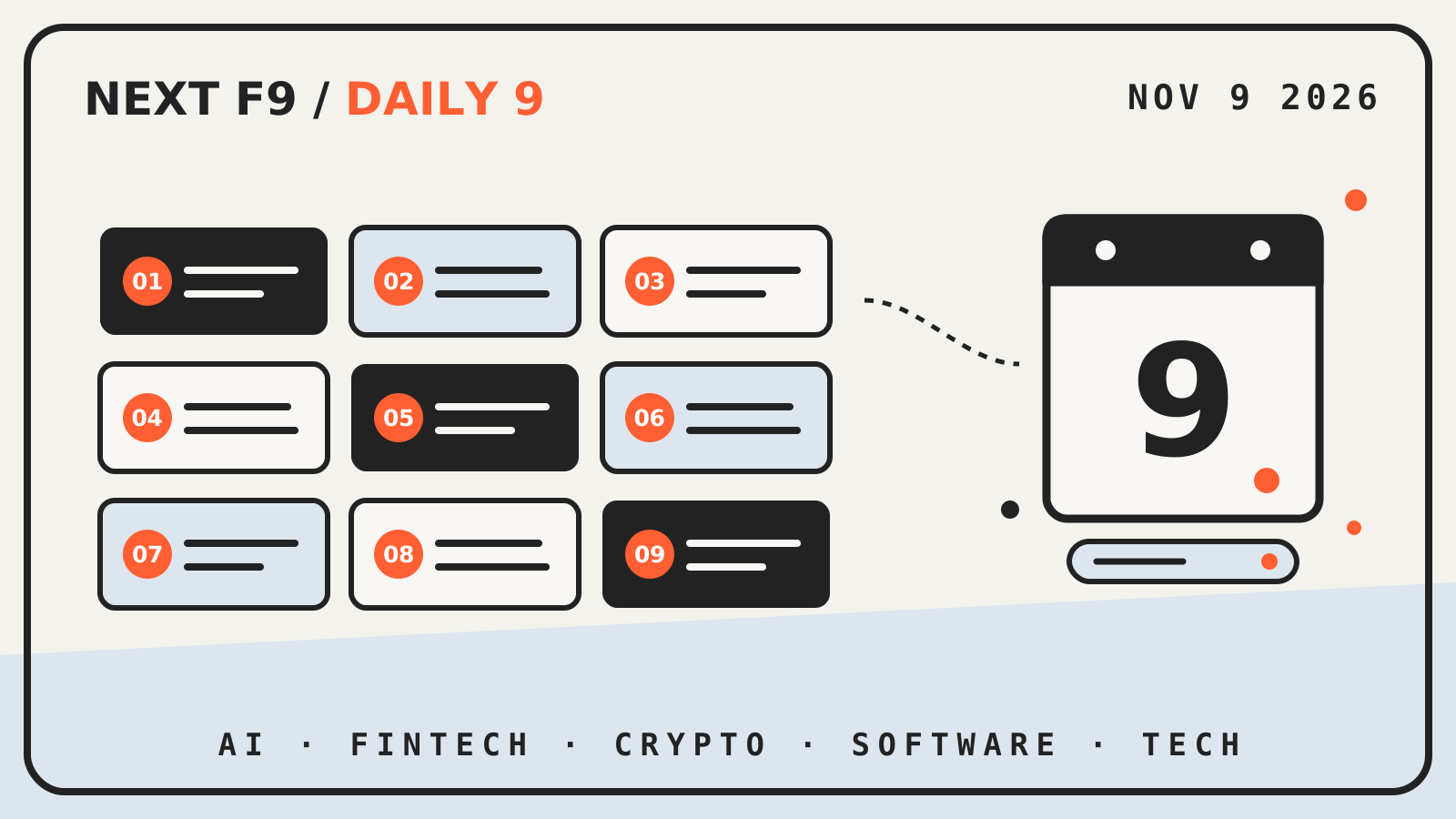
Daily 9 for November 9, 2026 covers nine developments across AI, fintech, crypto, software and tech, announced between November 4 and November 7. xAI now watermarks Grok API text by default, the US Treasury moved to cut MEXC Global off from the American financial system, and Algorand’s foundation shut down most of its community programmes.
Each item links to the company, project or organization that published it.
1. Meta adds Active Memory and Active Focus to Muse and Meta AI
Meta says new specialized models, trained with its Muse Wonder model, are coming to the Muse app and Meta AI. The update has two parts. Active Memory is meant to keep track of what a user said earlier in long conversations, and Meta reports a 2.4x reduction in forgetting critical information, with an Active Memory evaluation score of 90% against 76% before. Active Focus is aimed at multi-step tasks, and Meta reports a 67% improvement in completing everyday tasks when something unexpected goes wrong. Meta did not name the models or say how fast the rollout will go. Meta, November 6.
2. xAI turns on invisible watermarks for Grok API text
From November 7, 2026, xAI adds an invisible statistical watermark to text generated through its API, by default. The documentation lists seven models: grok-4.7, grok-4.6, grok-4.5, grok-4.3 and the reasoning, non-reasoning and multi-agent versions of grok-4.20. The watermark covers all endpoints, both the Responses and Chat Completions APIs, structured outputs and tool-call arguments. Developers can see whether a response was watermarked in the x-watermark header, and team admins can opt out per model. xAI gives the EU AI Act as the reason. Detection is statistical, and the detection API is available on request. xAI documentation, November 7.
3. Claude in Microsoft Copilot moves into the EU Data Boundary
Microsoft says Anthropic’s Claude models in Microsoft Copilot will be processed inside the EU Data Boundary by the end of 2026. The change applies to customers in the EU and EFTA, Copilot Cowork included. Claude stays off by default for those customers, and organizations that already use it do not need to do anything: processing moves automatically. Microsoft repeats that customer data is not used to train foundation models. The post is signed by Charles Lamanna. Microsoft, November 5.
4. FCA sets up a quantum group for financial crime
The UK Financial Conduct Authority is forming a Quantum Experimentation Group to test quantum machine learning against money laundering and fraud. The group starts in the first quarter of 2027 and works with a synthetic dataset built by the FCA. UK firms, quantum providers and research labs can send expressions of interest until December 31, 2026. The FCA calls it the first regulator-led group of its kind, and says taking part is not an endorsement of any firm or technology. FCA, November 5, with the group’s page.
5. MobiKwik’s lending arm gets its RBI licence
MobiKwik Financial Services, a subsidiary of the Indian payments company MobiKwik, received its certificate of registration as a non-banking financial company from the Reserve Bank of India. The certificate was issued on November 5 and received on November 6, after in-principle approval in April 2026. MobiKwik plans INR 5,000 crore of secured and unsecured loans to consumers and small businesses over three to four years. It will start with an asset-light co-lending model within three to six months. Disbursals through its 11 lending partners grew 34% to INR 1,083 crore in the second quarter of FY27. MobiKwik filing to NSE, November 6.
6. Treasury moves to cut MEXC Global off from US banks
The US Treasury’s Financial Crimes Enforcement Network issued an order against the crypto exchange MEXC Global under section 9714(a) of the Combating Russian Money Laundering Act. US financial institutions will be barred from any transmittal of funds to or from MEXC Global, starting 30 days after the order appears in the Federal Register. FinCEN says at least $16 billion in illicit funds moved through MEXC Global between May 2021 and May 2026. It links nearly $1.5 billion to Russian sanctions evasion and about $1 billion to more than 40 Iranian exchangers. US Treasury, November 6.
7. Algorand winds down its community programmes
The Algorand Foundation published a community update that closes most of its governance and grant programmes. xGov grants pause indefinitely from December 6. The community forum closed on November 6 and will be kept as a read-only archive. The Ecosystem Advisory Council ended the same day, and the foundation stops sponsoring the Algorand Technical Council. Staking rewards stay committed through January 2028. Project King Safety is paused, so there is no lift of the supply cap, no MEV capture and no higher minimum fee. The foundation says its focus is now post-quantum security. Algorand Foundation, November 6.
8. Playwright 1.65 runs tests under Bun
Microsoft released Playwright 1.65, and its test runner now works under Bun with bunx --bun playwright test. The project’s CI tests Bun 1.4.3 on Linux. Watch mode does not work under Bun yet, and the --tsconfig option is ignored. The release adds a “failures” reporter, an onlyFailures option and a “-exclusive-” lock for tests that cannot run in parallel. Several changes can break existing suites: useDefineForClassFields is now respected, actions wait for elements to stop being inert, cookie matching follows RFC 6265, and proxy credentials are no longer sent to websites. Playwright on GitHub, November 5.
9. Quantum Motion builds a superinductor from a standard chip process
Quantum Motion reported an IC-native superinductor in Nature Electronics. It is made from the titanium nitride film already present in GlobalFoundries’ 22nm FDSOI process, so no extra fabrication step is needed. The company’s readout circuit, an rfSET, takes 18 square micrometres, which it says is more than four orders of magnitude smaller than a spiral inductor. It reached a signal-to-noise ratio of 4,500 in 4 nanoseconds and a minimum integration time of 1 ± 0.3 picoseconds, against 625 picoseconds before. The next goal is spin-qubit readout well under a microsecond. Quantum Motion, November 4, with the paper. Background: how quantum computing works.