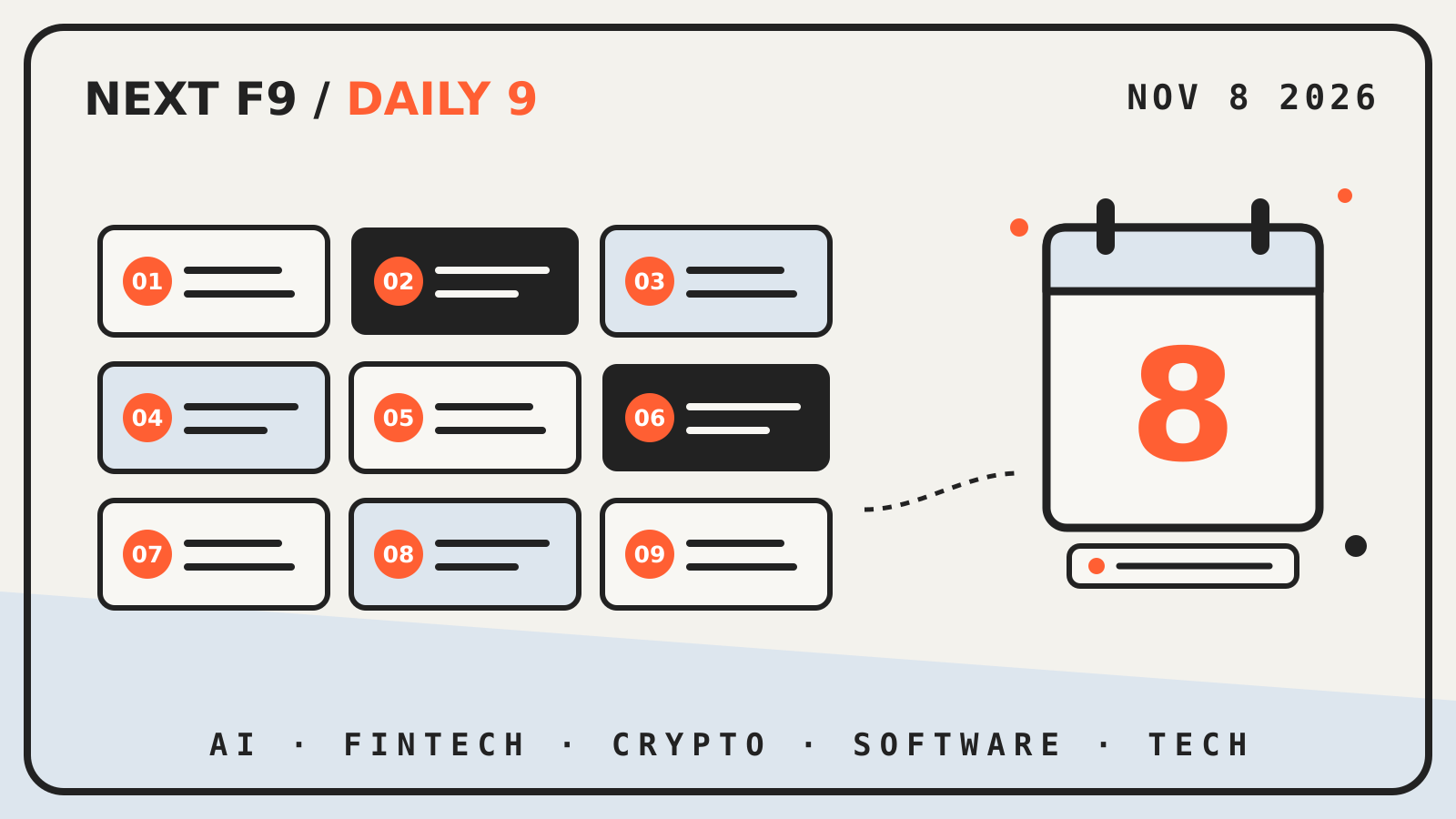
Daily 9 for November 8, 2026 covers nine developments across AI, fintech, crypto, software and tech, announced on November 5 and November 6. AI labs now have a shared scale for rating cyber jailbreaks, Nigeria’s central bank has published its rulebook for stablecoins, and two UK quantum programmes moved from plans to signed contracts.
Each item links to the company, project or organization that published it.
1. Frontier Model Forum proposes a scale for cyber jailbreaks
The Frontier Model Forum released version 1.0 of its Jailbreak Rating Framework for Frontier Cyber Threats. The framework rates a single successful jailbreak on four dimensions: capability gain, capability scope, ease of deployment and ease of discovery. The first two add up to a severity score and the last two to a likelihood score, and the pair maps to one of five bands from Negligible to Critical. Capability gain acts as a gate: a jailbreak that unlocks nothing new is rated Negligible and scoring stops there. The band does not prescribe a response, which stays with each company. Comments are open until December 21, 2026. Frontier Model Forum, November 5, with the full framework.
2. OpenAI and Ligo test agents on raw wet-lab data
OpenAI introduced BioBasicsBench, a benchmark built with the enzyme-design company Ligo. Its 100 tasks come from Ligo scientists’ own experiments and cover protein methods, imaging and cytometry, quantification and assays, nucleic acid methods and molecular cloning. Agents get raw evidence such as gel images, colony plates and instrument readouts, and they earn credit for catching errors and for saying when the evidence cannot support a conclusion. OpenAI tested only its own models, across 37 model and reasoning-effort settings. At the highest effort setting, GPT-6 Astra scored a mean reward of 66.7%. The tasks themselves are not public. OpenAI, November 6.
3. Cashfree opens its hosted checkout to browser agents
Cashfree Payments, an Indian payment aggregator, made its Hosted Checkout agent-ready with WebMCP, a proposed web standard that lets a page publish named tools for AI agents in the browser. Agents can read the order summary, list payment methods, open one and show a UPI QR code, then check the payment status. The user still scans the QR code and approves with a UPI PIN, and the tools never accept card numbers, CVV or one-time passwords. Support is on by default in redirect mode, and popup and inline checkouts are not covered yet. Agents need a Chromium-based browser with WebMCP, such as Chrome 149 or later. Cashfree, November 6.
4. Nigeria’s central bank publishes its stablecoin rulebook
The Central Bank of Nigeria published its Regulations for the Operations of Non-Security Virtual Assets in Nigeria. The rules cover naira-referenced stablecoins, foreign-currency stablecoins, deposit money tokens and the firms that issue, hold, exchange and move them. A naira stablecoin issuer needs paid-up capital of ten billion naira and a foreign-currency issuer fifteen billion; other service providers need one billion. Holders get a right to redeem at par, and issuers may not pay interest or yield. Algorithmic stablecoins without full reserve backing are not allowed. Securities-type tokens stay with Nigeria’s SEC. Central Bank of Nigeria, November 6. Background: what a digital wallet is.
5. Akash takes its first step toward Solana
Akash Network, a marketplace for cloud computing, upgraded its mainnet to v2.2.0 at block 29,399,482 on November 6. It is the first implementation step after Akash governance passed a proposal to migrate the protocol to Solana. The upgrade installs a one-way “sink” module for moving AKT to Solana, but the module ships switched off and needs a separate vote to turn on. It also updates the contract that checks Pyth price data and closes escrow payments left open after their leases ended, without touching balances. Akash Network, November 6.
6. Qt fixes a credential leak in QWebSocket
Qt published CVE-2026-114366, an information disclosure flaw in how QWebSocket in the Qt WebSockets module handles authentication. It can leak credentials, but Qt rates it Low, with a CVSS 4.0 score of 2.3. Affected versions run from Qt 6.6.0 to 6.8.9, from 6.9.0 to 6.11.2, and 6.12.0. The fix is in Qt 6.8.10, 6.11.3 and 6.12.1, and patches are available for older branches. Until then, Qt’s advice is not to reuse one QWebSocket instance for several connections. Qt, November 6.
7. Wazuh 4.14.9 patches a crash in its analysis engine
Wazuh published several advisories fixed in version 4.14.9 of its open source security platform. One, rated High with a CVSS 4.0 score of 8.7, lets repeated fields in JSON events leak memory in wazuh-analysisd until the process is killed. When that happens, the manager stops decoding events and raising alerts. According to the advisory, an outside host could get an agent identity through passwordless enrollment in the official single-node Docker setup and send those events. Two advisories rated Moderate cover an out-of-bounds write in wazuh-execd and missing hostname checks in the fluent-forward module. Wazuh, November 6.
8. UK national quantum centre licenses Phasecraft software
The UK’s National Quantum Computing Centre signed an enterprise licence with Phasecraft, a quantum algorithms company. It is the first time the NQCC offers quantum software, rather than hardware time, through its SparQ Access programme. UK businesses, researchers and public bodies can apply to use three Phasecraft tools: Magritte for materials and molecular modelling, Monet for quantum-enhanced density functional theory and Mondrian for optimisation. Expressions of interest open in late November 2026, and the first cohort starts in spring 2027. Phasecraft, November 6. Background: how quantum computing works.
9. Toshiba wins a UK contract for quantum networks
Toshiba Europe won a contract from Innovate UK to develop parts for commercial quantum networks: long-distance quantum links and networks that serve many users over existing fibre. The contract comes from Innovate UK’s Enabling Commercial Quantum Networking competition, a combined £20 million investment. Toshiba will build and test prototype subsystems with BT and Colt Technology Services. Toshiba did not say how much of the £20 million its own project receives. Toshiba, November 6.