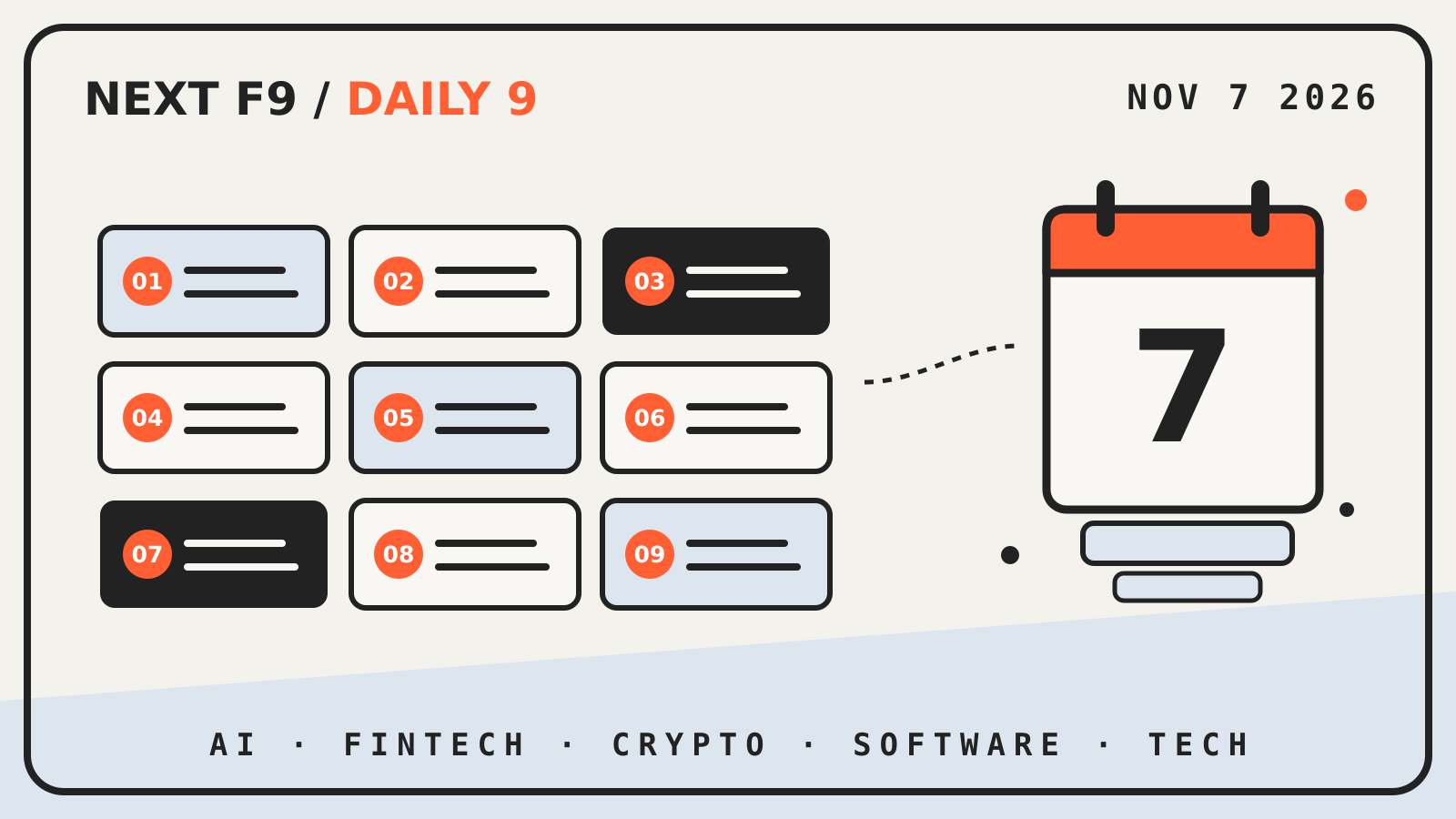
Daily 9 for November 7, 2026 covers nine developments across AI, fintech, crypto, software and tech, announced on November 5 and November 6. Claude can now read a user’s bank accounts, Canada’s instant payment system has a start date, and two security releases need attention: one for OpenSSH on musl-based Linux systems and one for Istio service meshes.
Each item links to the company, project or organization that published it.
1. Claude adds a read-only Personal Finance hub
Anthropic added Personal Finance to Claude, a beta feature that lets users link bank, card, loan and investment accounts through Plaid and ask questions about their own money. It is rolling out gradually to Pro, Max and Ultra subscribers in the US. Access is read-only: Claude cannot move, manage or invest money, and it never sees the bank password. For linked accounts it reads bank and account names, the last four digits, balances, credit limits and up to 24 months of transactions. Anthropic says conversations in the Personal Finance hub are not used to train its models; outside the hub, the user’s normal privacy settings apply. Anthropic, November 5, with details in Claude’s help center. Claude’s wider data terms: is Claude safe?.
2. Google cuts Gemini Omni video prices and allows 15-second clips
Google made Gemini Omni 1.2 Flash generally available on the Gemini API and Google Cloud. The video model now generates and edits clips of up to 15 seconds, up from 10 in Omni 1.1, and users can set the length in one-second steps from 3 seconds. Clips can be edited over several conversational turns instead of being regenerated. Google cut the price by 30% to $0.07 per second of 720p video. The model is also rolling out in Flow, Google Vids, Google Ads and, for Google AI Ultra subscribers, the Gemini app. Google says fast sports action and complex physics still need work. Google, November 5. Background: what C2PA content credentials are.
3. KCB Bank Tanzania puts PayPal inside its mobile app
KCB Bank Tanzania integrated PayPal into the KCB Mobile App and says it is the first bank in the country to do so. Customers can create or link a PayPal account in the app, receive international payments, make eligible payments wherever PayPal is accepted, and withdraw PayPal balances to their KCB accounts in Tanzanian shillings. The bank aims the service at freelancers, small businesses, tourism operators and content creators who are paid from abroad. The release gives no fees or exchange rates for withdrawals. KCB Bank Tanzania, November 6.
4. Canada’s Real-Time Rail gets a launch date: November 9
Payments Canada said the federal Budget 2026 confirms the launch of the Real-Time Rail, Canada’s new instant payment system, on Monday, November 9. Participating members, including financial institutions, credit unions and payment service providers, will be able to exchange, clear and settle payments in seconds, 24/7/365. Onboarding is staged: Payments Canada’s published timeline starts with initial direct participants in the fourth quarter of 2026, moves Interac e-Transfer clearing and settlement over through 2027, and targets more than 9 in 10 Canadian bank accounts by the third quarter of 2027. Neither source names the institutions that go live first. Payments Canada, November 5, with the launch timeline.
5. Base switches to 200-millisecond blocks
Base, the Ethereum layer 2 network incubated by Coinbase, activated its Denim upgrade on mainnet on November 5 at 18:00 UTC. Base now produces five full canonical blocks per second instead of one block every two seconds, and it retired Flashblocks, the preview stream that used to fill the gap. Apps that read Flashblocks must move to standard block subscriptions such as newHeads. Contracts can now read time to the millisecond through BaseTime, and Base’s B20 token standard gets extra transfer checks. A 200ms block is not final on its own: it becomes final when Ethereum finalizes the batch that contains it. Base, November 5, with migration notes in the Base docs.
6. Midnight hard-forks to Ledger 9
The Midnight privacy network upgraded its mainnet from Ledger 8 to Ledger 9 in a hard fork. Its Compact language now supports Keccak-256 and ECDSA natively, the ledger accepts ECDSA as well as Schnorr signatures, and the network implements BIP-44 address derivation, which Midnight says makes it easier for custodians and wallet providers to connect. Contracts can now call other contracts in the same transaction, check which contract called them and publish events. Balances and deployed contracts migrated automatically, but builders must update their apps to Midnight.js 5. Midnight skipped its usual Preprod testing period, saying security fixes required a more controlled release path. Midnight, November 6. Background: what a smart contract is.
7. OpenSSH 10.6p2 blocks a password bypass on musl systems
The OpenSSH team released portable OpenSSH 10.6p2 with what it calls a critical security workaround for Linux systems that use the musl C library with PAM disabled. On those builds, a password authentication bypass could be exploited through sshd. OpenSSH says the root cause lies outside sshd but can be avoided there. Özgün Kültekin of Wakefield reported it. The release also allows the post-quantum hybrid signature scheme ssh-mldsa44-ed25519 as a CA signature algorithm and fixes a short CPU spin when ChannelTimeout is used. Mainstream glibc-based distributions with PAM are not the target, but Alpine-style systems should update and restart sshd. OpenSSH release notes, November 5.
8. Istio fixes mTLS and authorization bypasses
Istio published security bulletin ISTIO-SECURITY-2026-009 for versions 1.30.0 to 1.30.7 and 1.31.0 to 1.31.3. The most severe flaw, rated 8.2, let plaintext traffic reach a port that required mutual TLS in ambient mode when a port-level STRICT policy was skipped. Other fixes cover a case-sensitive host match that could bypass an AuthorizationPolicy, a stale connection-tracking entry that could bypass the sidecar, crashes that any workload with a mesh identity could trigger in istiod, and IP-based DENY rules on ambient waypoints that could fail open. The fixes are in Istio 1.31.4 and 1.30.8. Istio, November 6.
9. IBM switches on a Quantum System Two in Chicago
IBM, the University of Chicago, the State of Illinois and the Illinois Quantum and Microelectronics Park unveiled an IBM Quantum System Two at Hyde Park Labs in Chicago, IBM’s first quantum computer in Illinois. It runs on IBM Quantum Nighthawk, which IBM calls its most powerful quantum chip so far. The system anchors the National Quantum Algorithm Center, where partners such as Deloitte, AbbVie and Northwestern University work on molecular simulation for drug discovery. It will move to the Illinois Quantum and Microelectronics Park once that campus is built. IBM gave no qubit count or performance figures for this installation. IBM, November 6. Background: how quantum computing works.