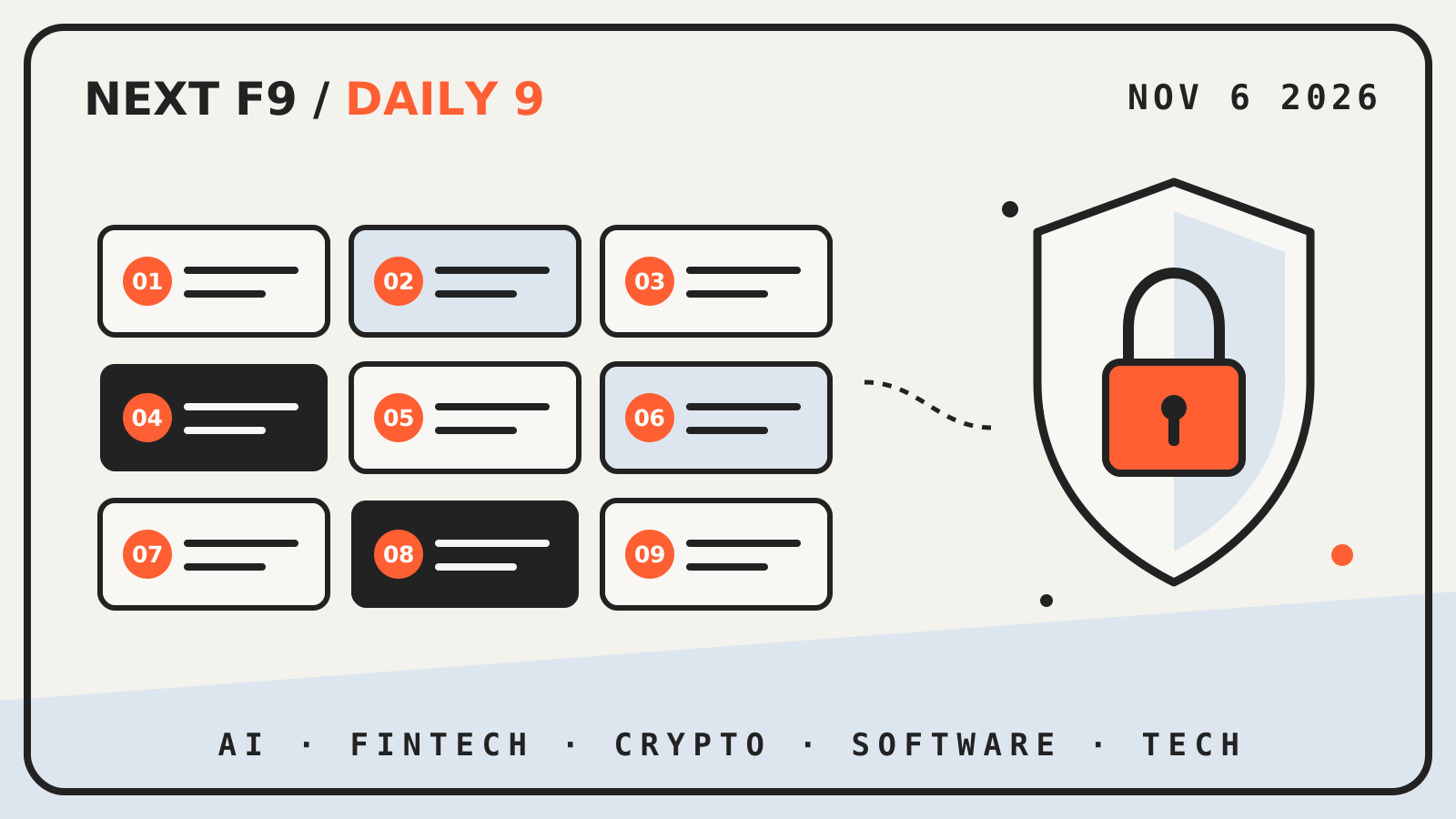
Daily 9 for November 6, 2026 covers nine developments across AI, fintech, crypto, software and tech, all announced on November 5. Three are security stories: a new OpenAI model built for defenders, and fixes for Keycloak and FrankenPHP that administrators should install soon. Two are quantum computing updates, one about hardware and one about the software that will run on it.
Each item links to the company or project that published it.
1. OpenAI releases GPT-6 Cyber for security teams
OpenAI released GPT-6 Cyber, a model for vulnerability research and exploit development, and said it wants to expand Daybreak, its security research program for defenders. OpenAI says the model scored 48.5% on its ExploitGym evaluation, against 32.1% for GPT-5.6 Cyber. Its researchers used GPT-6 Cyber to develop 948 privilege escalation exploits in Linux and to find 81 previously unknown high-severity vulnerabilities in Firefox, and Mozilla has released fixes for many of them. Security teams at Cisco, Calif and CodeRabbit already use the model. All results are OpenAI’s own. OpenAI, November 5. Background: what a large language model is.
2. Dropbox plans to buy Tigris Data and adds an agent to its app
Dropbox announced plans to acquire Tigris Data, which runs S3-compatible object storage, and unveiled DBX Agent Cloud, a storage layer for AI applications and agents. The first piece is object storage that works with tools built for Amazon S3; Dropbox says filesystem access and content processing come next. Inside the Dropbox app, a new agent can summarize folders, compare file versions, edit PDFs and images and transcribe recordings, and it shows a plan for the user to approve before it changes anything. Dropbox says its new AI features have already rolled out to more than 70,000 teams, starting with eligible teams in the US, UK and Australia, and plans a wider rollout in 2027. Dropbox gave no prices. Dropbox, November 5. Background: what happens to files you upload to AI.
3. Iute launches a Wallet payment account in North Macedonia
Iute launched Wallet, a free payment account inside its Myiute app in North Macedonia. The account is run by IutePay, an e-money institution licensed by the National Bank of the Republic of North Macedonia in July 2025. Customers can send and receive domestic bank transfers, withdraw cash from Iute ATMs, pay other Wallet users by phone number and repay loans in the app. IuteCredit loans now pay out straight to the Wallet. Iute says 180 customers opened a Wallet in the first 24 hours and more than 10 million denars went through the new accounts. Iute, November 5.
4. Stripe powers USDC purchases in Samsung Wallet
Stripe said its Crypto Onramp powers USDC purchases in the new Stablecoin Account in Samsung Wallet, which Stripe says is available to eligible users across 82 million Galaxy devices in the US. Users can buy with Samsung Pay, cards or ACH, and Stripe handles identity checks, compliance and fraud screening. Samsung Pay is now also offered to other businesses that use Crypto Onramp. Samsung’s FAQ says Bastion, a licensed money transmitter, provides the custodial wallet and the USDC sits in Coinbase’s institutional custody. The account is not a bank account and has no FDIC, NCUA or SIPC coverage. It requires Android 13 or later and is not available in New York. Stripe, November 5, with details in Samsung’s FAQ. Earlier: Samsung Wallet’s USDC transfers.
5. BitPay adds one-tap crypto buys through MoonPay
BitPay added one-tap crypto purchases to its wallet app through MoonPay, with Apple Pay, Google Pay and cards, plus SEPA bank transfers for users in the EU. The feature runs on iOS and Android in more than 100 countries, including the US and supported EU countries. Checkout comes pre-filled, returning MoonPay users are logged in automatically, and new users go through a one-time identity check. The crypto lands in the user’s self-custody BitPay wallet. The existing comparison of rates across several providers stays in place. BitPay, November 5. Background: what a crypto wallet stores.
6. Keycloak 26.8.2 fixes a SAML signature bypass
Keycloak 26.8.2 fixes CVE-2026-117691, a flaw in the SAML redirect binding. Keycloak accepted percent-encoded parameter names such as %53AMLResponse, while the signature check only looked at the literal names, so an attacker could slip in an unsigned SAML message and log in through a broker as any user. The release also fixes automatic account linking with an unverified identity provider email (CVE-2026-97175), an authentication race condition (CVE-2026-103112), claim injection through CIBA and dynamic client registration, SAML denial-of-service bugs and a Brotli out-of-bounds write (CVE-2026-111497). It moves to Quarkus 3.40.1.1. Read the migration guide before upgrading. Keycloak, November 5.
7. FrankenPHP 1.13.5 fixes 17 vulnerabilities
FrankenPHP, the PHP app server built on Caddy, released version 1.13.5 with fixes for 17 vulnerabilities. The most severe, rated High (GHSA-j99q-3wr8-xj43), let php_server run an uploaded non-PHP file as PHP through a path such as /uploads/photos.php.php/avatar.jpg. Other bugs hit the default php_server setup: an open redirect, HTTP/2 Host spoofing, a crash a client could trigger under the official Docker images’ PHP settings, and slow request bodies that could block every PHP thread. The release bundles Caddy 2.11.9 and Mercure 1.1.6. Most of the bugs were found by Anthropic’s OSS Scanner. Worker mode has a breaking change, so check the notes first. FrankenPHP release notes, November 5.
8. IBM, Oak Ridge and AMD build a quantum codesign platform
IBM, Oak Ridge National Laboratory’s Quantum Science Center and AMD announced a shared platform for working out how quantum and classical computers should run together, including for quantum error correction. The first deployment puts IBM quantum computers, among them the 120-qubit IBM Quantum Nighthawk, next to ORNL’s Umbra system, which uses AMD EPYC CPUs and AMD Instinct MI355X GPUs. The partners plan to connect the platform to the Oak Ridge Leadership Computing Facility, and it supports the Department of Energy’s Quantum Genesis Mission. AMD, November 5. Background: what quantum error correction is.
9. Quantinuum lays out a roadmap for its Nexus developer platform
Quantinuum published a roadmap for Nexus, its quantum software platform, that runs to Apollo, the fault-tolerant machine it plans for 2029. The roadmap splits work into developing, optimizing and deploying programs, and Nexus is meant to automate error-correction encoding, compilation and resource management along the way. Today developers can write programs, encode them for supported error-correction schemes, test them in emulation and run supported programs on Helios. A December release is expected to let applications react to quantum results as they arrive and to add more error-correction codes and execution analytics. Nexus launched in 2024. Quantinuum, November 5. Earlier: Quantinuum’s error-correction record.