Quantinuum’s error correction record, announced on October 19, comes from its Helios trapped-ion computer: a protected logical qubit reached 99.9995% fidelity, which the company describes as about five errors in a million operations. The result used a well-known scheme called the color code, and the company says it lowers its own error rate tenfold compared with a record it set in September. Quantinuum’s announcement
The bigger claim is about scaling. As the code grew, logical errors fell sharply, which is the behavior quantum computers need before they can run long, reliable programs.
What Quantinuum measured
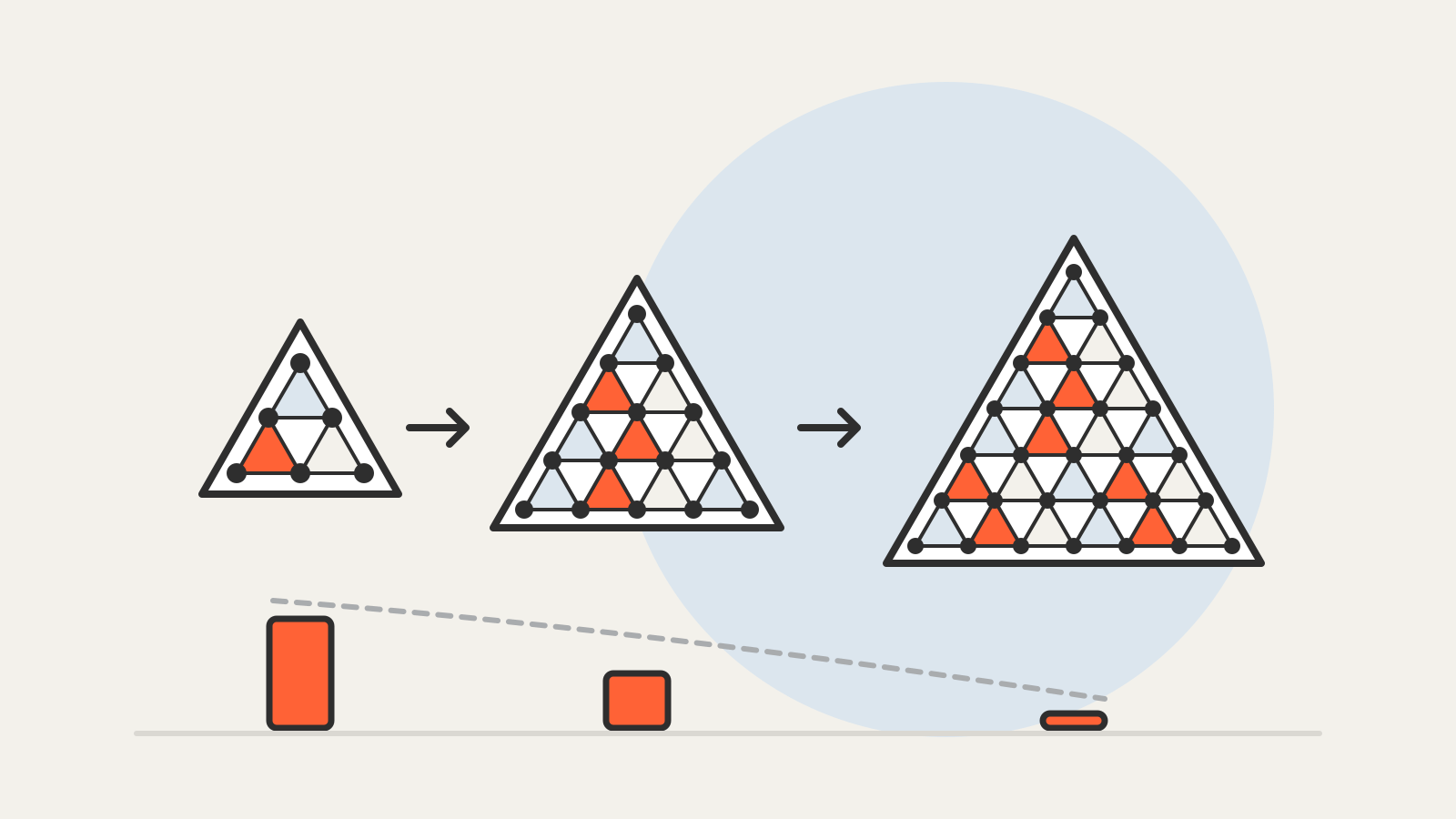
The research paper, published on Quantinuum’s website, describes triangular color codes at distances 3, 5 and 7 on the Helios processor, whose qubits are trapped barium ions. Distance is a measure of how many faults a code can catch; a larger distance uses more physical qubits. Quantinuum’s paper
In memory experiments, the team prepared a protected state, ran 20 rounds of error checks and then read the result. The logical error rate per round of checks fell from about 5.5 in 10,000 at distance 3 to about 3.8 in 100,000 at distance 5 and about 5 in a million at distance 7. The paper puts the reduction at a factor of about 12 for each step up in distance. That figure, written as Λ, is the usual test of whether a machine is “below threshold”: above it, adding qubits makes things worse; below it, a bigger code helps.
The team also ran a benchmark of two-qubit logical operations encoded at distances 3 and 5. At distance 5 the error rate was about 7 in 100,000 per logical operation, with errors again falling as the code grew.
How the hardware kept errors down
The paper credits two fixes for leakage, where an ion drifts out of the two levels that make up a qubit. A laser “repump” step returns leaked ions and, according to the paper, cut leakage about 6.5-fold after three cycles without adding time to the circuit. A circuit-level step swaps data qubits with freshly reset helper qubits.
Quantinuum also trained two neural-network decoders, the classical software that turns check results into corrections. The paper says their inference takes a few hundred microseconds, which it presents as a route to real-time decoding.
The trade-off between codes
In September, Quantinuum used a different code, which it calls Helix, on the same machine. The company says Helix used 10 physical qubits per logical qubit, while the color code used up to 37 but gave lower error rates. That is the cost of protection in plain numbers; our quantum error correction explainer covers why it is so high.
What the claims rest on
The “100 times lower” comparison with other hardware types is Quantinuum’s own, set against a published Google result on a superconducting chip. Robin Blume-Kohout of Sandia National Laboratories, who was not involved, said in the release that the paper shows “a logical qubit nearly 100x better than its component physical qubits.”
The limits are also clear. These were memory and benchmarking experiments, not a long useful program, and the release does not name a journal. Quantinuum ties the result to Apollo, a fault-tolerant computer it plans to have available by 2029; its own forward-looking statements note that results from experimental settings may not repeat at larger scale.
For background, see what a qubit is and earlier logical-qubit work from Infleqtion.