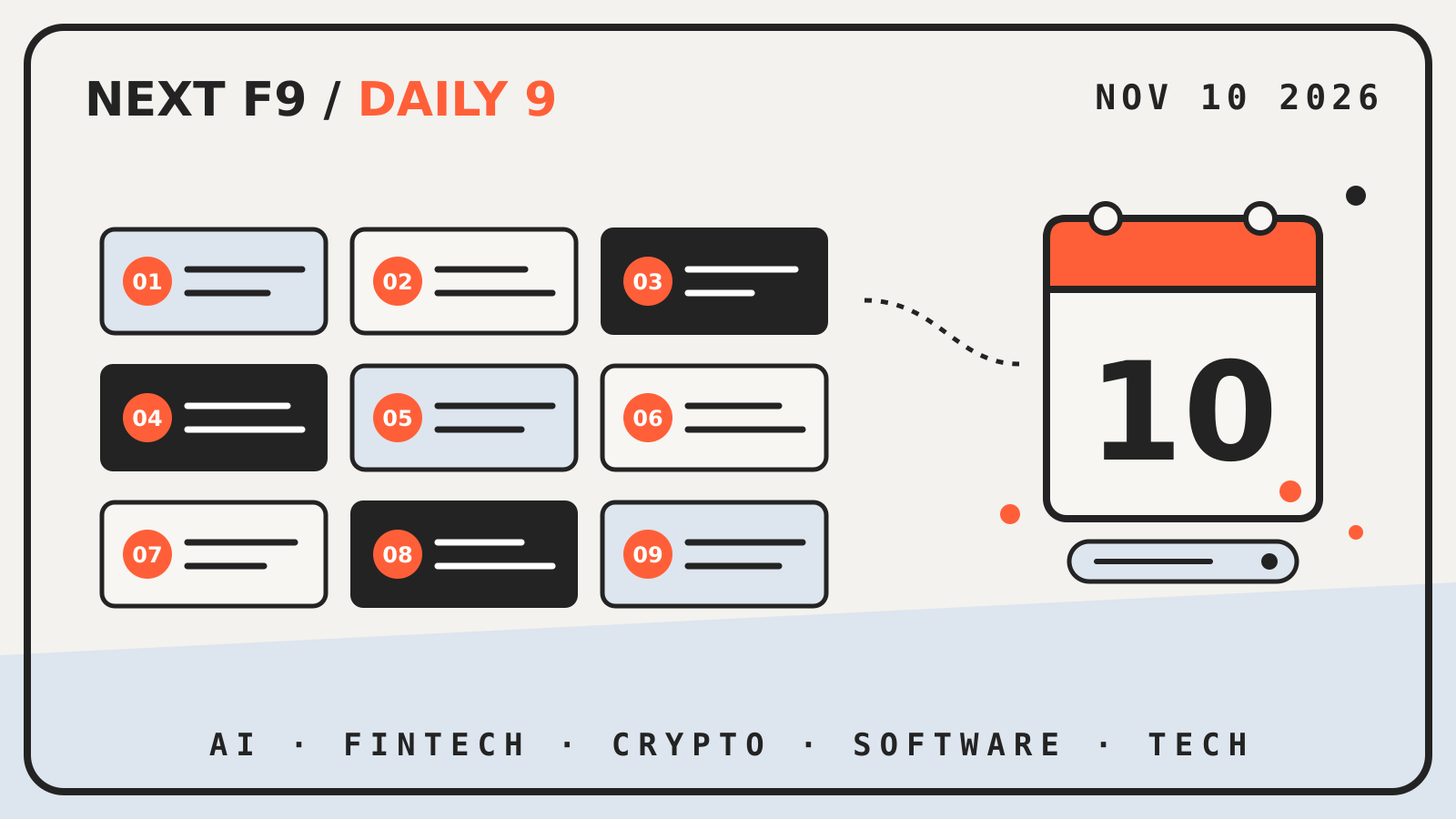
Daily 9 for November 10, 2026 covers nine developments across AI, fintech, crypto, software and tech, announced between November 9 and November 10. Anthropic released Claude Fable 5.2 and Mythos 5.2, Google added two new eighth-generation TPU systems, and New Zealand’s market regulator asked whether bank-backed NZD stablecoins should stop counting as financial products.
Each item links to the company, project or organization that published it.
1. Anthropic releases Claude Fable 5.2 and Mythos 5.2
Anthropic released two versions of the same underlying model. Claude Fable 5.2 is open to all users and ships with safeguards for cybersecurity and biology. Mythos 5.2 is the version for vetted customers in Anthropic’s Life Sciences and Cyber Verification Programs. Anthropic says 5.2 is up to 30% faster than 5.1. API pricing is $8 per million input tokens and $40 per million output tokens, and an optional fast mode, up to 2.5x quicker, costs $16 and $80. Anthropic reports 49.1% on FrontierCode 2.0 at its Xhigh setting, and it still recommends starting with Opus 5.5 for most tasks. The model id is claude-fable-5-2, and it is available on Anthropic’s platform, AWS, Google Cloud and Azure. Anthropic, November 9.
2. Meta launches Muse Ember, its smallest model
Muse Ember is the smallest and most efficient model Meta has released so far, aimed at agent sub-tasks: tool calls, coding steps, routing, extraction and long-document parsing. It takes text, images, audio and video, has a 1 million token context window and can write up to 512,000 tokens. Meta prices it at $0.10 per million input tokens, $0.004 per million cached input tokens and $0.50 per million output tokens. It runs on the Meta Model API and in Muse Code as muse-ember-1.0, with Responses API support. Meta claims more intelligence per dollar than Claude Haiku 5.5 and GPT-6 Luna, citing an Artificial Analysis Index score of 36, level with Haiku 5.5 and ahead of Luna’s 28. Meta, November 9.
3. Venmo splits restaurant bills from a photo of the receipt
Venmo added receipt scanning. A user taps the V button, picks “Scan receipt,” and Venmo itemizes the bill, adds each person’s share of tax and tip and sends the payment requests. PayPal says it works whatever phone the friends use. The feature is rolling out now and should be widely available in the coming weeks. PayPal also cites a Morning Consult survey of 5,000 US adults aged 18 to 22, run July 29 to 31, 2026, in which 40% said they are usually the one who pays first. PayPal, November 9.
4. Global Payments adds Visa’s IDX API to Adaptive Authentication
Global Payments added Visa Intelligent Data Exchange (IDX) API to its Adaptive Authentication platform. Merchants can send richer transaction data to card issuers during authorization, which is meant to cut false declines without adding a challenge step at checkout. Adaptive Authentication picks a method per transaction from 3D Secure, Data Only authentication, SCA exemptions and now Visa IDX. The Visa IDX part covers eligible domestic transactions in the US and Canada at first. Global Payments says Data Only and its AI optimization model have typically lifted approval rates by 4% to 6% for merchants. Global Payments, November 9.
5. New Zealand’s FMA consults on NZD stablecoins
The Financial Markets Authority proposes a class designation under section 562 of the Financial Markets Conduct Act. Qualifying NZD stablecoins would then not be financial products under that Act. To qualify, a coin must be fully backed by NZD held on bare trust at a New Zealand registered bank, redeemable at face value, and pay holders no return. Issuers would have to keep reserves at or above coins in circulation, publish a reserve confirmation at least monthly, get an independent check at least once a year and say on their website that they rely on the designation. The FMA says no decisions have been made. Submissions close at 5pm on Friday, December 18, 2026. FMA, November 9, with the consultation page.
6. Kinetiq opens Elysium mainnet for Hyperliquid
Kinetiq launched the public mainnet of Elysium, a Layer 2 for the Hyperliquid ecosystem built on the Arbitrum platform and operated with Conduit. It settles to HyperEVM and uses HYPE as native gas, moved 1:1 with no wrapper token. Blocks come every 100 milliseconds, and the execution target is 300 Mgas per second, which Kinetiq puts at 600x the throughput of HyperEVM’s big blocks. Kinetiq will put 50% of sequencer revenue toward buying back its KNTQ token and 25% toward builders whose apps drive demand. Contracts cannot yet read HyperCore order books or send trades to it. That comes in a scheduled upgrade after launch. Kinetiq, November 9.
7. Vite patches a critical dev-server flaw
Vite published advisory GHSA-p4f5-76q4-ffq7, rated Critical. Through the __vite-browser-external and __vite-optional-peer-dep virtual modules, an attacker could read files outside the allow list and get the server to evaluate code. Only dev servers explicitly exposed to the network with --host or server.host are affected. Vulnerable ranges are 4.0.0 to 6.4.5, 7.0.0 to 7.3.7, 8.0.0 to 8.1.6, 8.2.0 to 8.2.4 and 8.3.0 to 8.3.6. Fixed versions are 8.3.7, 8.2.5, 8.1.7, 7.3.8 and 6.4.6, plus vite-plus 1.5.1. Vite on GitHub, November 10.
8. Google adds TPU 8tx and TPU 8i Max
Google expanded its eighth-generation TPU line with two systems, which it says makes four new TPU systems in one year. TPU 8tx uses the same silicon as TPU 8t, pairs it with 5th Gen AMD EPYC hosts and keeps data and model weights protected while they are in use. Google pitches it at regulated companies and governments, and says it gives up to 2x lower latency than TPU 8t. TPU 8i Max puts two TPU 8i chips in one package, doubling compute, SRAM and HBM bandwidth against TPU 8i, and fits twice the silicon into the existing rack footprint. Google’s post gives no price or availability date. Google, November 9.
9. Diraq puts a silicon spin quantum computer in an Equinix data center
Diraq says its system, now live at Equinix in Sydney, is the first silicon spin quantum computer running inside a commercial data center. It has 8 qubits today, and Diraq is aiming for up to 256 qubits in the same system within the next year. The machine draws under 20 kW now and takes up 170 square feet. Diraq expects about 300 kW at utility scale and a footprint as small as 50 square feet later. The company is one of six in Stage C of DARPA’s Quantum Benchmarking Initiative and holds a US$38 million CHIPS letter of intent. Diraq, November 9. Background: what a qubit is.