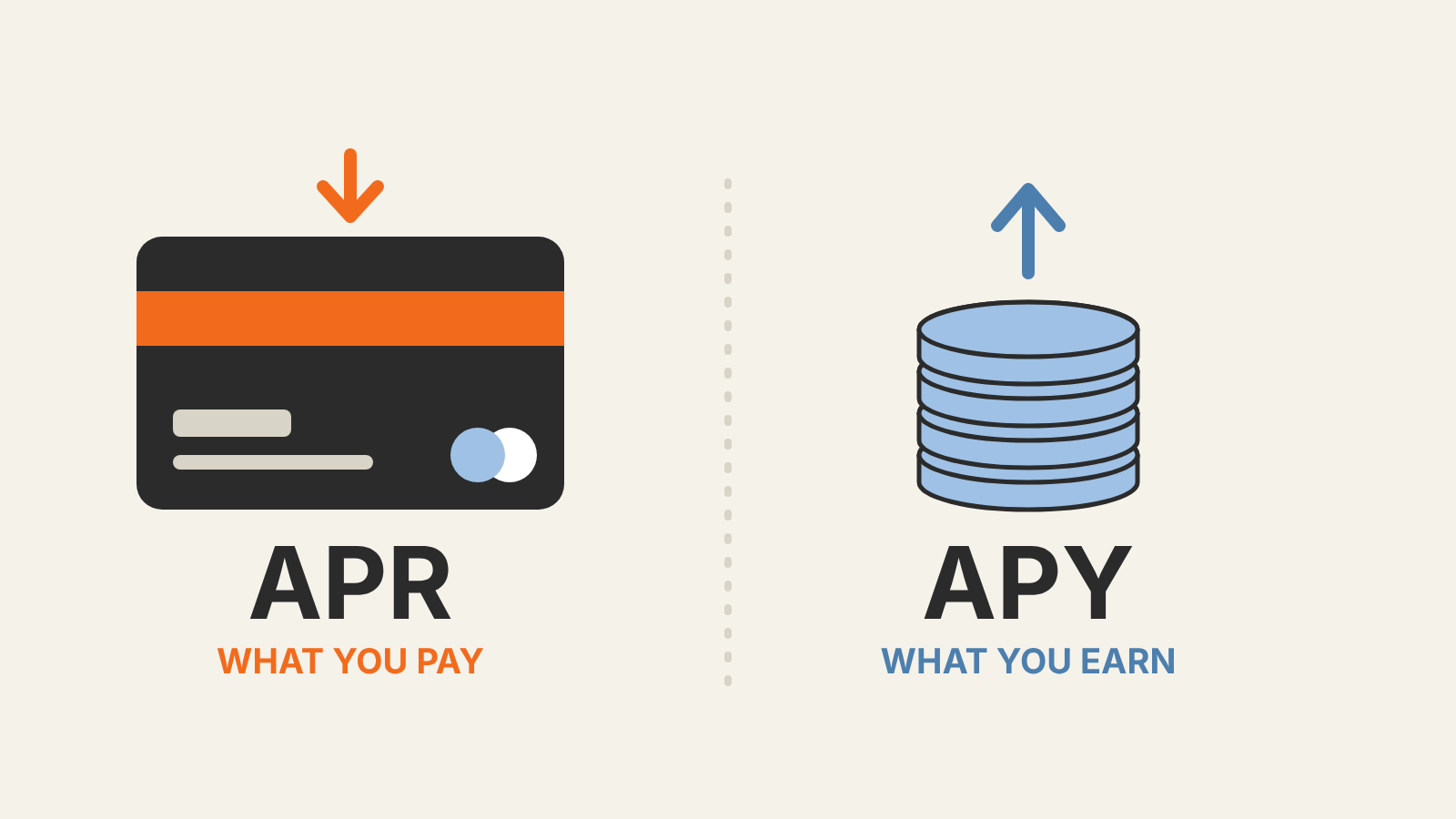
APR and APY look like twins, but they answer different questions. APR, the annual percentage rate, is the yearly price of borrowing money. APY, the annual percentage yield, is what you earn in a year on money you deposit, with compounding included. When a card, loan or savings account quotes one of them, the other number is usually missing, and mixing them up is how a rate looks better or worse than it is.
APR: what borrowing costs
For a credit card, the CFPB says the interest rate is the price of borrowing money and is usually stated as a yearly rate, the APR. On most cards you pay no interest on purchases if you pay the full balance by the due date each month.
For a loan, the CFPB defines APR as the interest rate plus additional fees the lender charges, such as origination charges. That makes APR the better number for comparing loans: the Truth in Lending Act requires lenders to disclose it, so you can line up offers. The CFPB’s advice is to compare APRs with APRs, not APRs with interest rates, because the two are not the same.
Credit cards work differently from loans. Under Regulation Z, the card’s APR is found by multiplying the periodic rate by the number of periods in a year. It does not show the effect of compounding. The CFPB notes that some issuers charge interest with a daily periodic rate, generally the APR divided by 360 or 365, applied to the balance each day, which means interest compounds daily.
APY: what saving earns
APY applies to deposit accounts. Regulation DD, the Truth in Savings rule, defines it as a percentage reflecting the total interest paid on an account, based on the interest rate and how often interest compounds, over a 365-day period. The formula is in the regulation’s Appendix A:
APY = 100 × [(1 + Interest ÷ Principal) ^ (365 ÷ Days in term) − 1]
Two details are easy to miss. APY counts interest only, so a sign-up bonus does not raise it. And banks have to disclose both the interest rate and the APY, using those terms. If a bank gives a rate orally, it has to state the APY.
Why the same rate gives two different numbers
Compounding is the whole difference. Take $10,000 in a savings account at a 4.00% interest rate that compounds daily. After a year it has earned about $408.08, not $400, so the APY is 4.08%. The gap grows with the rate and with how often interest compounds.
The same effect works against you on debt. Say a card has a 24% APR with daily interest, and you carry a $5,000 balance for a year without paying anything. Interest compounding each day would come to about $1,356, an effective yearly cost of roughly 27.1%. Real cards add payments, grace periods and different balance methods, so treat that as an illustration, not a prediction. But it shows why the quoted APR understates the cost of carrying a balance.
Which one to look at
- Saving: compare APY with APY. It already includes compounding, so accounts that compound on different schedules can be compared.
- Borrowing, one-time loans: compare APR with APR, because it folds in fees the interest rate leaves out.
- Borrowing on a card: the APR is the starting point. How much you pay depends on whether you carry a balance and how the issuer computes daily interest.
Check what kind of account you have, too. Regulation DD covers deposit accounts at depository institutions. If an app shows you a yield on a balance, find out whether the money sits in an insured bank deposit or somewhere else, and what the app means by “APY.” The guide on why a banking app isn’t always a bank explains how to tell.