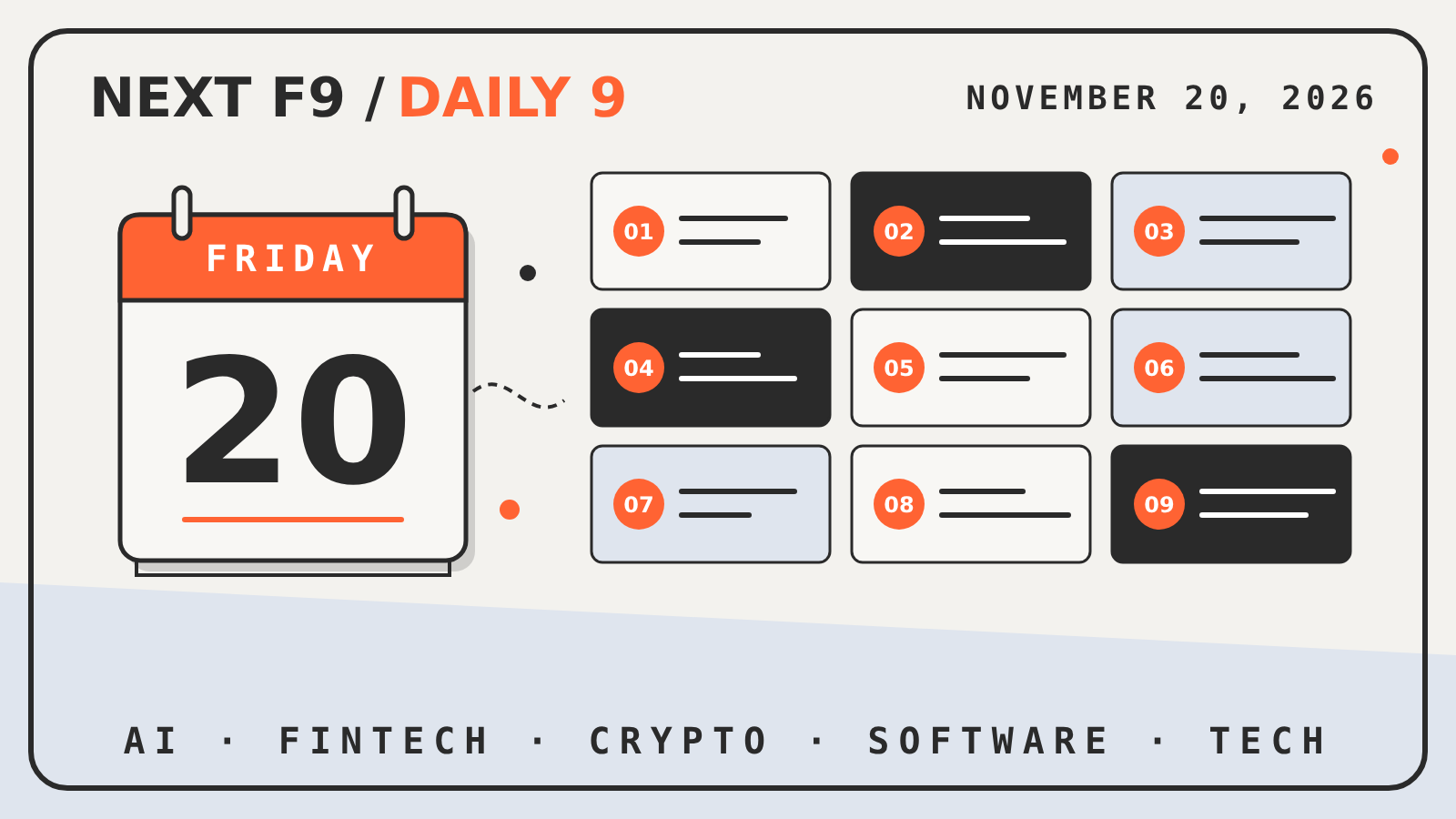
Daily 9 for November 20, 2026 covers nine developments across AI, fintech, crypto, software and tech, announced between November 17 and November 19. OpenAI released GPT-6.2 Astra and Sol, Google introduced Gemini 4 Neon, the European Central Bank warned about AI valuations, DBS opened direct USDC minting for institutions, and nginx shipped fixes for ten vulnerabilities.
Each item links to the company, project or organization that published it.
1. OpenAI releases GPT-6.2 Astra and Sol
OpenAI released two models: GPT-6.2 Astra, which it calls its frontier model for the hardest projects, and GPT-6.2 Sol, an efficient model for everyday work. Both are available to Plus, Pro, Enterprise and Edu users in ChatGPT and Codex, and in the API as gpt-6.2-astra and gpt-6.2-sol. Astra costs $8 per million input tokens and $40 per million output tokens, 20% less than GPT-6 Astra; Sol stays at $2 and $10. OpenAI says both models meet its Critical threshold for cybersecurity, and that Astra is the first model it has released externally that meets its High threshold for AI self-improvement. Background: GPT-6 Sol and Luna pricing. OpenAI, November 17.
2. Google introduces Gemini 4 Neon
Google DeepMind introduced Gemini 4 Neon, a model aimed at software engineering, knowledge work and science tasks. It costs $3 per million input tokens and $15 per million output tokens, with a 1 million-token context window. Google says Neon scores 61 on the Artificial Analysis Intelligence Index at its highest thinking level, third overall, and recorded its lowest fabrication rate yet in internal testing. It is rolling out in the Gemini API, Gemini for business, Google Antigravity for paid AI Pro and Ultra subscribers, and the Gemini app for Pro and Ultra subscribers. Background: what a large language model is. Google, November 18.
3. ECB flags AI valuations as a financial stability risk
The European Central Bank’s November Financial Stability Review says current AI valuations rest on ambitious earnings expectations that financing concerns or competition from cheaper AI models could challenge. Because AI infrastructure is increasingly funded with debt, the ECB says a change in sentiment could spread losses from equity markets to bond markets. It also points to fiscal imbalances and geoeconomic tensions. Vice-President Boris Vujčić said banks are well placed to absorb shocks, while vulnerabilities are more pronounced in some non-banks. European Central Bank, November 18.
4. UK regulators propose cyber guidance for financial firms
The Bank of England, the Prudential Regulation Authority and the Financial Conduct Authority proposed guidance on how financial firms should govern, protect against, detect, respond to and recover from cyber incidents. They said October 2026 saw the second-highest monthly number of cyber incidents reported to the FCA in five years. Separately, they published “effective practices” on AI-related cyber risks and on quantum computing, which could undermine the public-key cryptography behind financial transactions. The consultation closes on February 26, 2027. Background: what Q-Day is. Bank of England, November 19.
5. DBS lets institutions mint and redeem USDC directly
DBS and Circle announced a partnership under which eligible institutional clients can mint and redeem USDC directly through DBS, rather than relying only on secondary-market liquidity. Minting and redeeming through DBS comes with 24/7 USD-USDC settlement, outside banking hours and cut-off times. The two companies say the work builds on their participation in Project BLOOM, an initiative led by the Monetary Authority of Singapore. The release covers institutional clients only and gives no volumes or fees. Background: stablecoins explained. Circle, November 18.
6. CFTC sets agenda for its 24/7 trading roundtable
The Commodity Futures Trading Commission released the agenda for an industry roundtable on moving derivatives markets to 24/7 trading. The session runs on December 15 from 1 to 4 p.m. EST at CFTC headquarters in Washington and will be livestreamed. Topics include overnight and weekend trading, tokenization, margin, infrastructure and staffing needs, and operational readiness. Chairman Michael S. Selig said he wants to hear how round-the-clock trading would affect participants’ business models. The release announces a discussion, not a rule. CFTC, November 17.
7. nginx 1.30.7 and 1.31.9 fix ten vulnerabilities
The nginx project released stable version 1.30.7 and mainline version 1.31.9 with fixes for ten vulnerabilities. Three are rated major: memory corruption in HTTP/2 flow control (CVE-2026-123007), an infinite loop while reading a request body over TLS 1.3 (CVE-2026-118899) and a use-after-free in the mail proxy module (CVE-2026-113425). Others include use-after-free bugs in HTTP/2, HTTP/3 and the resolver, and an SNI bypass in client certificate checks in the stream module. Mainline 1.31.9 also now rejects header lines without a colon. nginx, November 18; security advisories.
8. Android developer verification goes global in January
Google said Android developer verification, live since September 30 in Brazil, Indonesia, Singapore and Thailand, will start its global rollout in January 2027 with seven app distributors: Google Play, Galaxy Store, Honor, Oppo, Xiaomi, Transsion and Vivo. Over several months it will expand to all countries and all installation sources on certified Android devices. Google says registered apps already account for over 99% of Android app installs. Limited distribution accounts for students and hobbyists can now share apps with 50 devices, up from 20, and an advanced flow lets experienced users install unregistered apps. Android Developers Blog, November 19.
9. Nvidia RTX Spark compact desktops go on sale
Compact desktops built on Nvidia’s RTX Spark platform are available from ASUS, Dell and MSI. Nvidia says they pair a 20-core Grace CPU with a Blackwell RTX GPU that has 6,144 CUDA cores, up to 128GB of unified memory and up to 1 petaflop of AI performance, plus 10-gigabit Ethernet. It pitches them as Windows PCs for running local models and always-on agents. Mini PCs from Acer, GIGABYTE and HP, and a Microsoft Surface RTX Spark Dev Box, are listed as coming soon. Nvidia’s post gives no prices. Background: running AI locally. Nvidia, November 18.