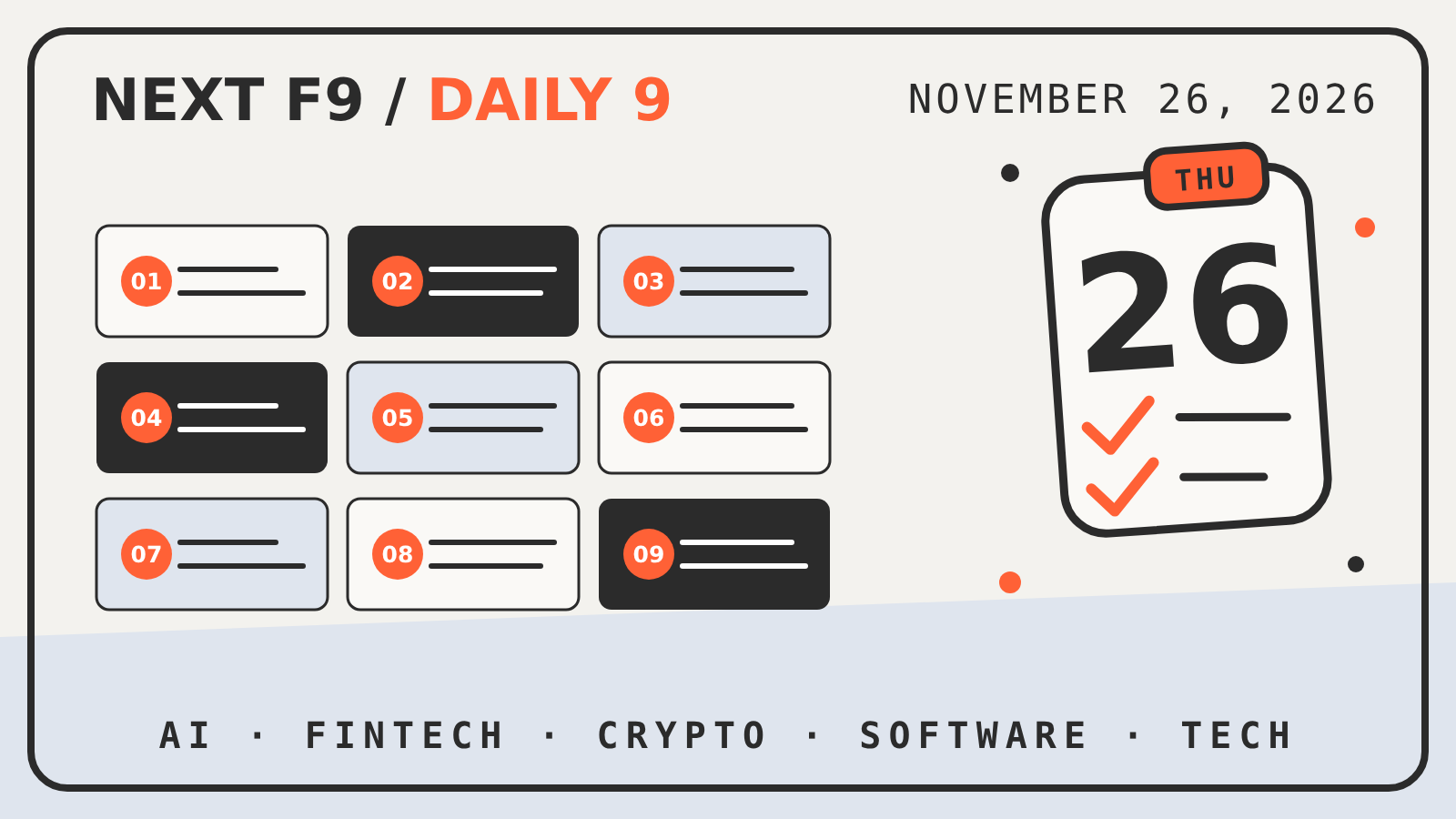
Daily 9 for November 26, 2026 covers nine developments announced between November 23 and 25. NVIDIA’s board brought Jensen Huang back as CEO, Kraken opened a waitlist for a cashback credit card, and OKXICE began trading tokenized U.S. stocks around the clock. Each item links to the organization that published it, and every date is stated.
1. NVIDIA’s board reinstates Jensen Huang as CEO
NVIDIA announced on November 23 that Jensen Huang is again President, CEO and a board member, effective immediately. The board voted unanimously and said it had received input from senior levels of the U.S. government, on which it based its confidence that his return poses no national security risk. A board committee is still investigating reports that Huang was the target of a foreign intelligence effort. NVIDIA also formed a National Security and Export Control Committee and is searching for a Chief Compliance Officer. Colette Kress, the interim CEO, stays on as CFO. NVIDIA, November 23.
2. OpenAI reports lab-tested protein designs from GPT-6
OpenAI published a preprint and summary on November 24 saying its GPT-6 models can design protein shapes using only reasoning and code. In lab tests with research partner Onava, 35 of 322 minibinders (10.9%) bound their intended targets across five targets. The designs came from a pre-release GPT-6.2, and specialized models supplied sequences and picked candidates. OpenAI says the results do not yet show end-to-end design without those tools, and that predicting a full protein structure remained a weakness. These are the company’s own results. OpenAI, November 24.
3. Meta’s Muse agent launches in the UK
Meta said on November 24 that its Muse personal AI agent is now available to anyone 18 and over in the UK, on iOS, Android, muse.ai and WhatsApp. It is free, with optional paid plans for more usage. Muse asks before it sends an email or makes a purchase, and each user’s Muse runs on its own cloud computer. For payments it can use Onelink, built by Stripe, or Shopify’s Shop Pay in supported stores. Launch retail partners include Marks & Spencer, ASOS, Currys and easyJet. Background: AI agents versus chatbots. Meta, November 24.
4. Cloudflare makes sites searchable by AI agents
Cloudflare introduced Search for Agents on November 25. Turning it on from a domain’s dashboard creates an AI Search instance, indexes the site’s content and adds a search endpoint at /.well-known/search. Agents can query it with GET or the HTTP QUERY method, and it returns matching content as Markdown, not a generated answer, so an agent can feed the results to its own model. The feature is on every plan, with usage billed under AI Search pricing and plan limits. Cloudflare changelog, November 25.
5. Kraken opens a waitlist for a 4% cashback credit card
Kraken announced the Krak Credit Card on November 24 and opened a U.S. waitlist, with shipping expected in late 2026. Applications are not open yet. Cashback runs from 1% when a Krak balance is under $1,000 to up to 4% at $150,000 or more, paid in dollars or bitcoin. The 3%, 3.5% and 4% rates cover the first $10,000 of eligible purchases each month, then 2%. The card requires a Krakpass subscription at $6.99 a month, and it is not offered in Indiana, Maine, Massachusetts or New York. Kraken, November 24.
6. FDIC: bank profits slipped to $84.8 billion in Q3
The FDIC’s Quarterly Banking Profile, released November 24, covers 4,205 insured institutions. Net income was $84.8 billion in the third quarter of 2026, down $5.3 billion (5.9%) from the second quarter and up $5.5 billion (7.0%) from a year earlier. Return on assets was 1.28%, and the industry net interest margin rose 7 basis points to 3.39%. Loans grew 1.9% on the quarter, domestic deposits rose 0.9% for a ninth straight increase, and the Deposit Insurance Fund reserve ratio reached 1.50%. FDIC, November 24.
7. CFTC staff allow crypto toward venues’ financial resources
On November 23, staff of the CFTC’s Division of Market Oversight and Division of Clearing and Risk issued an advisory on how swap execution facilities, designated contract markets and clearing organizations can use crypto assets to meet financial resources requirements. Bitcoin, ether and payment stablecoins may count toward the 12 months of operating costs those firms must cover, subject to haircuts. They do not qualify toward the separate liquidity requirement. The advisory reflects staff views only and creates no new rules. CFTC, November 23.
8. OKXICE opens 24/7 tokenized stock trading in the U.S.
OKXICE, a joint venture of OKX and the Intercontinental Exchange, launched its Tokenized Securities Venue for eligible U.S. customers on November 23. It lists 113 confirmed assets, including stocks, ETFs and ETPs, which are going live on a rolling basis. Each token is a security entitlement backed one-to-one by a share. Trading runs through Uniswap v4 liquidity pools on OKX’s X Layer network, with holdings in self-custodial wallets. OKXICE operates under a temporary SEC exemption and is not a registered exchange. OKX, November 23.
9. Tether invests in Argentine fintech Lemon
Tether said on November 25 that it has invested in Lemon, an Argentine app that combines digital-asset savings, stock investing, international payments and Visa prepaid virtual cards where available. Lemon shows users a single dollar balance powered by USD₮ and offers fractions of gold through XAU₮. The release gives no amount. It cites Chainalysis figures putting Argentina’s crypto activity at $88.5 billion, up 15.3% in a year. Background: how stablecoins work. Tether, November 25.