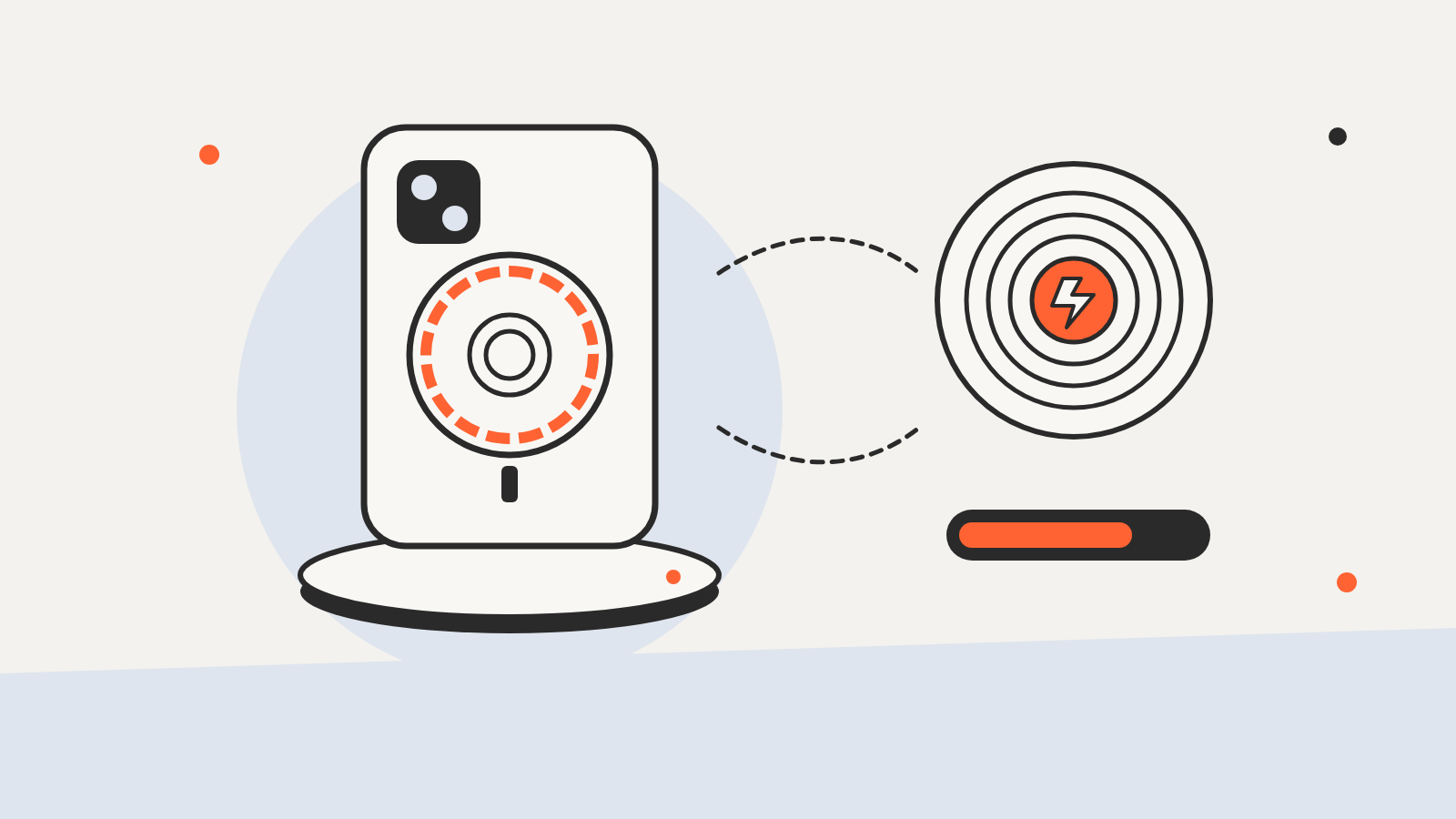
Qi2 is the wireless charging standard from the Wireless Power Consortium (WPC) that adds a ring of magnets, so a phone snaps onto its charger in exactly the right spot. So what is Qi2 doing that older Qi pads could not? It fixes alignment, the main weakness of flat charging pads, and that lets chargers deliver more power with less wasted energy. The newest version, Qi2 25W, raises the ceiling from 15 watts to 25.
Where Qi2 comes from
The original Qi standard has been around since 2010. The WPC, the industry group behind the standard, says on its Qi standard page that over 13,000 products are now Qi Certified. Its specification history runs from version 1.0 in 2010 through 1.3 in 2021 and 2.0 in 2023. The latest version, 2.3, is available to members.
The WPC announced Qi2 at CES in January 2023, pronounced “chee two,” built on a Magnetic Power Profile. Apple contributed the base for that profile from its MagSafe technology. The Qi v2.0 specification was approved on April 19, 2023, and certification began in November 2023, with the iPhone 15 lineup among the first certified phones and more than 100 other devices in testing.
How wireless charging works
Every Qi charger works by magnetic induction. The WPC’s explanation of the physics is simple at heart. A coil in the charger, the transmitter, carries an alternating current that creates a changing magnetic field. A second coil in the phone, the receiver, picks up that field and turns it back into current for the battery. The phone also sends control signals back to the charger, so the charger can adjust how much power it sends.
How well this works depends on how the two coils line up. The WPC says the coupling between them depends on their size and the distance between them. A phone set down off center moves its coil away from the charger’s, which weakens that coupling. On a flat pad with nothing to guide it, getting the position right is up to the user.
What the magnets add
The Magnetic Power Profile solves alignment mechanically. Magnets around the coils pull the phone into the right position every time, which the WPC says gives perfect alignment for better energy efficiency.
Qi v2.0 actually has two profiles. The November 2023 release explains the difference:
- Magnetic Power Profile (MPP): the magnetic version, which carries the Qi2 logo.
- Extended Power Profile (EPP): an improved version without magnets, which keeps the regular Qi logo.
So a charger can follow the 2.0 specification and still not be a magnetic Qi2 charger. The logo tells you which one you have. The WPC also points to other uses for the magnetic lock, such as AR and VR headsets and phone accessories.
Qi2 vs. Qi2 25W
The first Qi2 chargers delivered up to 15W. In July 2025, the WPC launched Qi v2.2.1 under the name Qi2 25W, with 14 devices certified in a limited first round. The WPC says Qi2 25W delivers nearly 70% more power than 15W Qi2 and can take a compatible phone from 0 to 50% in about 30 minutes. The same release said major Android phone makers were joining Qi2 for the first time; before Qi2, many of them relied on their own proprietary fast-charging methods.
| Qi2 | Qi2 25W | |
|---|---|---|
| Specification | Qi v2.0 (MPP) | Qi v2.2.1 |
| Launched | November 2023 | July 2025 |
| Maximum power | 15W | 25W |
| Magnetic alignment | yes | yes |
Both sides have to support the higher rate. The WPC’s consumer site, Charge with Qi, says 25W is only available when a Qi2 25W phone is used with a Qi2 25W charger. The site’s advice is to match the phone and charger generations to get the full speed.
What speed an iPhone gets
Apple’s own MagSafe chargers show how much this varies. Apple’s MagSafe Charger support page lists up to 25W for the iPhone 18 Pro and Pro Max, iPhone 17 Pro and Pro Max, iPhone 17, iPhone 16 Plus and iPhone 16 Pro Max, as long as the charger is one of the newer models and is powered by an adapter that supplies 15V at 2.0A. The iPhone Air tops out at 20W, the iPhone 16 and 16 Pro at 22.5W, and the iPhone 17e and iPhone 15 and earlier at up to 15W.
Apple also says any Qi-certified charger will charge an iPhone, and the same goes for AirPods cases that support wireless charging. Apple’s MagSafe page adds a few practical tips:
- Connect the charger to power before putting the phone on it.
- Keep credit cards and key fobs away from the charger.
- Expect charging to slow above 80% if the phone gets warm.
Apple’s page also notes, in its EU product information, that wireless charging can use more energy than charging by cable.
Why certification matters
Only certified products may carry the Qi or Qi2 logo. Under the WPC’s testing and certification process, a product is tested at an independent authorized lab. The consortium’s quality control overview adds interoperability testing against about 200 chargers or devices, and market checks four to six months after certification, backed by enforcement through retailers.
The safety side is the main reason to look for the logo. Charge with Qi says certified products are protected from heat and can detect foreign objects, such as a stray coin or key, on the charger. It warns that non-certified products can reach temperatures high enough to cause third-degree burns.
For the other short-range technologies in a phone, see our guides to what NFC is and what ultra-wideband is.