Researchers at the Superconducting Quantum Materials and Systems Center (SQMS), led by Fermilab, have linked differences in the performance of identically designed superconducting qubits to three nanoscale features of how the chips are made. Fermilab announced the study on October 1; the findings are published in Applied Physics Reviews. Source: Fermilab
A qubit is the basic unit of a quantum computer, and it is useful only while it holds its quantum state. Our explainer covers what a qubit is and why it is fragile.
What the researchers did
The team examined 22 superconducting transmon qubits, a widely used design, fabricated by Fermilab, Rigetti Computing and NIST. Teams at Fermilab, Northwestern University, Ames National Laboratory, NIST and the UK’s National Physical Laboratory took part, using seven materials-characterization techniques, including electron microscopy and X-ray photoelectron spectroscopy.
The study was blinded. The people characterizing the devices were not told how long each qubit held an excited state (its energy relaxation time, T1) until after they had recorded what they saw. Only then did the researchers look for correlations between material features and performance.
The three features
According to Fermilab, three features stood out:
- Surface oxide thickness. Earlier SQMS work found that this layer, only a few nanometers thick, dominates losses in niobium qubits. The new study adds that variations of a single nanometer from one device to the next can meaningfully shift performance.
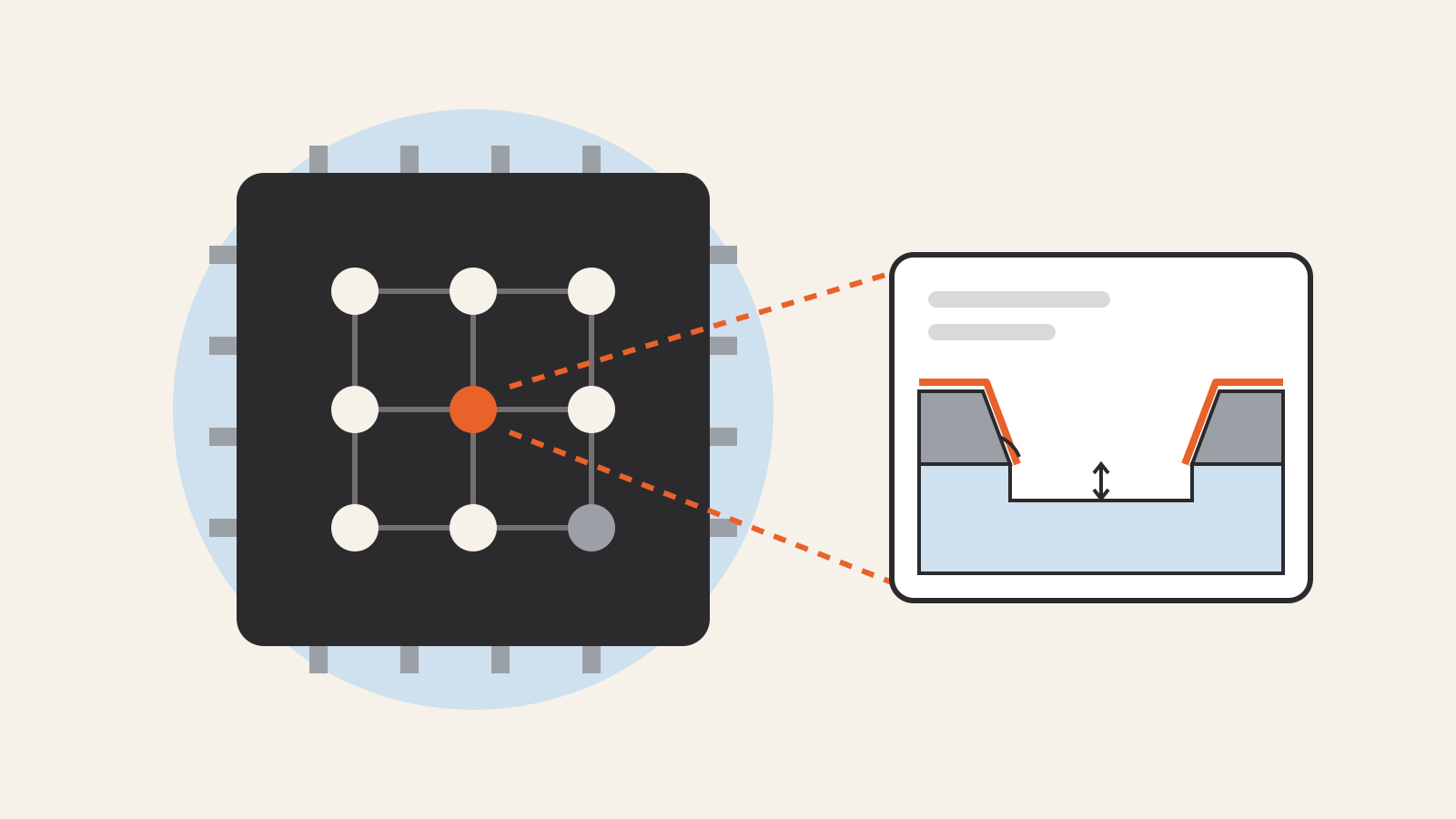
- Sidewall angle. Electromagnetic simulations indicate that a sharp etched sidewall of about 10 to 15 degrees could improve performance by 20 to 30% compared with a tapered angle of around 30 degrees.
- Trench depth. The depth of the recesses etched into the substrate next to the metal electrodes matters most below about 20 nanometers; deeper than that, the effect levels off.
Together, differences in these features accounted for as much as a twofold variation in performance among qubits made from identical materials. Visible defects such as scratches and particles showed no clear correlation with performance in this set of devices.
Why it matters
A quantum processor is limited by its weakest qubits. “Performance isn’t set by our best qubits — it’s set by our worst ones,” Andrew Bestwick, Rigetti’s chief technology officer, said in the announcement. The study gives chipmakers measured targets for etch geometry and surface chemistry rather than trial and error.
The scope is narrow. The results cover energy relaxation in 22 transmon devices; the team says its next step is to extend the analysis to dephasing and T2 coherence, which matter for gate accuracy in larger processors. Fewer weak qubits would also help quantum error correction, which builds reliable logical qubits out of many physical ones. Nothing in the study changes the timeline for machines able to break today’s encryption, which is the reason behind the move to post-quantum cryptography.