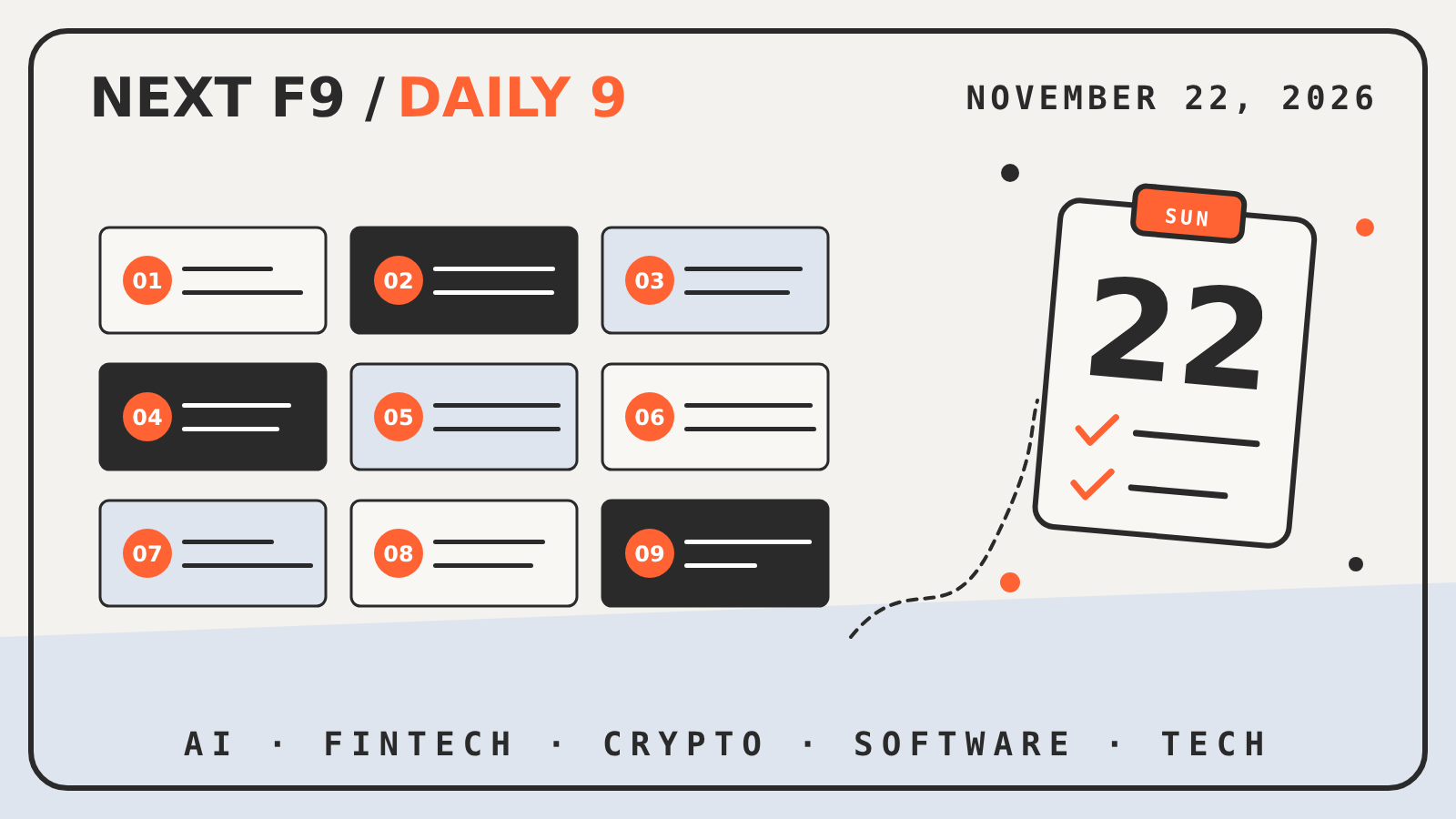
Daily 9 for November 22, 2026 covers nine developments across AI, fintech, software and tech, announced between November 18 and November 20. Stripe let AI agents move money inside its Treasury product, Google rolled out Genie 4 and named a launch partner for Project Suncatcher, AWS put GPUs behind Lambda, and NIST described a quantum way to prove where a person is.
Each item links to the company or agency that published it. Weekend news is thinner, so this edition reaches back to November 18 and states every date. It has no crypto item, because none could be confirmed on a primary source inside the window.
1. Gemini adds grocery, credit and tax Connected Apps
Google said on November 20 that new Connected Apps are rolling out in the U.S. through Search and the Gemini app, powered by the Universal Commerce Protocol. For groceries, they cover Albertsons, Safeway, Shaw’s and Target. Experian, already live in the Gemini app, is coming to Search so U.S. users can check their credit rating and shop for a personal loan, and H&R Block lets users calculate taxes and estimate refunds from Search. Angi and Thumbtack follow in the coming weeks. Background: Google’s Connected Apps platform preview. Google, November 20.
2. Project Genie gets Genie 4 for AI Ultra subscribers
Google DeepMind rolled out a new Project Genie to eligible Google AI Ultra subscribers on November 18. Genie 4 lets users change a world mid-session with a text prompt, such as the weather or a new character, and adds real-time native audio. Genie 3 now runs sessions of up to 3 minutes, up from 60 seconds, and can start from 360-degree panorama images. A Project Genie agent builds worlds from conversation, and a community gallery lets people publish and remix them. Google AI Pro members can join a waitlist, and Google says output carries SynthID watermarking. Google DeepMind, November 18.
3. OpenAI introduces MedChemBench for drug-discovery reasoning
OpenAI published MedChemBench, a benchmark of 99 problems drawn from 117 papers and patents and 761 distinct molecular structures. It tests whether a model can connect a molecule’s structure with experimental evidence to explain results and predict properties. At the xhigh reasoning setting, OpenAI says GPT-6.2 Astra earned 84.5% of the available credit, against 83.3% for GPT-6 Astra and 58.2% for GPT-5.6 Sol. The benchmark and the scores are OpenAI’s own, and the post is about OpenAI’s models. OpenAI, November 20.
4. Meta pauses its commercial terms update for consultation
Meta said on November 18 that proposed updates to its commercial terms of service are on hold and will be revised after consultation. It cited concerns from news publishers about how the updates apply to its web crawlers, and says its crawlers follow the robots.txt standard. The consultation has three phases: listening, considering feedback and, in early 2027, further engagement with publishers, other stakeholders and regulators before any rollout. Meta expects the process to take a few months and says it will notify account holders before new terms take effect. Meta, November 18.
5. Stripe lets agents move money, with approvals
Stripe said on November 19 that agents can now move money through Stripe Treasury, in public preview. More than 24,000 businesses already use Treasury for agents with read access. The new write access covers fund transfers, currency conversion and vendor payments within limits the business sets, through Stripe’s MCP server. By default, agent-initiated refunds, payouts and outbound transfers need human approval. An agent with its own API key can have custom rules, such as processing ACH transfers under $50 automatically. Stripe says cards with spending limits come next. Background: AI agents vs. chatbots. Stripe, November 19.
6. AWS Lambda runs GPU functions on EC2 G-series instances
AWS made GPU support generally available for Event Functions on Lambda Managed Instances on November 18. Developers package a function as a container image and Lambda provisions and scales the GPU instance, with no drivers or clusters to manage. It supports the EC2 G4dn, G5, G6, G6f, Gr6, Gr6f and G6e families at launch. Customers pay the EC2 instance fee plus a 9.75% management fee, and the standard $0.20 per million requests. AWS says the feature is tuned for inference on custom models, not for training. AWS News Blog, November 18.
7. Nvidia and Microsoft expand Azure and Windows at Ignite
Nvidia said on November 19 that Vera Rubin NVL72 systems are running in Azure data centers, in a preview, and that Microsoft Foundry Managed Compute now supports deploying custom model weights and the Nemotron 3.5 lineup. The companies are also working to extend confidential computing to bare-metal and rack-scale AI infrastructure. For Windows 365 Cloud PCs with GPU acceleration, a Direct Stream feature supports up to two 4K streams at 60 frames per second; a limited preview is open for sign-ups, with public preview planned for early 2027. NVIDIA Blog, November 19.
8. Google picks Blue Origin for Suncatcher’s first launch
Google said on November 19 that Blue Origin’s New Glenn rocket will carry the first heavy-lift launch for Project Suncatcher, its long-term effort to scale AI infrastructure in space with solar power in orbit. The launch is targeted for the first quarter of 2029. Each satellite will have roughly the capacity of a data center rack and go into sun-synchronous orbit. The date is a target, not a commitment. Background: Suncatcher’s first prototype response. Google, November 19.
9. NIST team shows quantum position verification without loopholes
NIST and collaborators reported in Nature on November 18 a first-of-its-kind experiment that uses entangled photons and a loophole-free Bell test to confirm a person is at a specified location. NIST says the method could one day help authenticate financial transactions or block phishing from unknown locations, but applying it in real settings is a decade or more away. It needs high-fidelity quantum communication networks that do not yet exist at scale. Background: what a qubit is. NIST, November 18; Nature paper.