Researchers from Rutgers University, IBM and several other institutions have run one of the largest tests so far of quantum feedback control: a quantum computer that measures parts of itself while a calculation is running and resets them in response. The study, “Order from chaos with adaptive circuits on quantum hardware,” was published in Nature Physics on October 9, and Rutgers announced it the same day. Source: Rutgers
The researchers present the work as a step toward fault-tolerant machines, not as one. Rutgers notes that no one has yet built a quantum computer that keeps computing correctly while its individual qubits make small mistakes.
What the experiment did
The team used IBM’s 156-qubit Heron processor and selected a connected chain of up to 100 qubits. The preprint of the paper names the device as ibm_fez, a Heron r2 chip with fixed-frequency transmon qubits. arXiv preprint
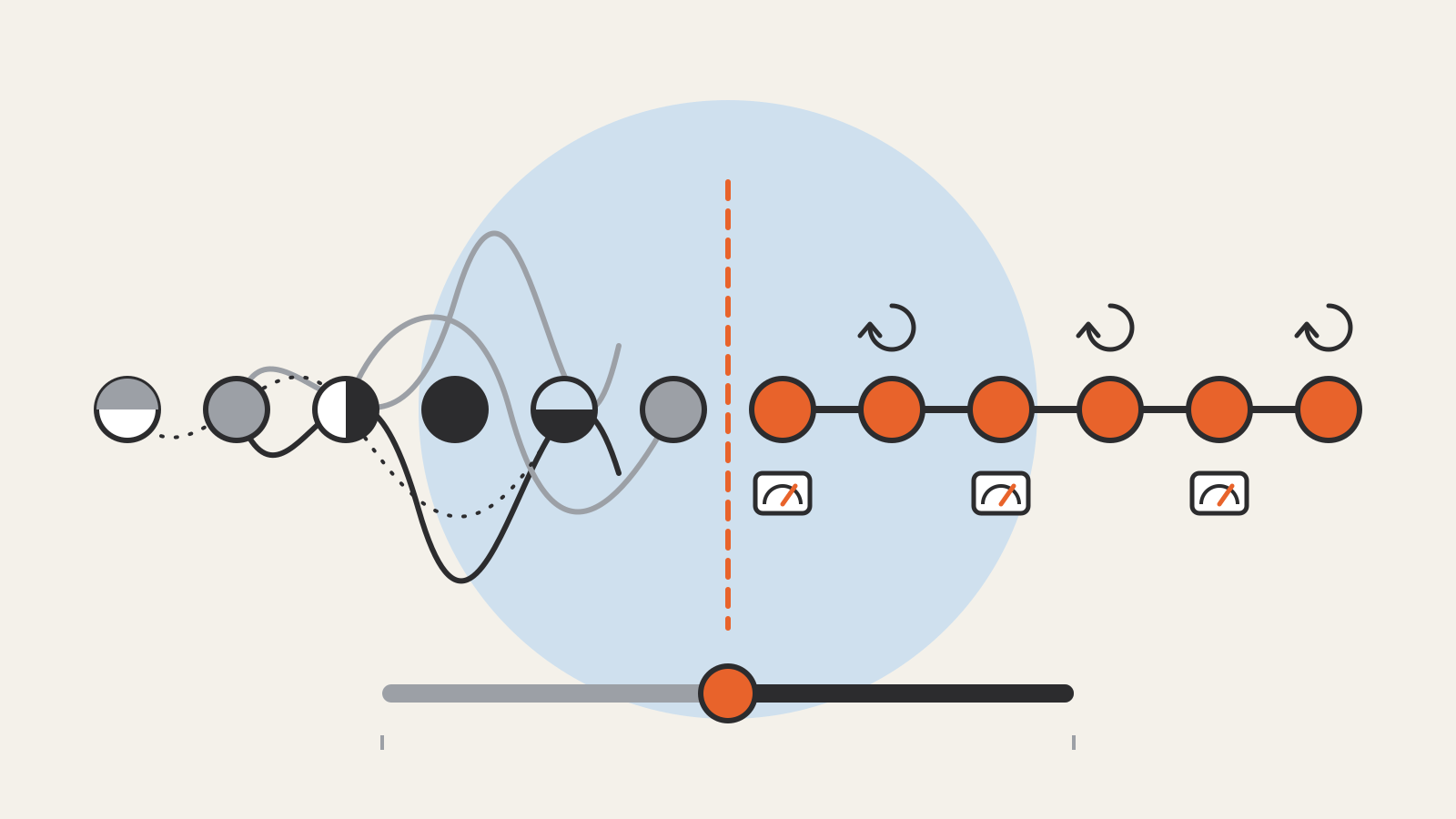
The circuit alternated between two competing steps. One acted as a scrambler, a quantum version of a chaotic mathematical rule known as the Bernoulli map, which mixes information between neighboring qubits. The other was a control step: measure a qubit in the middle of the circuit and, depending on the result, reset it, nudging the whole system toward one simple target state.
In total the runs applied nearly 5,000 entangling gates, the two-qubit operations that link qubits, and nearly 5,000 mid-circuit measurements and resets. Rutgers says the researchers consider it the largest successful demonstration of this approach to date.
Chaos, then control
The researchers set how often each step happened. According to Rutgers, when scrambling made up more than half of the steps, the system stayed chaotic. When checks and resets happened more often, the qubits could be guided to the chosen state. Near an even split, a small change in that balance flipped the behavior of the whole chain. Physicists call this a phase transition.
That switch had been predicted by the same group’s theory. “What was striking was that the transition became more clearly defined as we studied larger systems,” co-first author Haining Pan said in the announcement. The paper says the results were compared with noisy simulations and other models to check that the processor was producing a genuine quantum process rather than random noise.
Why it matters
Quantum error correction depends on exactly this kind of loop: measure, decide and act, many times, without stopping the rest of the processor. “This experiment shows that present-day hardware can coordinate quantum operations, measurements and resets thousands of times across a large system,” said Maika Takita, an IBM principal research scientist and one of the senior authors.
The limits are clear. This experiment controlled a chaotic circuit; it did not protect a useful calculation from errors or create logical qubits. It shows that the measure-and-reset machinery holds up at the 100-qubit scale on today’s hardware. For the background, see what a qubit is and how a quantum circuit runs from gates to measurement. The decoding side of the same problem, turning measurement results into corrections fast enough, is a separate challenge; IonQ reported one approach in September.